Saint Jean-Baptiste
Caravaggio · 1598
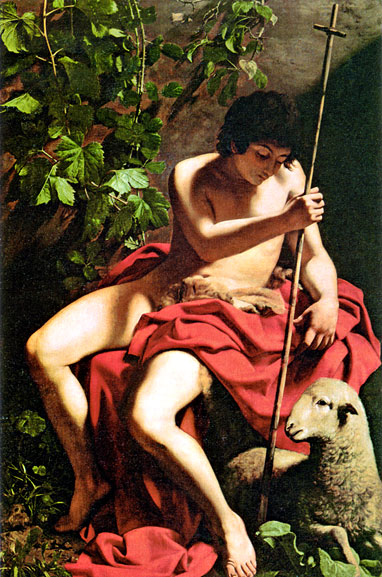
A youth sits on a red cloak among green vines and thorny stems, gazing down at a lamb at his feet. Whether Caravaggio painted this Toledo Baptist is still an open question, and that mystery is part of its pull.
The story behind the painting
This Saint John the Baptist, also called Saint John in the Wilderness, is dated around 1598 and kept in the Museo Tesoro Catedralicio, the cathedral treasury museum of Toledo. It has been attributed to Caravaggio, who made about seven versions of the theme, but research increasingly favours his contemporary Bartolomeo Cavarozzi. John Gash suggested in 2004 that it might be one of the paintings Caravaggio made for the prior of the Hospital of the Consolation, who, according to the early biographer Mancini, took them back to his homeland. One copy of Mancini's manuscript says Seville, another says Sicily.
What to look for
John sits before a green vine mixed with thorny brambles, on a red cloak, holding a thin reed cross and looking at a lamb lying at his feet. The leaves behind him, and the plants and soil at his feet, are painted with careful, almost photographic detail, like the still life Basket of Fruit. The scholar Alfonso Pérez Sánchez found the vine leaves of extraordinary quality, more typical of Caravaggio than of Cavarozzi. Gash also points to the gentle chiaroscuro and delicate contours. The red cloak would become typical of Caravaggio's work.
Meaning and intent
The details carry meaning. The vine leaves recall the vine that gave the wine of the Last Supper, the thorns evoke the Crown of Thorns, and the lamb is a reminder of Christ's sacrifice. Showing John as a youth was somewhat unusual; he was more often an infant with the young Jesus, or an adult baptising him. Leonardo and Andrea del Sarto had already painted young Baptists with a private, hard to read meaning, and Caravaggio turned that approach into a personal icon across his many variations.
Legacy
Peter Robb, who believes the painting is Caravaggio's, dates it to about 1598, when the artist lived with his first patron, Cardinal Francesco Maria del Monte, and sees in John the same model as in the Sacrifice of Isaac, itself a disputed work. The case for Cavarozzi remains strong, since he is known to have travelled to Spain around 1617 to 1619. If the painting was by Caravaggio and reached Seville early, it could have influenced the young Velázquez. Either way, it stays in Toledo, a quiet riddle.
Le saviez-vous ?
- Dated around 1598, kept in the cathedral treasury museum of Toledo.
- Attributed to Caravaggio, but increasingly given to Bartolomeo Cavarozzi.
- Vine leaves, thorns and lamb point to the Passion of Christ.
- Peter Robb links its model to the Sacrifice of Isaac.
À propos de l'artiste
Caravaggio (1571-1610)
art religieux · Jean le Baptiste · Peinture baroque italienne
Autres œuvres de Caravaggio
 Le Souper à Emmaüs - Caravaggio (1601)
 La Vocation de saint Matthieu - Caravaggio (1609)
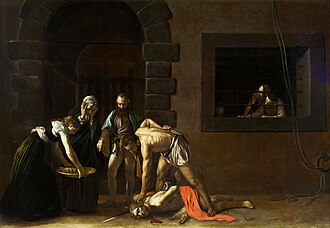 La Décollation de saint Jean-Baptiste - Caravaggio (1608)
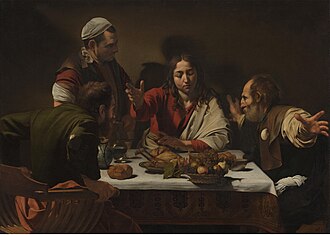 Le Souper à Emmaüs - Caravaggio (1601)
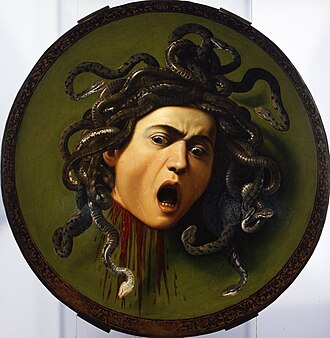 Méduse - Caravaggio (1597)
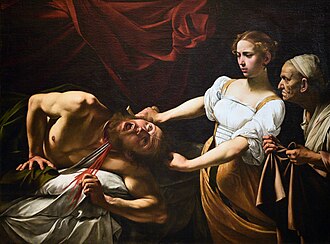 Judith décapitant Holopherne - Caravaggio (1598)
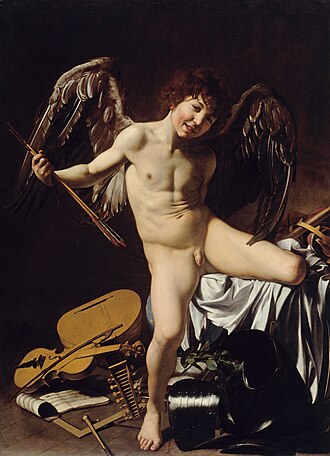 L'Amour victorieux - Caravaggio (1600s)
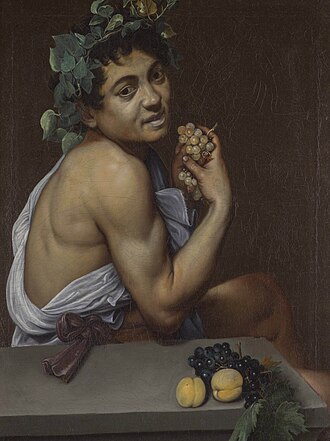 Le Petit Bacchus malade - Caravaggio (1595)
Œuvres d'artistes liés
 Les Ménines - Diego Velázquez (1656)
 La Reddition de Bréda - Diego Velázquez (1635)
 Saint Francis in Meditation - Francisco de Zurbarán (1639)
 The Immaculate Conception - Francisco de Zurbarán (1661)
 Triple portrait de Charles Ier - Anthony van Dyck (1635)
 Charles Ier à cheval avec Monsieur de Saint Antoine - Anthony van Dyck (1636)
 L'Érection de la croix - Peter Paul Rubens (1609)
 L'Enlèvement des filles de Leucippe - Peter Paul Rubens (1618)
 La Ronde de nuit - Rembrandt van Rijn (1642)
 Autoportrait - Rembrandt van Rijn (1659)
 Le Joyeux Buveur - Frans Hals (1620s)
 Le Cavalier riant - Frans Hals (1624)