L'Extase de saint François
Caravaggio · 1590s
.jpg)
In the dark of a mountain night, a saint sinks back, unconscious, into the arms of an angel. There is no blaze of fire here, only a soft light and a moment of overwhelming love.
The story behind the painting
This is thought to be Caravaggio's very first religious painting, made around 1595, soon after he entered the household of Cardinal Francesco Maria del Monte in Rome. It was presumably painted for del Monte himself, and Francis of Assisi was the Cardinal's name-saint. The subject is the moment Francis received the Stigmata, the wounds of Christ's crucifixion. According to his companion Brother Leo, Francis withdrew to the wilderness in 1224 to pray that he might know both Christ's suffering and his love, and at night a six-winged seraph descended to him in a dazzling, violent vision. Del Monte kept the painting until the end of his life. It now belongs to the Wadsworth Atheneum in Hartford, Connecticut.
What to look for
Caravaggio turns Leo's storm of fire into something quiet. The six-winged seraph becomes a single two-winged angel, a boy wrapped in a sheet with what look like stage-prop wings, and he looms much larger than the fainting saint. Francis, in his Franciscan robe, leans back peacefully into the boy's arms. Look for the wound at his side: it is almost the only sign of the Stigmata. In the middle distance, nearly lost in shadow, are his companions. On the horizon, strange glimmers of light flicker across a night landscape. The two main figures glow with an unearthly light, so the scene feels at once real and unreal. The sources note that the saint has the features of del Monte.
Meaning and intent
Earlier painters, from Giotto around 1290 to Giovanni Bellini around 1480-85, had shown Francis receiving the wounds as a public, awe-filled event. Caravaggio makes it intimate. Instead of shouts and blood there is a body letting go, held tenderly by a messenger from heaven. The ecstasy of the title is not drama but surrender: the saint has been overwhelmed by what he prayed for, and the angel catches him. By removing almost every conventional sign, Caravaggio asks us to feel the experience rather than read it. The atmosphere, the sources say, remains genuinely spiritual, carried by light, darkness and the closeness of two figures.
Legacy
As Caravaggio's first venture into sacred subjects, this canvas points toward the religious work that would later define him. The model for the angel resembles the boy in Boy Peeling a Fruit, the Cupid in The Musicians, and especially the cheated youth in The Cardsharps, linking it to his early circle of studio models. Several copies went into circulation and were greatly valued, a sign that the new, quieter vision found admirers. Today in Hartford, the picture still invites a slow look: let your eyes adjust to the darkness, and the faint figures and distant lights begin to appear, just as they might on a mountain at night.
Le saviez-vous ?
- Thought to be Caravaggio's first religious painting, c. 1595.
- Francis was the name-saint of Cardinal del Monte, who kept the work until his death.
- Held at the Wadsworth Atheneum, Hartford, Connecticut; 93.5 × 128.4 cm.
À propos de l'artiste
Caravaggio (1571-1610)
art religieux · Peinture baroque italienne · ange · François d'Assise
Autres œuvres de Caravaggio
 Le Souper à Emmaüs - Caravaggio (1601)
 La Vocation de saint Matthieu - Caravaggio (1609)
 La Décollation de saint Jean-Baptiste - Caravaggio (1608)
 Le Souper à Emmaüs - Caravaggio (1601)
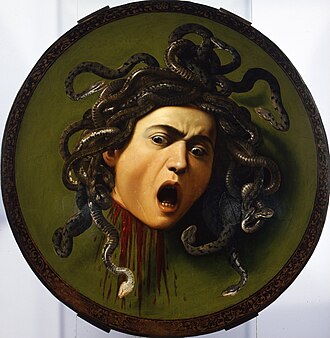 Méduse - Caravaggio (1597)
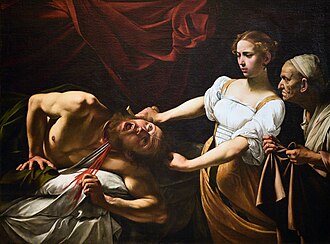 Judith décapitant Holopherne - Caravaggio (1598)
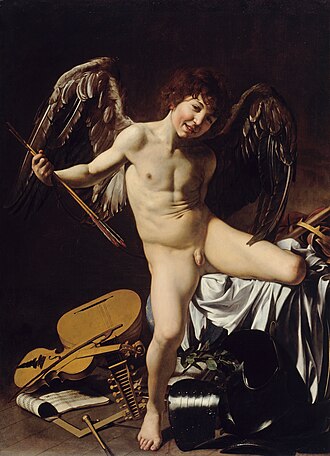 L'Amour victorieux - Caravaggio (1600s)
%2C%201595%20circa%2C%20534.jpg) Le Petit Bacchus malade - Caravaggio (1595)
Le Petit Bacchus malade - Caravaggio (1595)
Œuvres d'artistes liés
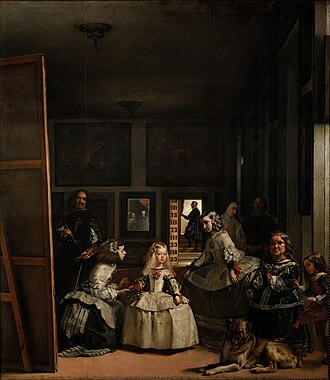 Les Ménines - Diego Velázquez (1656)
 La Reddition de Bréda - Diego Velázquez (1635)
 La Ronde de nuit - Rembrandt van Rijn (1642)
 Autoportrait - Rembrandt van Rijn (1659)
 La Jeune Fille à la perle - Johannes Vermeer (1665)
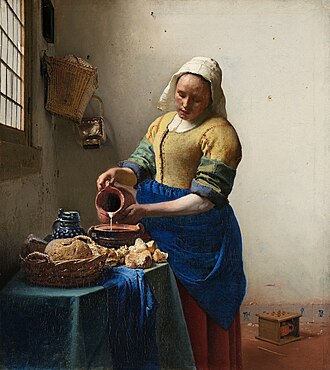 La Laitière - Johannes Vermeer (c. 1658)