Portrait de Jacopo Sannazaro
Titien · 1510s
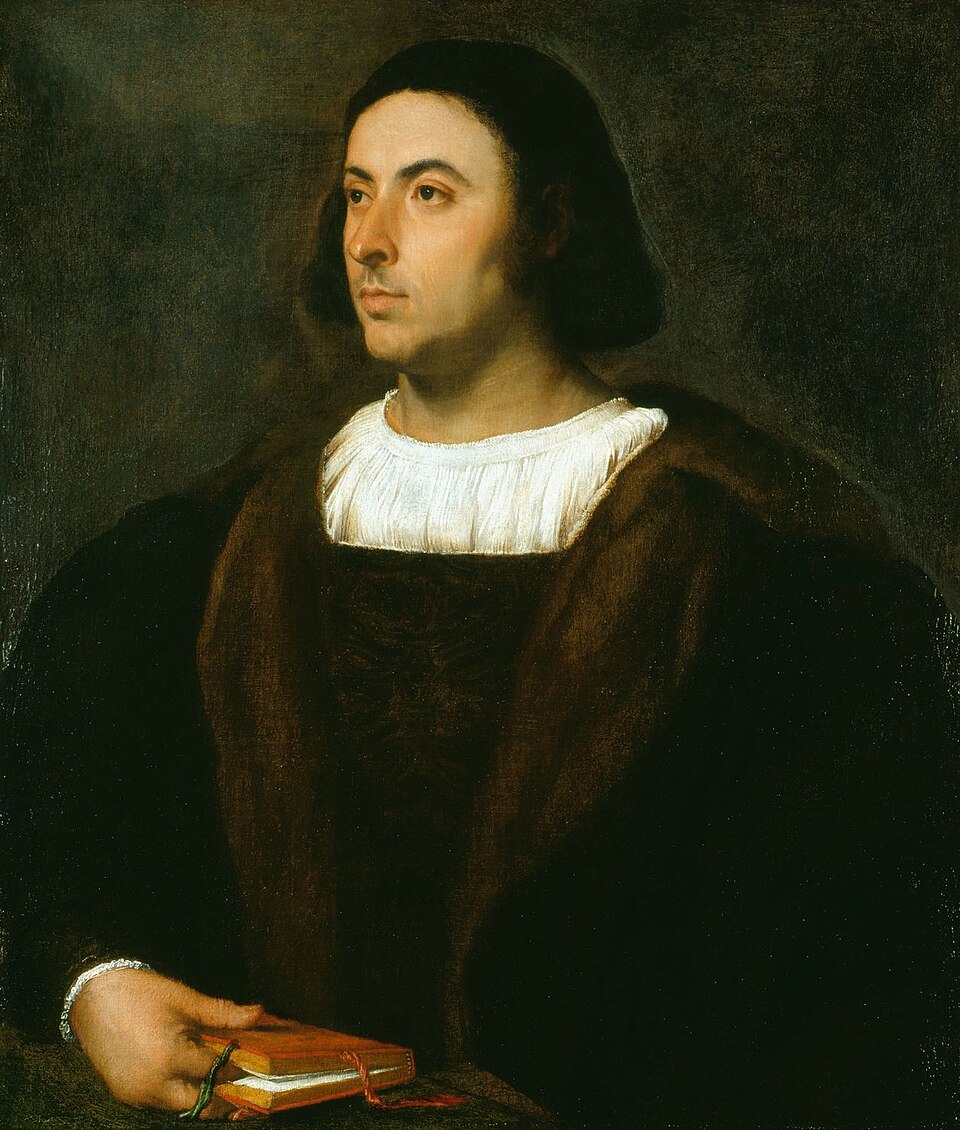
A man rests one hand on a book while his eyes drift off into space. For centuries he was taken for Boccaccio, then for Alessandro de' Medici. Today he is thought to be the Neapolitan poet Jacopo Sannazaro, painted by the young Titian.
The story behind the painting
This oil painting by Titian, also called Portrait of a Man, belongs to the Royal Collection and hangs in Buckingham Palace. Its date has been placed anywhere from about 1511 to the early 1520s, but the style of the clothes and hair points to around 1513, and certainly before 1520. Georg Gronau saw in it the moment of transition from a purely Giorgionesque manner to Titian's own personal style, and compared it with the Parma portrait in Vienna, which he thought its companion.
What to look for
Gronau noticed that in Titian's early single portraits the hands work as a key sign of personality. Here only one hand is visible, resting on a book lying on the parapet in front, while the sitter's eyes wander away into space. That pairing of book and distant gaze makes us read him as a man of letters. The canvas measures about 85.7 by 72.7 cm. Charles Ricketts, writing in 1910 after dirt and old varnish had been removed, noted a large damaged patch on the brow but called the picture otherwise in good condition.
Meaning and intent
The name of the sitter has changed with time. Earlier titles named him Boccaccio and Alessandro de' Medici, both now considered wrong. In 1895 Gronau proposed Jacopo Sannazaro, a poet and humanist from Naples, and an early copy in the Walker Art Gallery in Liverpool supports him with the inscription Sincerus Sannzarius, since Actius Sincerus was a known alias of the poet. Ricketts praised the combination of dignity and simplicity, ranking it with the Man in Black in the Louvre and the Man with a Glove.
Legacy
The portrait is well known through an engraving by Van Dalen. It is said to have belonged to King Charles I of England. Later it was in the Van Reynst cabinet, which after its owner's death was bought by the States of Holland and West Friesland and given to Charles II in 1660. Ricketts wrote that the work had few rivals among Titian's finest portraits, illustrating the magisterial quality that Reynolds praised in him. It remains in the Royal Collection today.
Le saviez-vous ?
- Dated to about 1513, certainly before 1520.
- Formerly called Boccaccio and Alessandro de' Medici.
- Identified as Jacopo Sannazaro by Georg Gronau in 1895.
- Given to Charles II in 1660; now at Buckingham Palace.
À propos de l'artiste
Titien (1488-1576)
portrait · Haute Renaissance · École vénitienne · Royal Collection
Autres œuvres de Titien
 Vénus d'Urbin - Titian (1538)
 L'Assomption de la Vierge - Titian (1510s)
 Amour sacré et Amour profane - Titian (1510s)
 Charles Quint à cheval à Mühlberg - Titian (1548)
 Flore - Titian (1517)
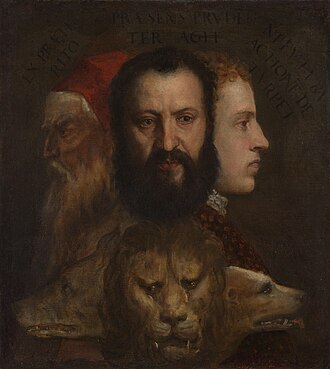 Allégorie du Temps gouverné par la Prudence - Titian (1550)
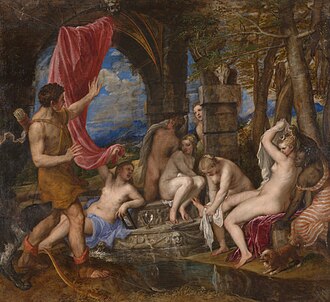 Diane et Actéon - Titian (1550s)
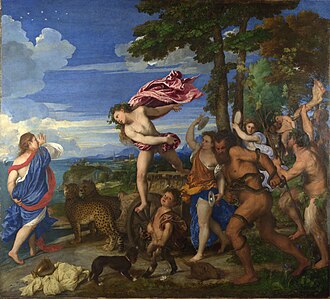 Bacchus et Ariane - Titian (1520s)
Œuvres d'artistes liés
 La Cène - Jacopo Tintoretto (1563)
 Miracle de l'esclave - Jacopo Tintoretto (1540s)
 Les Noces de Cana - Paolo Veronese (1560s)
 Le Repas chez Levi - Paolo Veronese (1573)