L'Homme au gant
Titien · 1520
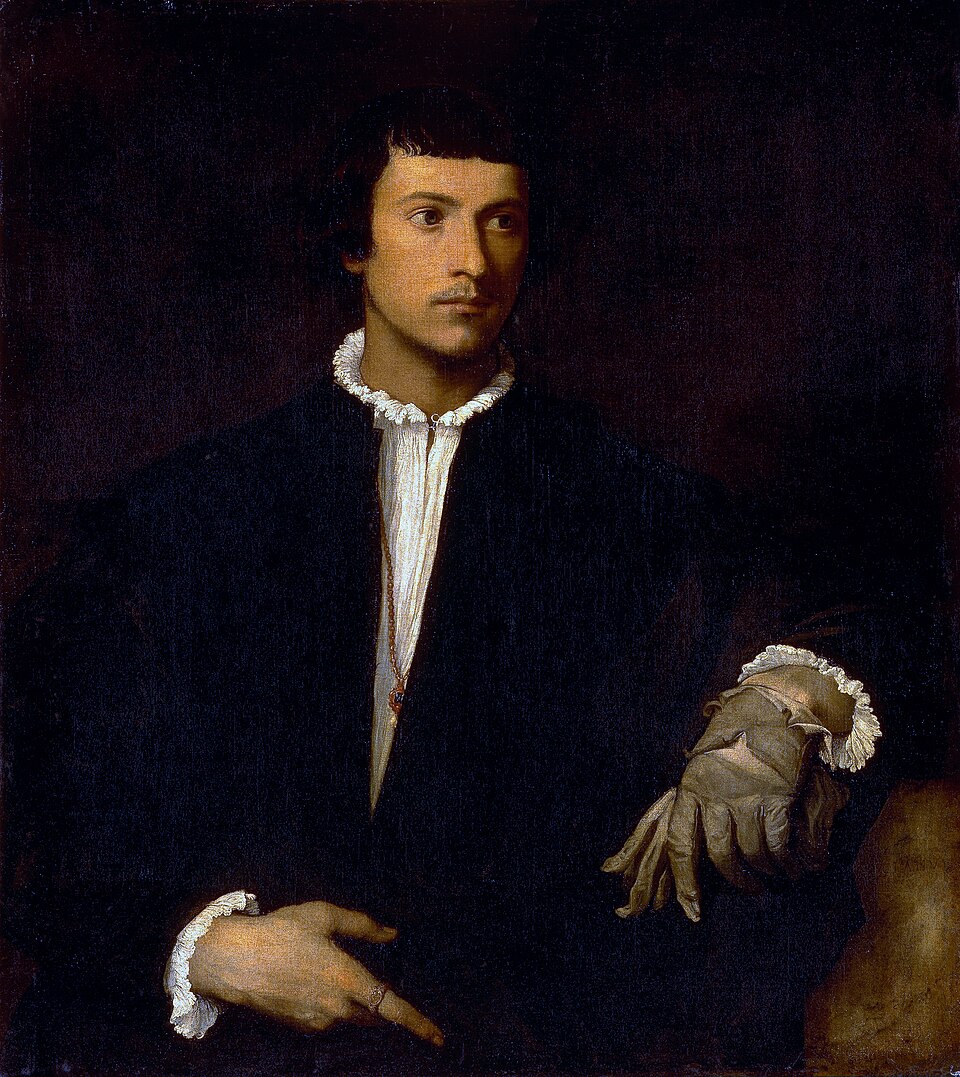
A young man in black looks past us, one bare hand resting, the other gloved. Nobody knows his name, but writers from Henry James to Camus could not forget his face.
The story behind the painting
Titian painted this oil on canvas portrait around 1520. It comes from the Gonzaga collection in Mantua and was acquired by Charles I of England in 1627. After the king's execution in 1649 it was auctioned and bought by the Cologne banker Eberhard Jabach, then passed to Louis XIV of France, and it moved from Versailles to the Louvre in 1792. The sitter has never been identified. He may be Girolamo Adorno, named in a 1527 letter from Pietro Aretino, Giambattista Malatesta, a Gonzaga agent in Venice, or Ferrante Gonzaga.
What to look for
The man is seen in three quarter view against a flat black background, gazing at an indefinite point to the left. He wears a wide jacket and a white shirt in the fashion of the period. His left hand, gloved, rests on his knee and holds a second leather glove, an accessory of refined gentlemen. His right hand wears a gold ring. Notice the necklace with a sapphire and a pearl, and the parapet, a device often used by the young Titian.
Meaning and intent
With almost nothing around him, the portrait rests on the face, the hands and the contrast of white and black. The gloves, a fashion statement, and the ring signal wealth and refinement, yet the expression stays calm and withdrawn. Siegfried Sassoon noted the grave young man's calm scrutiny. If he is Ferrante Gonzaga, he would have been about sixteen in 1523. Without a name, he became simply the man with a glove, and viewers are left to read his character from his pose alone.
Legacy
Writers kept returning to him. In Henry James's The Ambassadors of 1903, characters meet in front of the young man with the strangely shaped glove and blue grey eyes. In Somerset Maugham's Christmas Holiday a mother calls it one of the finest portraits ever painted. Sassoon kept a reproduction over his mantelpiece. Camus, Marquand, Mika Waltari and the science fiction writer Fred Saberhagen also wrote it into their stories. In Saberhagen's tale, the painting is carried on a starship meant to save humanity's important artworks.
Le saviez-vous ?
- Painted by Titian around 1520.
- Owned by the Gonzaga, Charles I, Jabach and Louis XIV.
- The sitter remains unidentified.
- In the Louvre since 1792.
À propos de l'artiste
Titien (1488-1576)
portrait · homme · Haute Renaissance · département des peintures du musée du Louvre · École vénitienne
Autres œuvres de Titien
.jpg) Vénus d'Urbin - Titian (1538)
Vénus d'Urbin - Titian (1538)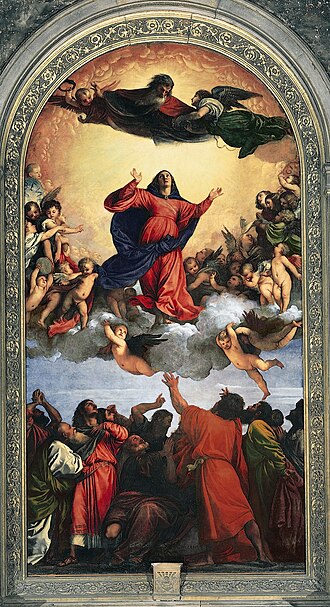 L'Assomption de la Vierge - Titian (1510s)
FXD.jpg) Amour sacré et Amour profane - Titian (1510s)
Amour sacré et Amour profane - Titian (1510s)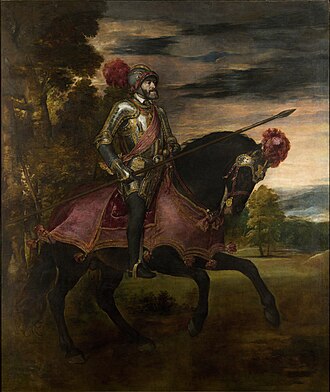 Charles Quint à cheval à Mühlberg - Titian (1548)
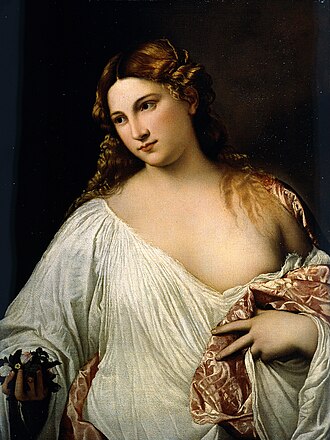 Flore - Titian (1517)
 Allégorie du Temps gouverné par la Prudence - Titian (1550)
 Bacchus et Ariane - Titian (1520s)
%20nave%20left%20-%20Altar%20of%20Madona%20di%20Ca'Pesaro.jpg) Madonna di Ca' Pesaro - Titian
Madonna di Ca' Pesaro - Titian