Judith décapitant Holopherne
Caravaggio · 1607
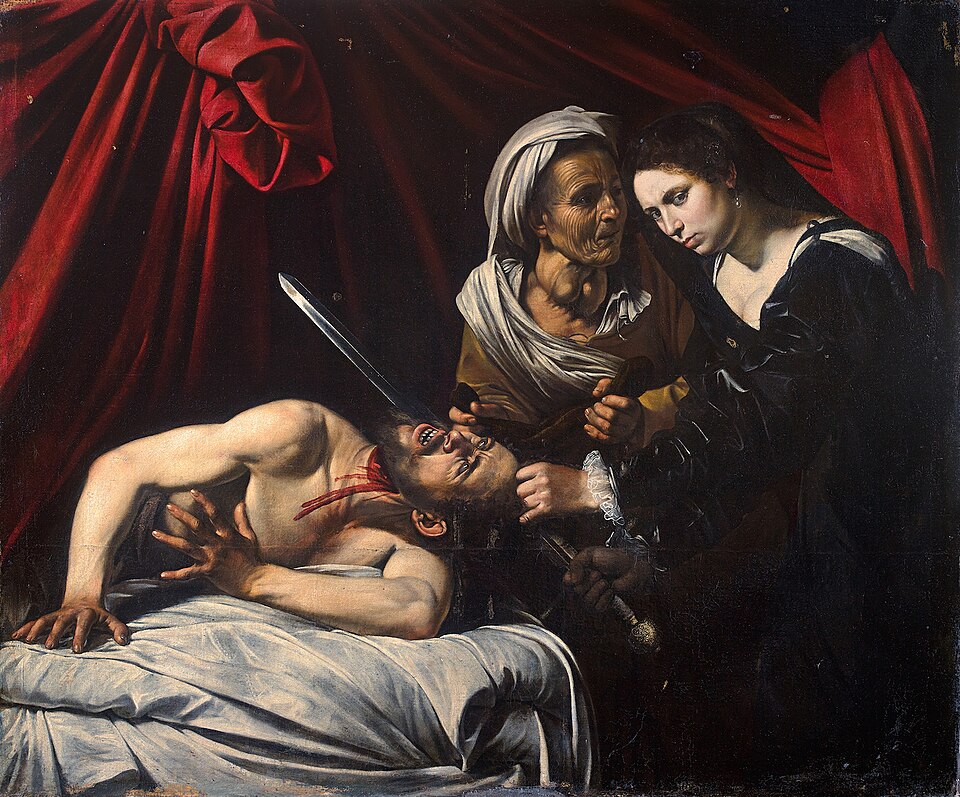
A large canvas of Judith beheading Holofernes turned up in an attic near Toulouse in 2014. Some experts hail it as a lost Caravaggio from Naples, others as the masterpiece of his Flemish follower Louis Finson. The argument is still open.
The story behind the painting
According to its owners, the painting, oil on canvas about 144 by 173 cm, was found in 2014 in the attic of their private home near Toulouse, supposedly by chance during a water leak. The auctioneer Marc Labarbe was told of it, and the Paris expert Éric Turquin immediately linked it to a lost Caravaggio. When Caravaggio left Naples on 14 June 1607, he left two paintings, the Madonna of the Rosary and a Judith Beheading Holofernes, in the studio shared by the Flemish painters and dealers Louis Finson and Abraham Vinck. The Madonna later went to Antwerp and is now in Vienna; the Judith has left no trace since 1619.
What to look for
The scene shows the biblical heroine Judith killing Holofernes, with a maidservant beside her. Supporters of Caravaggio point to the preparation of the canvas, the incised lines and the shadows as typical of him, and to underdrawing and changes of mind beneath the paint, signs of an artist inventing rather than copying. Sceptics point to other details: the tight wrinkles on the maid's forehead and the raw, distorted face of Holofernes, which they find unlike Caravaggio. They note a canvas of the same kind Finson used, a black outline, and the technique called del risparmio, leaving the dark ground bare as a half-tone, which Finson learned from Caravaggio.
Meaning and intent
The painting is a test case for how attributions are made. Éric Turquin, Nicola Spinosa and Keith Christiansen believe it was painted by Caravaggio in Naples between September 1606 and June 1607, or in Rome in 1604 to 1605. Maria Cristina Terzaghi, Gianni Papi and Sylvain Bellenger see it as an original work by Finson, not even a copy. Supporters cite a letter of 25 September 1607 in which Frans Pourbus the Younger described to the Duke of Mantua a Judith and Holofernes by Caravaggio for sale in Naples, but there is no proof linking that picture to the Toulouse canvas. Finson is known to have spent time in Toulouse, where he organised a lottery in 1615.
Legacy
The Louvre's experts studied the work, and on 25 March 2016 the French Ministry of Culture declared it a national treasure, blocking its export for 30 months. No French museum acquired it, and the ban was lifted in December 2018. It was due to be auctioned in Toulouse as an autograph Caravaggio on 27 June 2019, but two days earlier it was sold privately. The New York Times and the Gazette Drouot then named the buyer as the American businessman and collector J. Tomilson Hill. It is called the Caravaggio of Toulouse by its promoters and the Judith of Toulouse by those not convinced, and a related version in Naples has also been reconsidered.
Le saviez-vous ?
- Found in 2014 in an attic near Toulouse.
- Oil on canvas, about 144 x 173 cm.
- Attributed by some to Caravaggio (1607), by others to Louis Finson.
- Declared a French national treasure in 2016; acquired by J. Tomilson Hill in 2019.
À propos de l'artiste
Caravaggio (1571-1610)
Autres œuvres de Caravaggio
 Le Souper à Emmaüs - Caravaggio (1601)
 La Vocation de saint Matthieu - Caravaggio (1609)
 La Décollation de saint Jean-Baptiste - Caravaggio (1608)
 Le Souper à Emmaüs - Caravaggio (1601)
 Méduse - Caravaggio (1597)
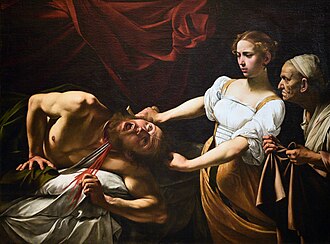 Judith décapitant Holopherne - Caravaggio (1598)
 L'Amour victorieux - Caravaggio (1600s)
 Le Petit Bacchus malade - Caravaggio (1595)
Œuvres d'artistes liés
 Les Ménines - Diego Velázquez (1656)
 La Reddition de Bréda - Diego Velázquez (1635)
 Saint Francis in Meditation - Francisco de Zurbarán (1639)
 The Immaculate Conception - Francisco de Zurbarán (1661)
 Triple portrait de Charles Ier - Anthony van Dyck (1635)
 Charles Ier à cheval avec Monsieur de Saint Antoine - Anthony van Dyck (1636)
 L'Érection de la croix - Peter Paul Rubens (1609)
 L'Enlèvement des filles de Leucippe - Peter Paul Rubens (1618)
 La Ronde de nuit - Rembrandt van Rijn (1642)
 Autoportrait - Rembrandt van Rijn (1659)
 Le Joyeux Buveur - Frans Hals (1620s)
 Le Cavalier riant - Frans Hals (1624)