Diane et ses compagnes
Johannes Vermeer · 1650s
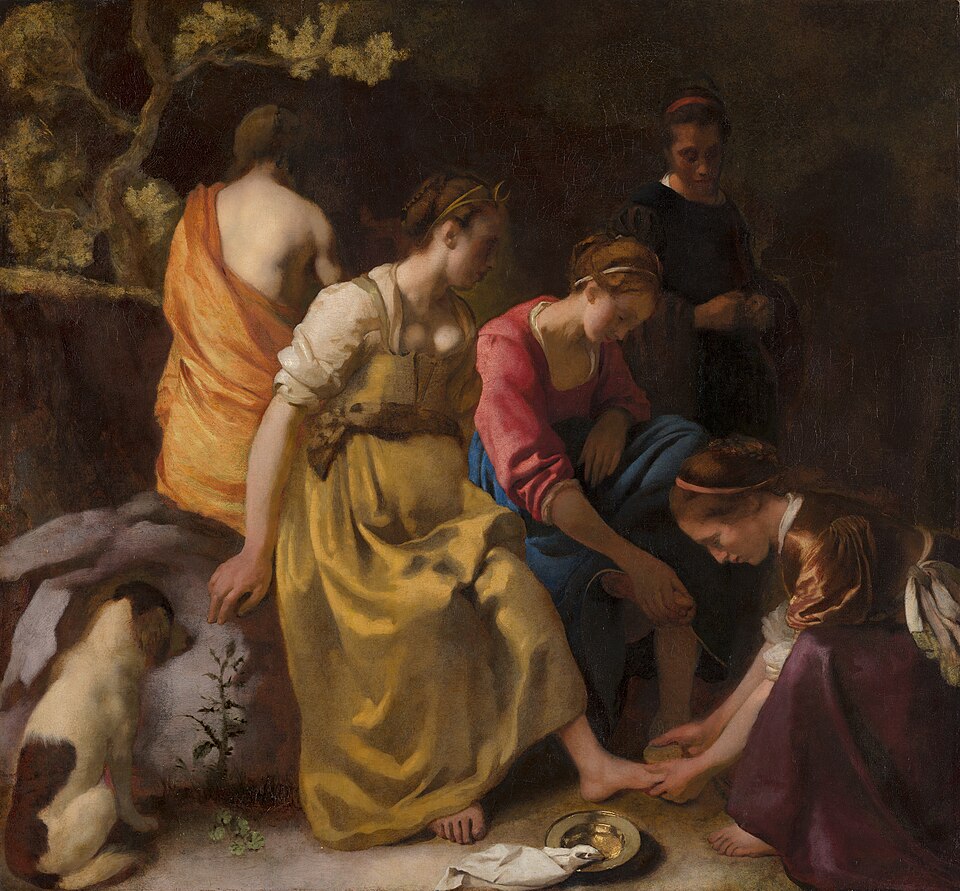
No hunt, no angry goddess, no drama: just Diana sitting quietly while a companion washes her foot. This may be Vermeer's earliest surviving painting, and it already belongs to the silence he became famous for.
The story behind the painting
Johannes Vermeer completed Diana and Her Companions in the early to mid-1650s; the exact year is unknown. It may be his earliest surviving painting, with some historians placing it before Christ in the House of Martha and Mary and some after. Nothing of its history before the mid-19th century is known. When it was auctioned in 1876 it was attributed to Rembrandt's pupil Nicolaes Maes, because Vermeer's signature had been altered to look like his. Doubts lasted until about 1901, when Abraham Bredius and Willem Martin of the Mauritshuis saw its similarities in colour and technique with Martha and Mary, which Vermeer had signed.
What to look for
Diana sits on a rock in a loose yellow dress with an animal-skin sash and a crescent moon diadem. One companion washes her left foot. Another, behind her, sits with her back partly bare, the most skin Vermeer shows in any of his surviving paintings. A third holds her own foot, and a fourth stands apart, eyes cast down. A gentle dog sits at lower left before a thistle. All the faces are in shadow and no woman looks at another. In 1999 to 2000 restorers found that the blue sky at upper right had been added in the 19th century, and about 15 cm had been cut from the right.
Meaning and intent
Arthur Wheelock says the picture has no visual precedent. It shows neither Actaeon surprising the bathers nor Callisto's pregnancy revealed, the popular dramatic episodes, nor any dead game or bow to mark the huntress. Instead it has an overwhelming solemnity he links more to Christian than mythological tradition. Foot-washing was a Christian symbol of humility and purification, recalling Mary Magdalene washing Christ's feet. The companion holding her foot resembles the ancient Spinario, removing a thorn, and the thorn and thistle can suggest suffering. A woman in a private, reflective moment would become the heart of Vermeer's later work.
Legacy
The painting shows Vermeer learning from others. Diana's stout figure, the thick impasto following the folds of her dress, and the shadowed faces recall Rembrandt, and Wheelock compares its feeling to Rembrandt's Bathsheba of 1654, which Vermeer very likely saw. Rembrandt's former pupil Carel Fabritius, in Delft from 1650 until 1654, may have been the link. Technical study shows Vermeer first outlined the composition in dark brown and scratched the hairs of the dog's ear with the handle of his brush. The painting, about 97.8 by 104.6 cm according to Wikidata, is in the Mauritshuis in The Hague.
Le saviez-vous ?
- Painted in the early to mid-1650s; possibly Vermeer's earliest surviving work.
- Sold in 1876 as a work by Nicolaes Maes.
- A 19th-century patch of sky was covered during the 1999-2000 restoration.
- Held by the Mauritshuis, The Hague.
À propos de l'artiste
Johannes Vermeer (1632-1675)
femme · âge d'or de la peinture néerlandaise · peinture mythologique · arbre · chien · roche · Mauritshuis · nymphe
Autres œuvres de Johannes Vermeer
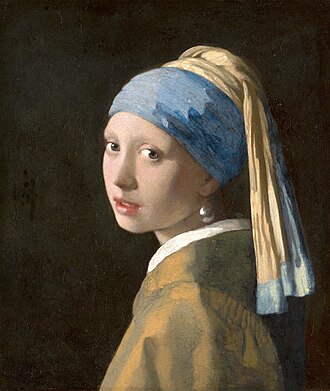 La Jeune Fille à la perle - Johannes Vermeer (1665)
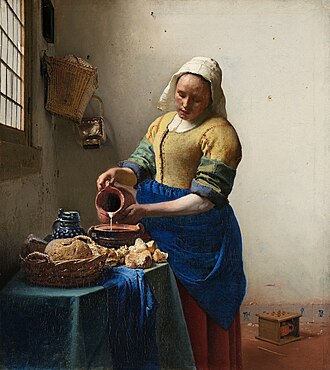 La Laitière - Johannes Vermeer (c. 1658)
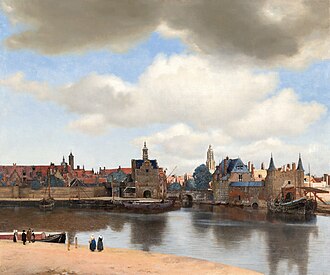 Vue de Delft - Johannes Vermeer (1660s)
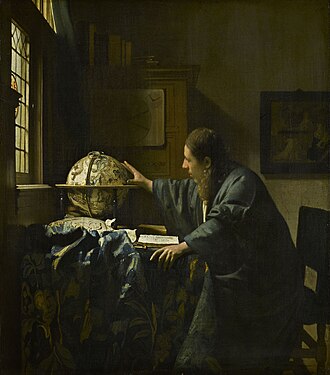 L'Astronome - Johannes Vermeer (1664)
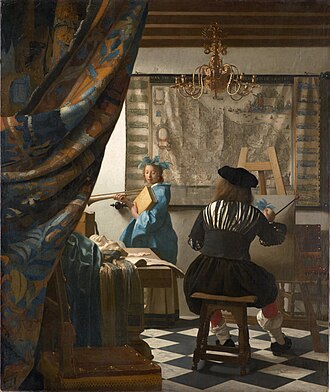 L'Art de la peinture - Johannes Vermeer (1660s)
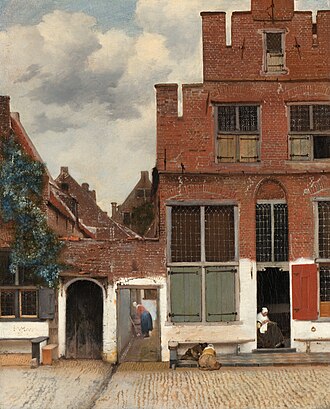 La Ruelle - Johannes Vermeer (1658)
.jpg) La Liseuse à la fenêtre - Johannes Vermeer (1650s)
La Liseuse à la fenêtre - Johannes Vermeer (1650s)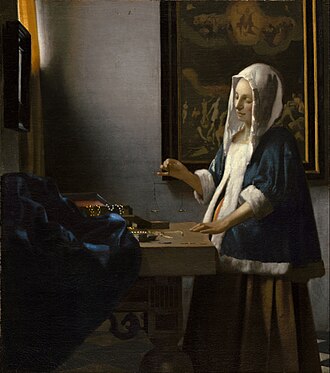 La Femme à la balance - Johannes Vermeer (1665)
Œuvres d'artistes liés
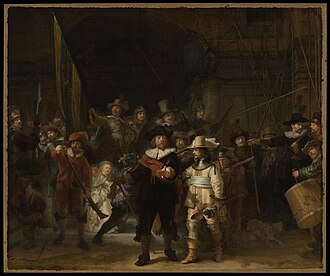 La Ronde de nuit - Rembrandt van Rijn (1642)
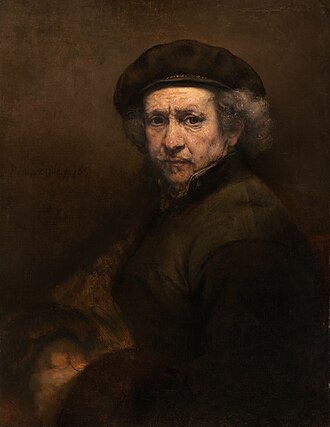 Autoportrait - Rembrandt van Rijn (1659)