David avec la tête de Goliath
Caravaggio · 1607
.jpg)
A young David strides forward with the giant's head hanging from his hand, more triumphant than troubled. Caravaggio painted this version on wood around 1606 to 1607, and it now hangs in Vienna.
The story behind the painting
Caravaggio often explored one subject in several variations. He painted David and Goliath around 1600, now in the Prado, and two pictures titled David with the Head of Goliath: this one in the Kunsthistorisches Museum, from about 1606 to 1607, and another in the Galleria Borghese, dated either 1607 or 1609 to 1610. Wikidata gives 1607 for the Vienna panel. The moment seems to be the one in 1 Samuel 17:57, when Abner brings David to Saul with the Philistine's head still in his hand.
What to look for
The pose is the usual one for this episode: David striding in triumph, the head held in his hand. The picture is painted in oil on wood and measures about 91 by 116 cm. Compared with the Borghese version it is less dark in mood, and Goliath's head is more generic, while in Rome the head is widely accepted as a self-portrait of the painter and is pushed frontally toward the viewer.
Meaning and intent
The difference in feeling is the heart of the comparison: here David is more triumphant, there he is introspective and oddly compassionate. The model for David in both seems to be an older version of the boy who posed for Amor Vincit Omnia and for the Capitoline and Pamphilj John the Baptist around 1602. Some, most notably Peter Robb, identify him as Cecco, Caravaggio's apprentice and lover in Rome, though there is no record of Cecco with the painter after his flight from Rome in 1606.
Legacy
Peter Robb believes the painting was acquired in Naples between 1611 and 1617 by the Count of Villamediana, since Giovanni Bellori records that the count returned to Spain with a half-figure of David by Caravaggio. In 2020 a cropped version, with chains added to David's neck, appeared on the cover of Westside Gunn's album Pray for Paris, designed by Virgil Abloh. The striding, confident David of Vienna thus found a new audience four centuries later.
Le saviez-vous ?
- Painted in oil on wood around 1606 to 1607.
- One of three Caravaggio paintings of David and Goliath.
- The David here is more triumphant than in the Borghese version.
- Kept in the Kunsthistorisches Museum, Vienna.
À propos de l'artiste
Caravaggio (1571-1610)
art religieux · homme · baroque · musée d'Histoire de l'art de Vienne · épée · David · tête décapitée · tête
Autres œuvres de Caravaggio
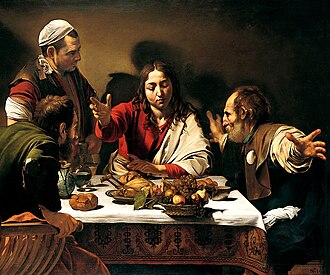 Le Souper à Emmaüs - Caravaggio (1601)
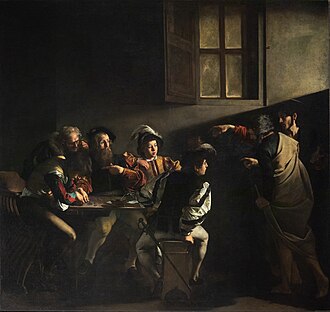 La Vocation de saint Matthieu - Caravaggio (1609)
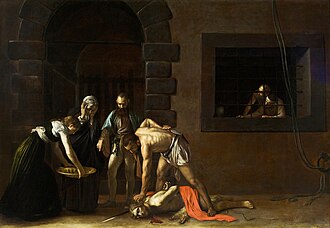 La Décollation de saint Jean-Baptiste - Caravaggio (1608)
 Le Souper à Emmaüs - Caravaggio (1601)
 Méduse - Caravaggio (1597)
 Judith décapitant Holopherne - Caravaggio (1598)
 L'Amour victorieux - Caravaggio (1600s)
%2C%201595%20circa%2C%20534.jpg) Le Petit Bacchus malade - Caravaggio (1595)
Le Petit Bacchus malade - Caravaggio (1595)
Œuvres d'artistes liés
 Les Ménines - Diego Velázquez (1656)
 La Reddition de Bréda - Diego Velázquez (1635)
.jpg) L'Érection de la croix - Peter Paul Rubens (1609)
L'Érection de la croix - Peter Paul Rubens (1609) L'Enlèvement des filles de Leucippe - Peter Paul Rubens (1618)
%20-%20Google%20Art%20Project.jpg) Triple portrait de Charles Ier - Anthony van Dyck (1635)
Triple portrait de Charles Ier - Anthony van Dyck (1635)%20with%20M.%20de%20St%20Antoine%20-%20Google%20Art%20Project.jpg) Charles Ier à cheval avec Monsieur de Saint Antoine - Anthony van Dyck (1636)
Charles Ier à cheval avec Monsieur de Saint Antoine - Anthony van Dyck (1636) La Ronde de nuit - Rembrandt van Rijn (1642)
 Autoportrait - Rembrandt van Rijn (1659)
 La Jeune Fille à la perle - Johannes Vermeer (1665)
 La Laitière - Johannes Vermeer (c. 1658)