L'Attaque de la diligence
Francisco Goya · 1787
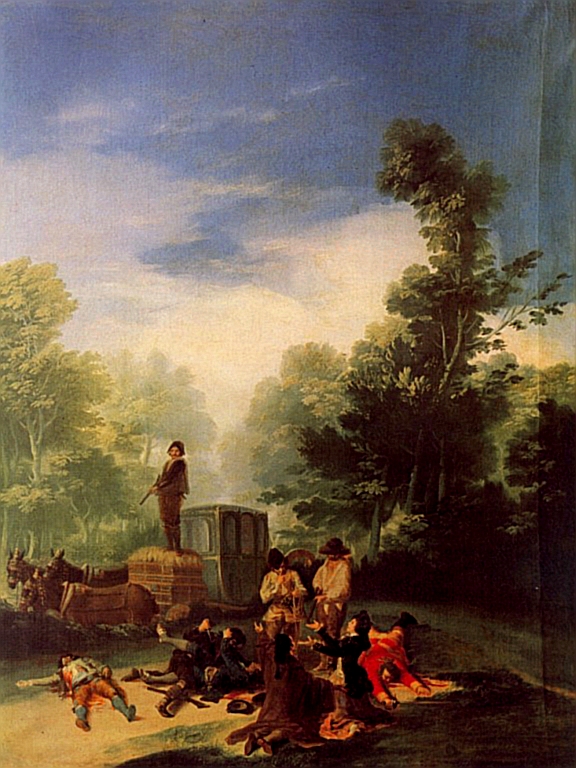
Robbers have stopped a travellers' carriage and are going through the loot, while a body lies almost unnoticed in the corner. Above them, Goya painted a calm, pastel sky.
The story behind the painting
Goya painted this picture in 1786 to 1787 for the Dukes of Osuna, for their country retreat, the park of El Capricho near Madrid. The Duchess, María Josefa Pimentel y Téllez-Girón, was a cultivated woman active in the circles of the Madrid Enlightenment. To decorate the property, the couple asked Goya for a series of scenes of everyday customs, similar to the designs he made for tapestries in the royal residences. The paintings were delivered to the Osuna family in 1787.
What to look for
Like the rest of the series, the canvas takes a popular scene as its subject: a group of thieves attacking a passenger carriage. The figures occupy only the lower third of the picture. The other two thirds belong to a landscape of clear sky and lush vegetation, painted in pastel blues and greens. The corpse is placed in the lower left corner, while the main group of robbers inspects what they have taken. The figures are smaller in proportion than in Goya's tapestry designs, which stresses the theatrical, Rococo quality of the setting.
Meaning and intent
The striking thing is the tension between subject and treatment. The series is notable for bringing scenes of violence and misfortune into decorative painting, yet here the arrangement of figures, the composition and the colours soften the violence. The gentle pastel landscape stands in paradoxical contrast to the gravity of a bloody event, which is pushed to the margin. The setting is almost a locus amoenus, the ideal pleasant place of classical poetry, and the robbery happens inside it like a scene on a stage.
Legacy
The other works in the Osuna series include The Greasy Pole, The Swing, The Fall, Village Procession, Ploughing and Apartado de toros. A few years later Goya returned to the same theme as a variation in Assault of Thieves, painted in 1793 to 1794. In that small work on tin plate, violent death moves to the centre and earth tones replace the pastel sky. Seen side by side, the two pictures show how Goya's way of looking at cruelty sharpened within a few years.
Le saviez-vous ?
- Painted in 1786-1787 for the Dukes of Osuna.
- Made for their park of El Capricho near Madrid.
- Figures fill only the lower third; landscape fills the rest.
- Goya revisited the theme in Assault of Thieves (1793-1794).
À propos de l'artiste
Francisco Goya (1746-1828)
Autres œuvres de Francisco Goya
 Tres de Mayo - Francisco Goya (1814)
 La Maja nue - Francisco Goya (1800)
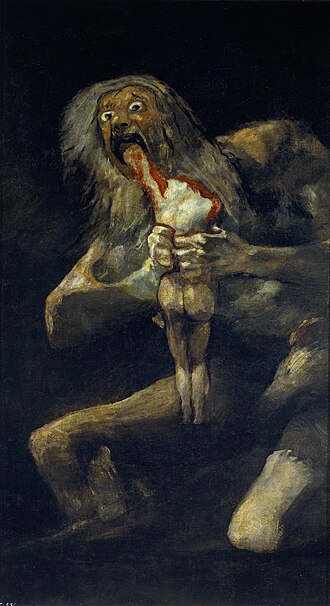 Saturne dévorant un de ses enfants - Francisco Goya (1819)
 La Famille de Charles IV - Francisco Goya (1800)
 La Maja vêtue - Francisco Goya (1800)
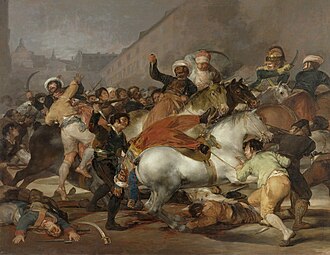 Dos de Mayo - Francisco Goya (1814)
 Le Chien - Francisco Goya (1819)
 Le Sabbat des sorcières - Francisco Goya (1820s)
Œuvres d'artistes liés
 Le Voyageur contemplant une mer de nuages - Caspar David Friedrich (c. 1818)
 L'Abbaye dans une forêt de chênes - Caspar David Friedrich (1800s)
 La Liberté guidant le peuple - Eugène Delacroix (1830)
 La Mort de Sardanapale - Eugène Delacroix (1827)
 Le Dernier Voyage du Téméraire - J. M. W. Turner (1839)
 Pluie, Vapeur et Vitesse - J. M. W. Turner (1844)
 L'Enfant bleu - Thomas Gainsborough (1770)
 Les Époux Andrews - Thomas Gainsborough (1748)