Venus y Adonis
Paolo Veronese · 1580
.jpg)
Adonis sleeps in the lap of Venus, while little Cupid holds back a hunting dog straining to go. Veronese knew the ending of Ovid's story: the hunt will kill the young man. This tender, doomed moment hangs today in the Prado.
The story behind the painting
Paolo Veronese painted this oil on canvas in the early 1580s; Wikidata gives the year 1580. The subject comes from the Metamorphoses, the narrative poem by the Roman poet Ovid, which tells how the goddess Venus loved the young hunter Adonis. Venus had foreseen that Adonis would die while hunting. Veronese made the picture after spending time in Rome, and he painted a pendant in the same period, Cephalus and Procris, showing another tragic couple from the Metamorphoses. That companion piece is now in the Museum of Fine Arts of Strasbourg.
What to look for
The canvas measures 162 by 191 cm. Adonis lies asleep in Venus' lap, and in front of her, her son Cupid struggles with a sighthound, trying to quench the dog's eagerness to hunt. Behind them stretches a lively green landscape under a vivid blue sky. Veronese borrowed from ancient art: his Cupid is modelled on the Hellenistic sculpture of a boy with a goose, and Adonis may be modelled on the figure of Endymion on a Roman sarcophagus in the Archbasilica of Saint John Lateran. Notice the contrast between the calm, sleeping couple and the restless dog.
Meaning and intent
The quiet of the scene is full of tension. Everyone who knew Ovid knew that Adonis would wake, go hunting and be killed. Cupid restraining the dog is a small, touching attempt to hold back fate, echoing his mother's fear. The painting lets us linger in the last peaceful moment of a love story, under a bright sky that gives no hint of the tragedy. Paired with Cephalus and Procris, another couple undone by a hunt, it becomes part of a meditation on love and loss.
Legacy
In the 18th century the painting was enlarged by 50 cm at the top; a restoration in 1988 removed the addition, giving back its original horizontal format. It may have been bought in Venice in 1641, together with its pendant, which Diego Velázquez acquired for the Spanish crown. In any case it was in the Spanish royal collection by 1666, in a gallery of the Alcázar of Madrid. After the Alcázar burned in 1734, it is recorded in rooms of the New Royal Palace between 1772 and 1818, before most of the collection moved to the Prado, where it remains.
¿Sabías que…?
- Painted by Paolo Veronese in the early 1580s.
- Based on Ovid's Metamorphoses.
- Its pendant, Cephalus and Procris, is in Strasbourg.
- An 18th-century addition at the top was removed in 1988.
Sobre el artista
Paolo Veronese (1528-1588)
Museo del Prado · pintura mitológica · escuela veneciana · manierismo · paisaje · perro · Venus · hombre vestido, mujer desnuda · Afrodita
Más obras de Paolo Veronese
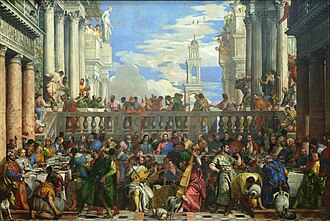 Las bodas de Caná - Paolo Veronese (1560s)
.jpg) Cena en casa de Leví - Paolo Veronese (1573)
Cena en casa de Leví - Paolo Veronese (1573)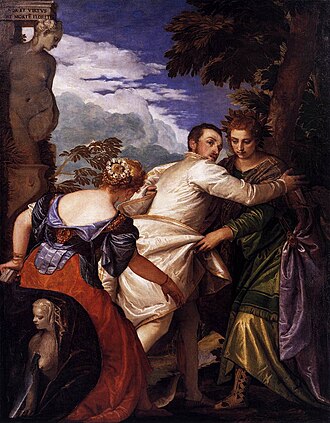 Alegoría de la Virtud y el Vicio - Paolo Veronese (1565)
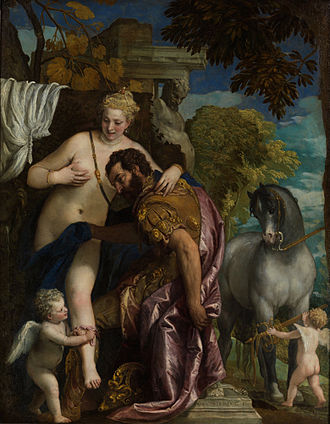 Marte y Venus unidos por Amor - Paolo Veronese (1570s)
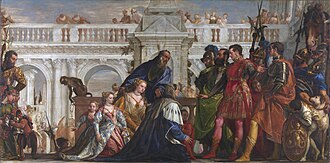 The Family of Darius Before Alexander - Paolo Veronese (1565)
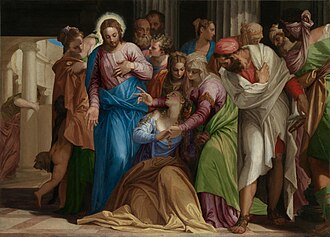 The Conversion of Mary Magdalene - Paolo Veronese (1548)
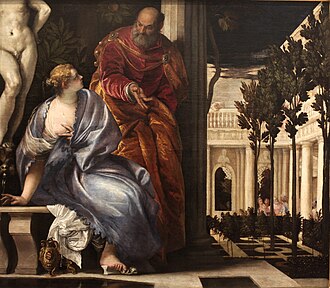 Bathsheba at Her Bath - Paolo Veronese (1575)
%20grande.jpg) Jesús entre los doctores - Paolo Veronese (1560)
Jesús entre los doctores - Paolo Veronese (1560)
Obras de artistas relacionados
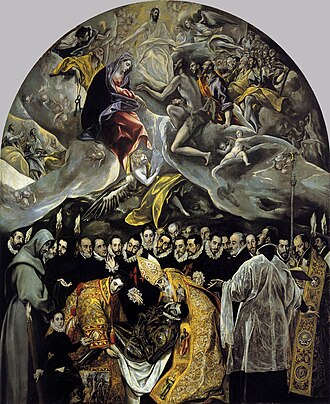 El entierro del Conde de Orgaz - El Greco (1586)
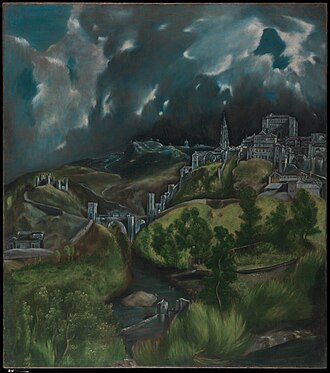 Vista de Toledo - El Greco (1596)
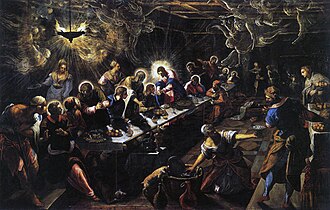 La Última Cena - Jacopo Tintoretto (1563)
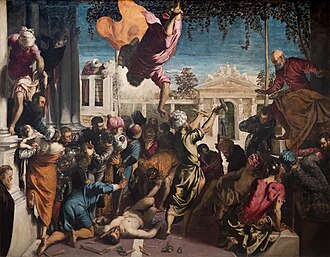 San Marcos liberando al esclavo - Jacopo Tintoretto (1540s)
.jpg) Venus de Urbino - Titian (1538)
Venus de Urbino - Titian (1538)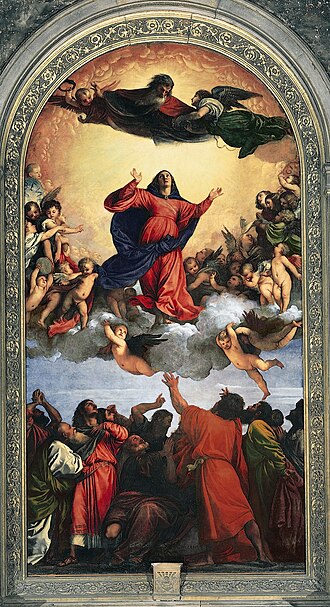 La Asunción de la Virgen - Titian (1510s)
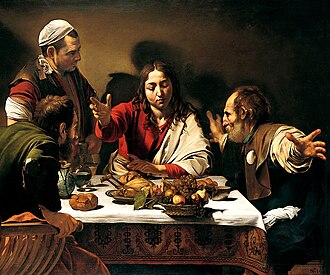 La cena de Emaús - Caravaggio (1601)
 La vocación de San Mateo - Caravaggio (1609)
 Los embajadores - Hans Holbein the Younger (1533)
 El cuerpo de Cristo en la tumba - Hans Holbein the Younger (1520s)