Paolo Veronese
1528-1588
Paolo Veronese, a stonecutter's son from Verona, filled Venice with feasts of colour: vast banquets, glowing ceilings and crowds in shimmering finery that made later painters call him the greatest colourist who ever lived.
Origins
Paolo Veronese took his name from Verona, where a census shows he was born in 1528, the fifth child of a stonecutter named Gabriele and his wife Caterina. Since surnames often came from a father's trade, he was first known as Paolo Spezapreda, from the Venetian word for stonecutter. He later called himself Paolo Caliari, because his mother was the illegitimate daughter of a nobleman named Antonio Caliari. By 1541 he was apprenticed to Antonio Badile, later his father-in-law, and in 1544 to Giovanni Francesco Caroto, both leading Verona painters. His precocious gifts soon outgrew the workshop, and he developed a taste for a more radiant palette.
Life and turning points
In his late teens he painted for important churches in Verona, and in 1551 the Giustiniani family commissioned an altarpiece for their chapel in San Francesco della Vigna in Venice. In 1552 he painted an altarpiece for Mantua Cathedral. He moved to Venice in 1553 after his first state commission, ceilings in the Doge's Palace. His ceilings for San Sebastiano and the Marciana Library, for which he won a prize judged by Titian and Sansovino, made him a master among his peers. In 1565 he married Elena Badile, his first master's daughter, and they had a daughter and four sons. He died in Venice on 19 April 1588.
Style and technique
After an early Mannerist period, Veronese developed a naturalist style influenced by Titian, and he is known as a supreme colourist. His most famous works are elaborate narrative cycles full of majestic architecture and glittering pageantry, and he was the leading Venetian painter of ceilings. In his refectory pictures he set the architecture mostly parallel to the picture plane, so that figures move along a horizontal axis like a procession; they are above all about the incandescence of light and colour. At the Villa Barbaro, built by Palladio, his frescoes used complex perspective and trompe l'oeil, with ceilings opening onto blue skies and mythological figures.
Stories and anecdotes
The contract for The Wedding at Cana, painted in 1562 and 1563 for the monks of San Giorgio Maggiore, demanded a canvas of 66 square metres, premium colours including blue made from lapis lazuli, and as many figures as possible. Among the guests are portraits said to include Titian, Tintoretto and Veronese himself. A decade later his Last Supper for Santi Giovanni e Paolo, filled with soldiers, dwarves and animals, brought him before the Inquisition on 18 July 1573. He told them that painters take the same liberties as poets and madmen. Ordered to change the painting, he renamed it The Feast in the House of Levi instead.
Legacy
With Titian and Tintoretto, Veronese is one of the great trio of sixteenth century Venetian painting. Modern critics have often valued him least of the three, and the art historian Charles Hope compared his sumptuous effect to a visit to a patisserie. Yet many great artists admired him, among them Rubens, Watteau, Tiepolo, Delacroix and Renoir. Delacroix wrote that he made light without violent contrasts and kept the strength of colour in shadow, and Théophile Gautier called him the greatest colourist who ever lived. Lawrence Gowing wrote that his bright outdoor harmonies inspired the whole nineteenth century. Most of his great works remain in Venice.
¿Sabías que…?
- After his death his family workshop signed their works Haeredes Pauli, Heirs of Paolo.
- He was one of the first painters whose drawings were collected during his lifetime.
- The Feast in the House of Levi measures 5.55 by 12.80 metres.
- A Monty Python sketch is based on the story of The Feast in the House of Levi.
manierismo · escuela veneciana
Artistas relacionados
El Greco · Tintoretto · Tiziano · Caravaggio · Hans Holbein the Younger
Obras de Paolo Veronese
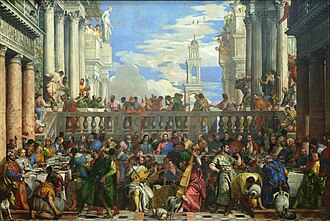 Las bodas de Caná - Paolo Veronese (1560s)
.jpg) Cena en casa de Leví - Paolo Veronese (1573)
Cena en casa de Leví - Paolo Veronese (1573).jpg) Venus y Adonis - Paolo Veronese (1580)
Venus y Adonis - Paolo Veronese (1580)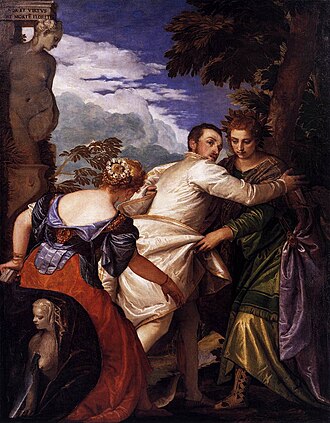 Alegoría de la Virtud y el Vicio - Paolo Veronese (1565)
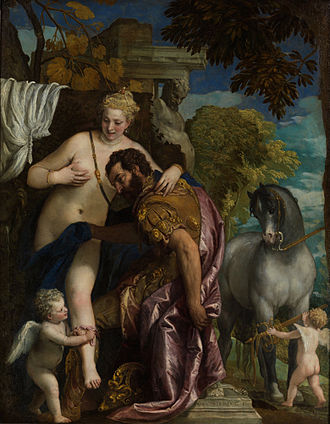 Marte y Venus unidos por Amor - Paolo Veronese (1570s)
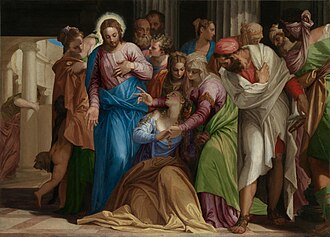 The Conversion of Mary Magdalene - Paolo Veronese (1548)
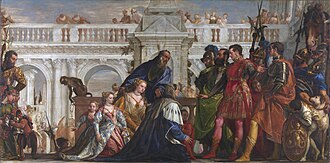 The Family of Darius Before Alexander - Paolo Veronese (1565)
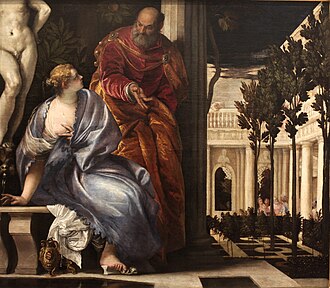 Bathsheba at Her Bath - Paolo Veronese (1575)
%20grande.jpg) Jesús entre los doctores - Paolo Veronese (1560)
Jesús entre los doctores - Paolo Veronese (1560)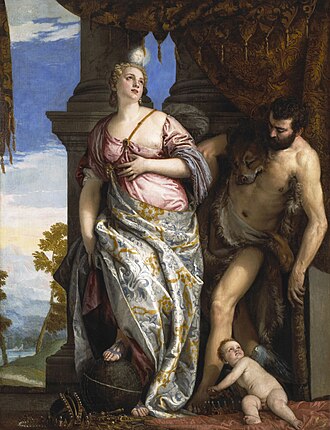 Alegoria da sabedoria e da forca - Paolo Veronese (1565)