El entierro del Conde de Orgaz
El Greco · 1586
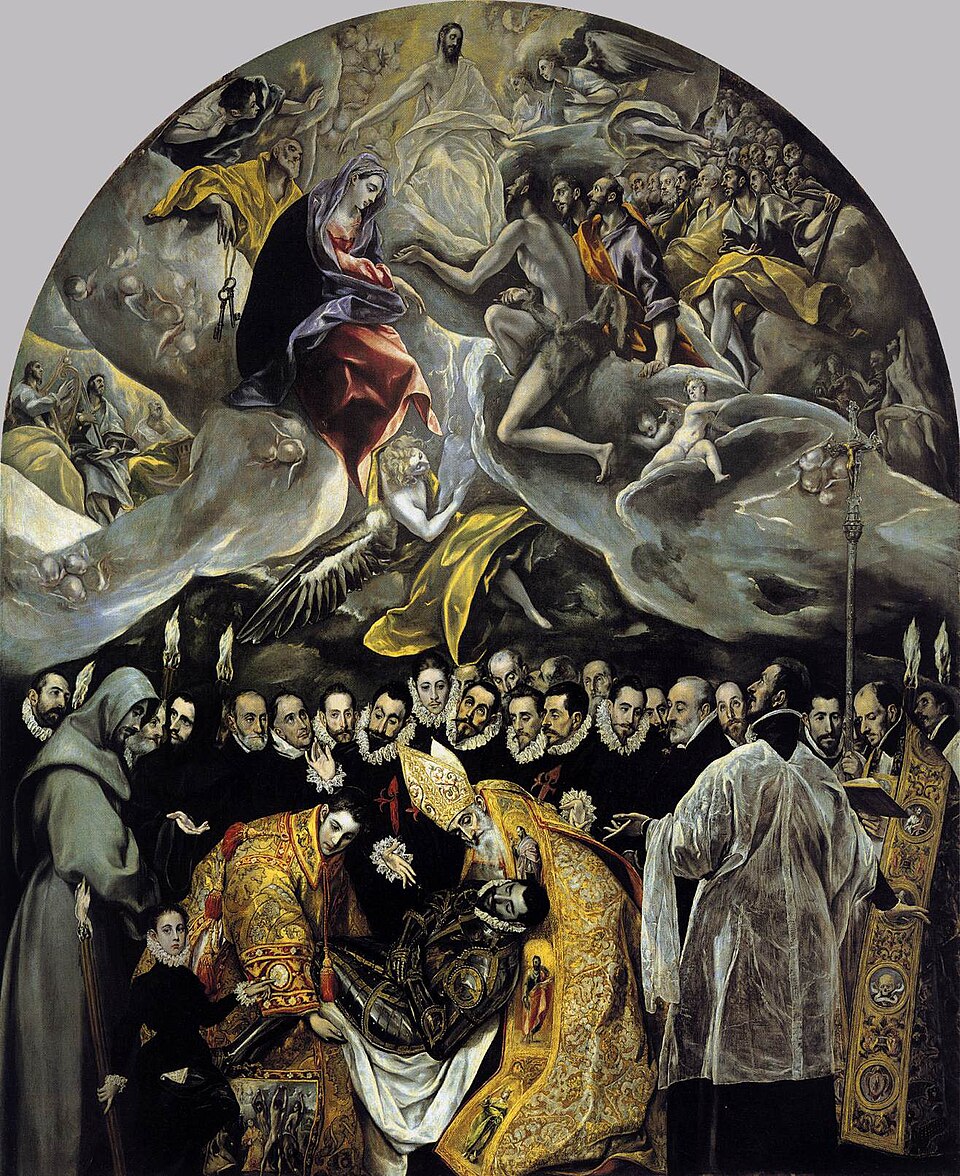
Two saints step down from heaven to lay a nobleman in his tomb, while above, the clouds part to receive his soul. El Greco's vast canvas still hangs in the Toledo church where the legend began.
The story behind the painting
The painting illustrates a local legend. In 1323 Don Gonzalo Ruiz de Toledo, lord of Orgaz, died; a pious philanthropist, he had left money to enlarge and adorn the church of Santo Tomé, El Greco's parish church, where he wished to be buried. At his burial, it was said, Saint Stephen and Saint Augustine came down from heaven and laid him in the tomb with their own hands. In 1586 the parish priest Andrés Núñez, who had begun refurbishing the Count's burial chapel, commissioned El Greco. The contract, signed on 18 March 1586, set out every detail of the subject and asked for completion by Christmas 1587. El Greco worked at a frantic pace and finished between late 1587 and spring 1588.
What to look for
The canvas, 480 by 360 cm, is divided into an earthly zone below and a heavenly zone above. Below, all is natural in scale: Saint Augustine and Saint Stephen, in gold and red vestments, bend reverently over the Count in magnificent armour, while Toledo's noblemen in black mourning watch with restrained composure. Find the boy at the left, El Greco's son Jorge Manuel; the handkerchief in his pocket bears the artist's signature and 1578, the year of the boy's birth, and he points us into the scene. El Greco himself appears above the raised hand of a knight of Santiago. Above, icy swirling clouds open on Christ in white, the Madonna, John the Baptist, saints and even Philip II.
Meaning and intent
The contract fixed the theme, but El Greco modernised the legend with features of a sixteenth-century funeral and portraits of eminent Toledans. That served a teaching purpose in line with Counter-Reformation doctrine: veneration of saints and good deeds lead to salvation. The two zones are bound together by standing figures, torches and a cross, so there is little sense of duality. At the centre an angel pushes the Count's soul, shown as an ethereal newborn, upward. Franz Philipp saw this assumption of the soul as a third zone. Scholars also link the composition to the Byzantine icon of the Dormition of the Virgin, connecting it with El Greco's Cretan origins.
Legacy
Already in 1588 people flocked to Santo Tomé to see the painting, drawn above all by its lifelike portraits of the notable men of Toledo. In 1612 Francisco de Pisa wrote that the people of the city never grew tired of it, because it contained realistic portraits of many notable men of the time. Scholars have since called it one of the most truthful pages in the history of Spain, a masterpiece of Western art and of late Mannerism, and the epitome of El Greco's style. It remains in the church of Santo Tomé, still serving the chapel and the legend for which it was made more than four centuries ago.
¿Sabías que…?
- Commissioned by the parish priest Andrés Núñez; the contract was signed on 18 March 1586.
- The boy at the left is El Greco's son Jorge Manuel, with the date 1578 on his handkerchief.
- The canvas measures 480 by 360 cm and is still in the church of Santo Tomé, Toledo.
- In 1612 Francisco de Pisa noted that Toledans never tired of looking at it.
Sobre el artista
El Greco (1541-1614)
arte religioso · Virgen María · ángel · retrato grupal · Francisco de Asís · Juan el Bautista · Esteban
Más obras de El Greco
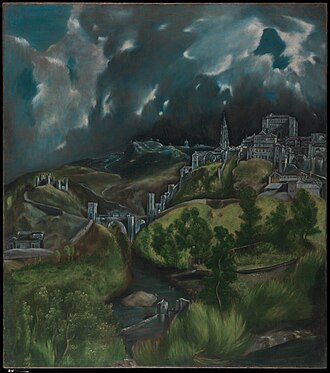 Vista de Toledo - El Greco (1596)
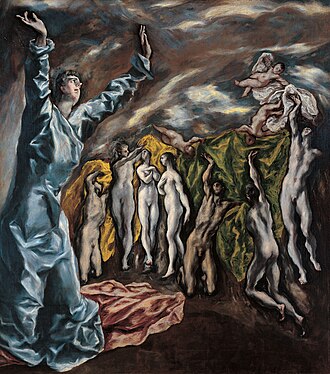 Visión del Apocalipsis - El Greco (1610)
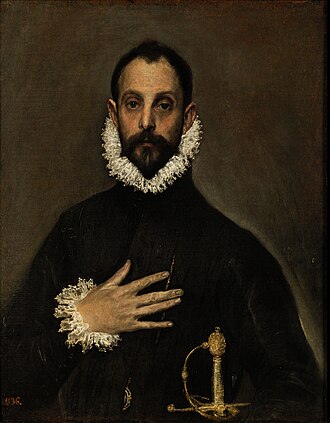 El caballero de la mano en el pecho - El Greco (1580)
%20-%20Laoco%C3%B6n%20-%20Google%20Art%20Project.jpg) Laocoonte - El Greco (1610s)
Laocoonte - El Greco (1610s)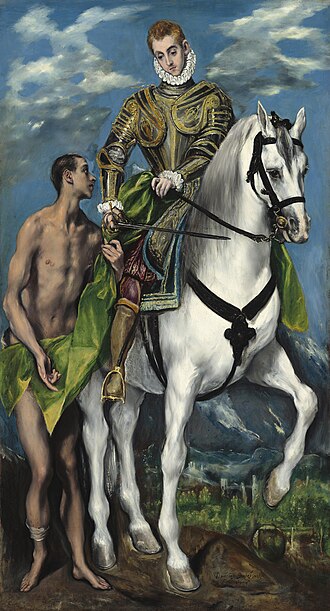 San Martín y el mendigo - El Greco (1597)
.jpg) Adoración de los pastores - El Greco (1612)
Adoración de los pastores - El Greco (1612)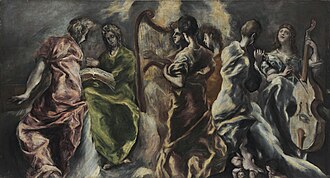 Concierto de ángeles - El Greco (1600s)
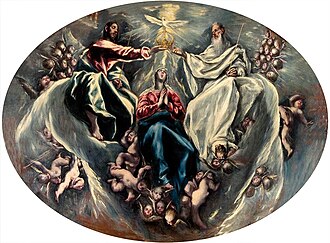 La coronación de la Virgen - El Greco (1597)
Obras de artistas relacionados
 La cena de Emaús - Caravaggio (1601)
 La vocación de San Mateo - Caravaggio (1609)