Juramento del Juego de Pelota
Jacques-Louis David · 1791
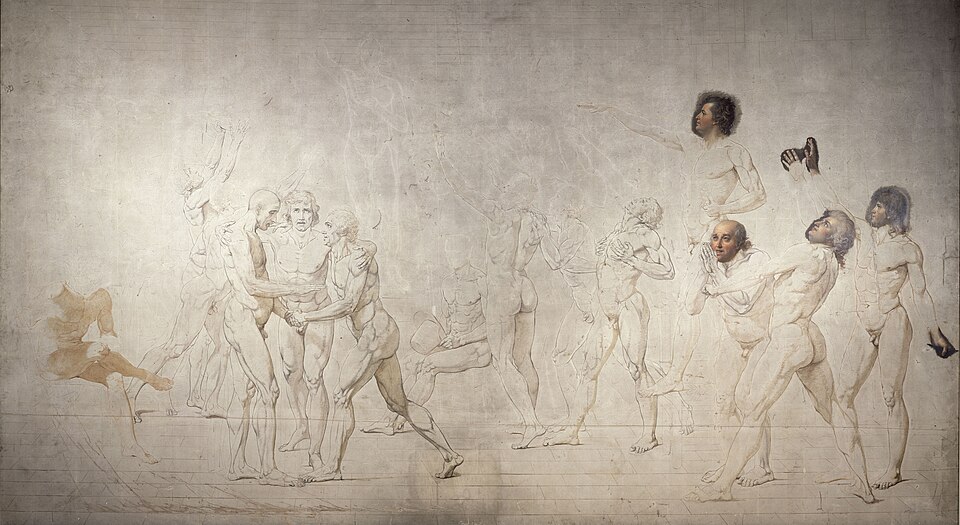
Hundreds of deputies stretch out their arms toward one man, the wind tearing at the curtains above them. David meant to paint the birth of the French Revolution on a canvas four metres high, but the Revolution itself overtook him and the work was never finished.
The story behind the painting
On 20 June 1789, after King Louis XVI locked their meeting hall at Versailles, the deputies of the Third Estate gathered in an indoor tennis court and proclaimed themselves the National Assembly. In 1790 David persuaded the Jacobin Club to launch a national subscription for a painting of the event. He showed a pen and brown ink drawing of his plan at the Salon of 1791 in the Louvre, but only about a tenth of the subscription was taken up. The National Constituent Assembly then decided to fund the work from the public treasury, topped up by sales of engravings. Wikipedia says David worked on it between 1790 and 1794, while Wikidata dates it 1791.
What to look for
Every deputy turns toward Jean Sylvain Bailly, a device that shows their support for him. David drew all the faces in detail so that each figure could be recognised. In the lower right corner sits Martin-Dauch, the only man who refused to take the oath, a quiet counterpoint to the general enthusiasm. Look for the monk Dom Gerle beside the Protestant pastor Jean-Paul Rabaut Saint-Etienne, a sign of new religious tolerance. High above, large windows are crowded with smiling members of the public, and the wind blowing in and billowing the curtains stands for the wind of Revolution sweeping through France.
Meaning and intent
In the eighteenth century an oath was sacred, a guarantee that a person would keep their word, as in David's own Oath of the Horatii. During the Revolution, collective oaths like this one were seen as a source of national unity. The tennis court oath, nearly unanimous, almost entirely middle class and free of popular violence, was regarded as the forerunner of the 1789 revolution. It also expressed the idea that national sovereignty was built from the personal will of each individual. David's composition turns that idea into a single surge of bodies and arms, all directed toward one shared promise.
Legacy
By 1793 David was too busy as a deputy himself, and politics had turned against the picture: Mirabeau, a hero of 1789, was now seen as a traitor after his secret letters to Louis XVI came to light, and many former deputies had been declared enemies of the government. David left the canvas unfinished, about 400 by 660 cm, and the subscribers reclaimed their engravings. Its ideas fed his later Distribution of the Eagle Standards and Leonidas at Thermopylae, and artists such as Auguste Couder and Luc-Olivier Merson reworked the subject. Acquired for the Louvre in 1836 and shown there from 1880, it is now at the Palace of Versailles.
¿Sabías que…?
- Commissioned through a Jacobin Club subscription launched in 1790.
- A drawing of the design was shown at the Salon of 1791.
- Left unfinished as the politics of the Revolution shifted.
- Now at the Palace of Versailles.
Sobre el artista
Jacques-Louis David (1748-1825)
varón · neoclasicismo · retrato grupal
Más obras de Jacques-Louis David
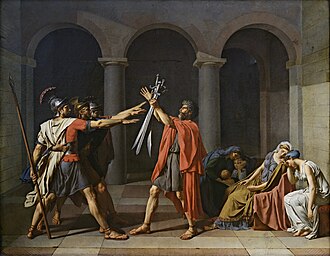 Juramento de los Horacios - Jacques-Louis David (1784)
.jpg) La intervención de las sabinas - Jacques-Louis David (1799)
La intervención de las sabinas - Jacques-Louis David (1799) Marte desarmado por Venus y las Gracias - Jacques-Louis David (1824)
 Madame Récamier - Jacques-Louis David (1800)
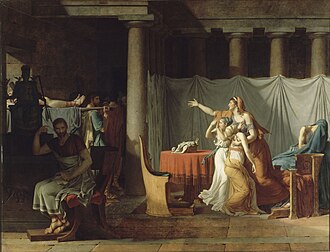 Los lictores llevan a Bruto los cuerpos de sus hijos - Jacques-Louis David (1789)
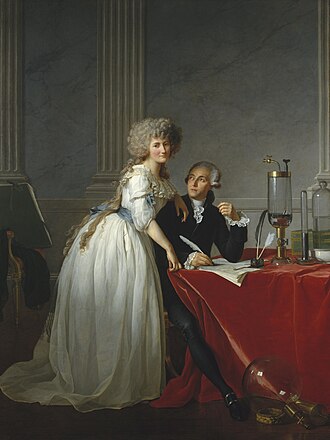 Retrato de Antoine-Laurent Lavoisier y su esposa - Jacques-Louis David (1788)
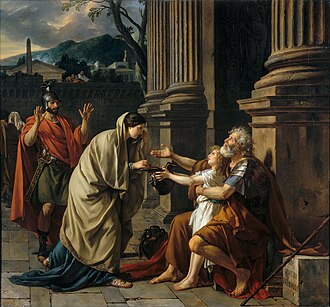 Belisario - Jacques-Louis David (1781)
Cupido y Psique - Jacques-Louis David (1817)
Obras de artistas relacionados
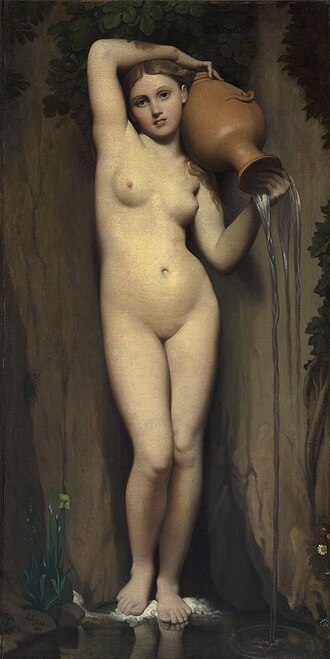 La fuente - Jean-Auguste-Dominique Ingres (1856)
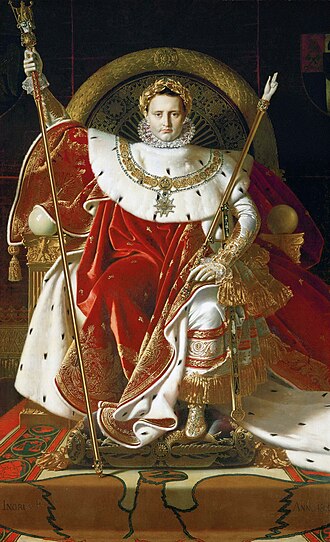 Napoleón en su trono imperial - Jean-Auguste-Dominique Ingres (1806)
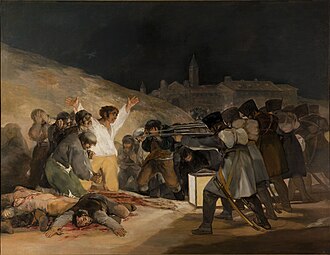 El tres de mayo de 1808 - Francisco Goya (1814)
.jpg) La Maja desnuda - Francisco Goya (1800)
La Maja desnuda - Francisco Goya (1800)