La Forkapto de Ganimedo
Rembrandt van Rijn · 1635
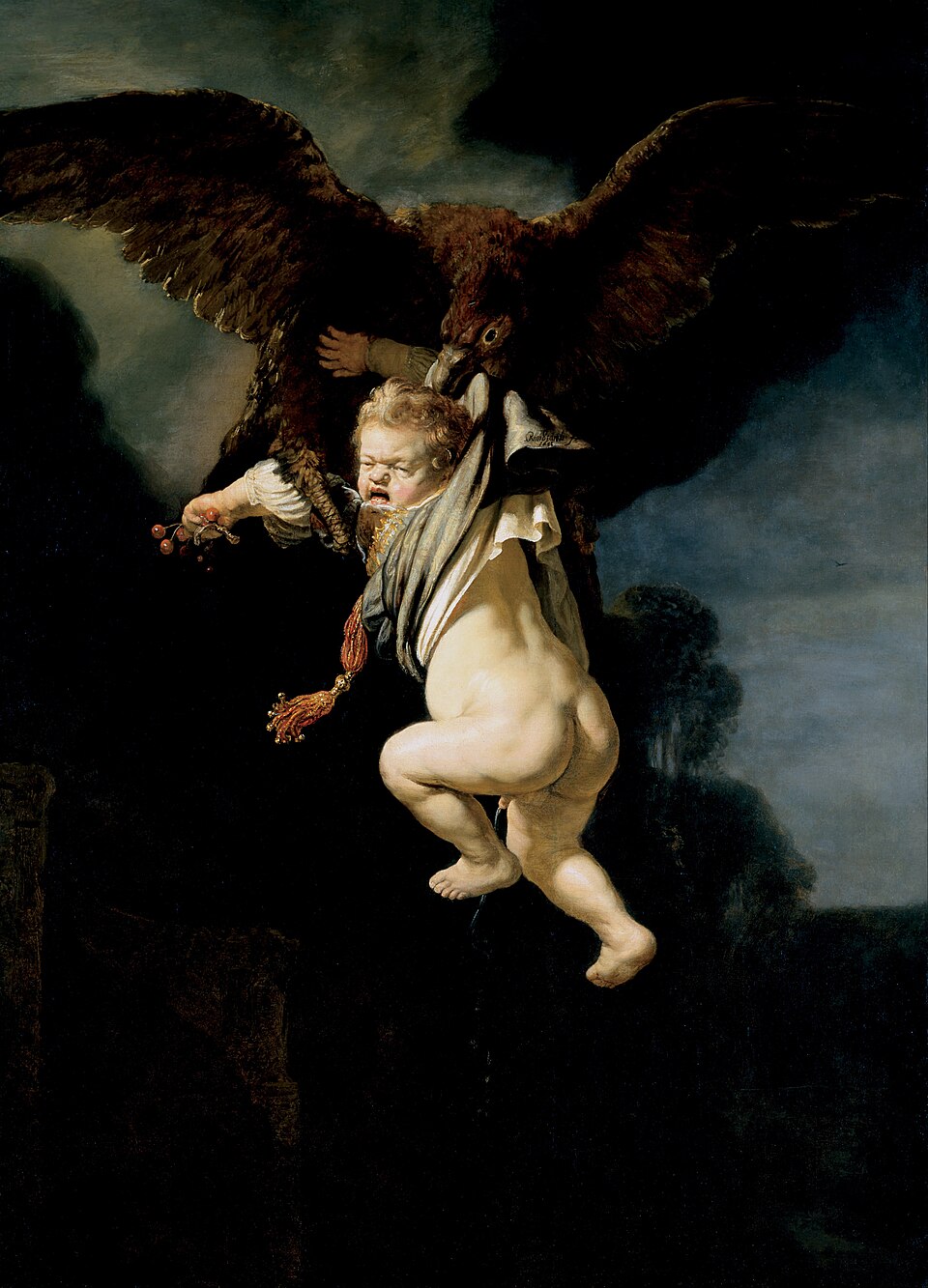
An eagle carries off a chubby, wailing child, cherries still clutched in his fist. Rembrandt turned the classical myth of the beautiful youth Ganymede into something startling and human, and viewers have puzzled over it ever since.
The story behind the painting
In the myth, Zeus in the form of an eagle carries the Trojan prince Ganymede up to the heavens. Rembrandt painted the subject in 1635 and signed it at the top, on the hem of the boy's shirt, Rembrandt ft. 1635. A sketch for the picture survives in the Dresden print room. The painting was sold in Amsterdam in 1716 and in Rotterdam in 1751, and in the same year it was bought in Hamburg for Dresden through Heinecken. It has been in the Gemäldegalerie Alte Meister ever since.
What to look for
The eagle, seen from the front with wings spread, rises toward the sky. It grips the boy's clothes in its beak and his left arm in its talons. The curly-haired child, turned sharply and almost seen from behind, faces round as if crying loudly and pushes at the bird with his right hand. His light blue clothes are pulled up, leaving his legs bare, and in his fright he wets himself. In his left hand he still holds cherries. Bright light falls from the left onto the boy against a sombre background with trees and the pinnacles of a building.
Meaning and intent
The 19th-century writer John Smith found the picture so unusual that he thought Rembrandt must have meant to burlesque the myth, showing the beautiful Ganymede as a great lubberly child with a blubbering grimace. A later reading sees it differently: not in the Renaissance tradition of Ganymede as an object of desire, but in a newer Protestant Baroque view of Ganymede as a beloved child taken from life too soon. In the 1670s Nicolaes Maes even painted a series of Ganymedes regarded as deathbed portraits of children.
Legacy
The picture has long been catalogued by scholars, from Smith to Hofstede de Groot in 1915, and it was engraved several times. Sources differ on its support and size. Hofstede de Groot describes an oak panel of 68 1/2 by 52 inches, while Wikidata gives 177 by 129 cm. An inventory of 1671 for Catharina van der Pluym, aunt of Rembrandt's great-nephew and pupil Karel van der Pluym, lists a piece of Ganymede, a sign the theme also circulated around his family.
¿Sabías que…?
- Signed and dated 1635 on the hem of the boy's shirt.
- Bought for Dresden in 1751.
- The boy still holds cherries in his hand.
- Read as a child taken from life too soon.
Sobre el artista
Rembrandt van Rijn (1606-1669)
pintura mitológica · pintura del Siglo de oro neerlandés · Staatliche Kunstsammlungen Dresden
Más obras de Rembrandt van Rijn
 La ronda de noche - Rembrandt van Rijn (1642)
 Autorretrato - Rembrandt van Rijn (1659)
 Lección de anatomía del Dr. Nicolaes Tulp - Rembrandt van Rijn (1632)
 La novia judía - Rembrandt van Rijn (1660s)
 La tormenta en el mar de Galilea - Rembrandt van Rijn (1633)
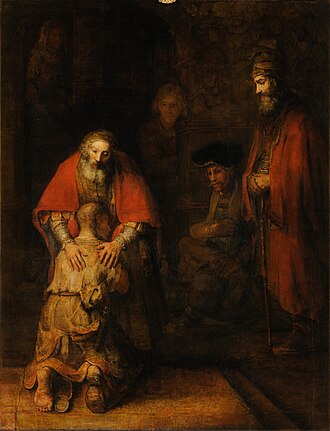 El retorno del hijo pródigo - Rembrandt van Rijn (1668)
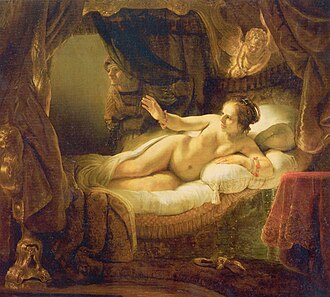 Dánae - Rembrandt van Rijn (1636)
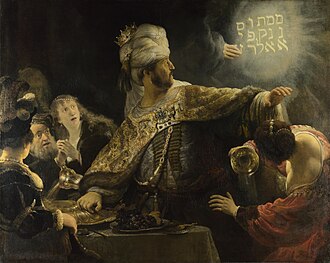 Banquete de Belsasar - Rembrandt van Rijn (1636)
Obras de artistas relacionados
 La joven de la perla - Johannes Vermeer (1665)
 La lechera - Johannes Vermeer (c. 1658)
 La fiesta de San Nicolás - Jan Steen (1660s)
 Joven comiendo ostras - Jan Steen (1658)
 El alegre bebedor - Frans Hals (1620s)
 Caballero sonriente - Frans Hals (1624)
 El molino de Wijk bij Duurstede - Jacob van Ruisdael (1670)
 El cementerio judío - Jacob van Ruisdael (1650s)
 Patio de una casa de Delft - Pieter de Hooch (1658)
 Mujer pelando manzanas - Pieter de Hooch (1663)