Las grandes bañistas
Pierre-Auguste Renoir · 1884
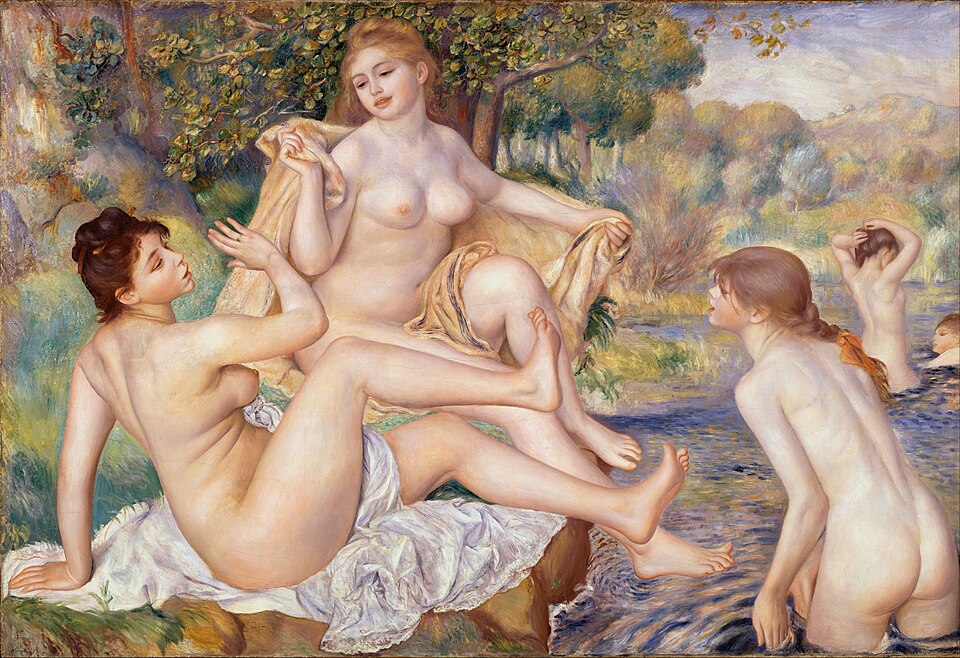
On a sunny riverbank, one bather is about to splash her friend, who leans back laughing to dodge the water. Renoir spent three years trying to make this playful moment as timeless as a classical relief.
The story behind the painting
Pierre-Auguste Renoir worked on The Great Bathers for about three years, from 1884 to 1887; Wikidata gives the date simply as 1884. After a trip to Italy in 1881 and 1882, where he absorbed the frescoes of Raphael, he began painting in a more disciplined, conventional manner, gave up painting outdoors and made the female nude his main focus. The picture draws on a 1672 lead relief by François Girardon, The Bath of the Nymphs, made for a fountain at Versailles, and on his admiration for Veronese, Tiepolo, Ingres and the Rococo painter François Boucher. Before he was satisfied, Renoir made more than twenty studies and sketches, including at least two full-sized figure drawings.
What to look for
In the foreground two women sit beside the water while a third stands in it. She seems ready to splash one of the seated women, who leans back to avoid it. Compare the two halves of the canvas. On the left, the two large bathers have crisp outlines and carefully drawn ears, hair and lips; Renoir traced them onto the canvas from exact drawings, giving them a smooth, sculptural feel. Now look right: the smaller bathers in the background and the landscape were painted directly with small, loose brushstrokes, softer and blurrier. Notice the crossed legs of the foreground bathers, a pose linked to Boucher's Diana Bathing of 1742, and how the figures look almost pasted against the shimmering scenery.
Meaning and intent
Renoir wanted to reconcile modern painting with the traditions of the seventeenth and eighteenth centuries, especially Ingres and Raphael, and to find a meeting point between old masters such as Rubens and Titian and the new Impressionist style. He exhibited it as a decorative essay, Essai de peinture décorative, signaling an ornamental conception of the picture. The Rococo spirit of sensuality he loved, partly as a reaction against the mechanized look of industrial life, shows in his full-bodied figures. The painting has even been called his pictorial testament. Among the models were two of his favorites: Aline Charigot, the seated blonde woman, whom he married in 1890, and the painter Suzanne Valadon.
Legacy
Shown at the Petit Gallery in May 1887, the painting was meant by Renoir to be his great masterpiece, and he reportedly expected viewers to be dumbfounded. Instead it stirred controversy without the acclaim he hoped for; many critics felt the mix of Rococo and Impressionist styles lacked harmony. Berthe Morisot and Claude Monet, however, greatly admired it, and Monet remarked that it was not understood by all, but by many. It strongly influenced Paul Cézanne, who later painted his own series of bathers in nature. First bought by Renoir's former student Jacques-Émile Blanche, it passed to Carroll Sargent Tyson Jr. in 1927 and was bequeathed to the Philadelphia Museum of Art in 1963.
¿Sabías que…?
- Painted over about three years, 1884 to 1887 (Wikidata gives 1884)
- Inspired partly by Girardon's relief The Bath of the Nymphs (1672) at Versailles
- First exhibited at the Petit Gallery in May 1887
- Bequeathed to the Philadelphia Museum of Art in 1963
Sobre el artista
Pierre-Auguste Renoir (1841-1919)
mujer · escena de género · retrato · sentado · desnudo · de pie · ribera
Más obras de Pierre-Auguste Renoir
 Baile en el Moulin de la Galette - Pierre-Auguste Renoir (1876)
 El almuerzo de los remeros - Pierre-Auguste Renoir (1881)
 El columpio - Pierre-Auguste Renoir (1876)
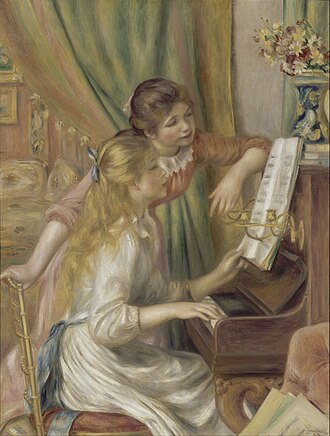 Muchachas al piano - Pierre-Auguste Renoir (1892)
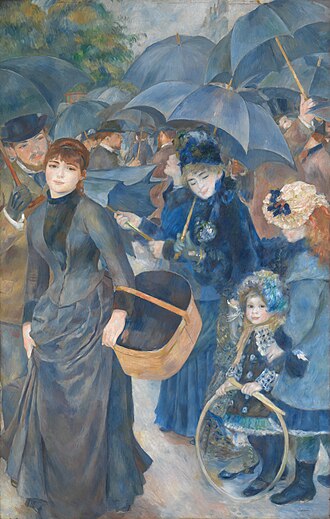 Los paraguas - Pierre-Auguste Renoir (1880s)
%20(46499625955).jpg) El palco - Pierre-Auguste Renoir (1874)
El palco - Pierre-Auguste Renoir (1874)%20-%201933.455%20-%20Art%20Institute%20of%20Chicago.jpg) En la terraza - Pierre-Auguste Renoir (1881)
En la terraza - Pierre-Auguste Renoir (1881)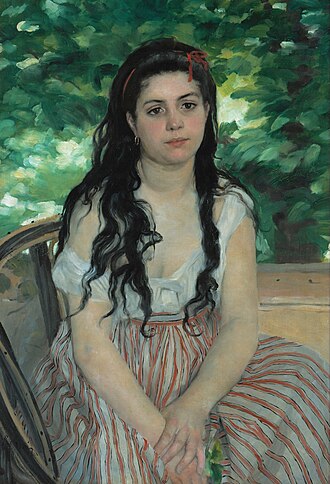 En verano - Pierre-Auguste Renoir (1868)
Obras de artistas relacionados
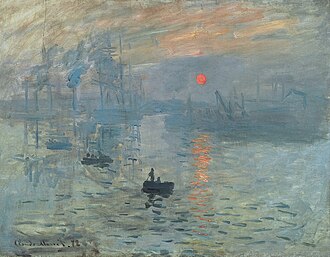 Impresión, sol naciente - Claude Monet (1872)
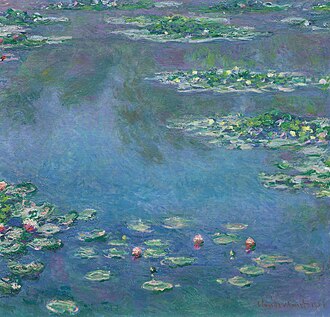 Nenúfares - Claude Monet (1906)
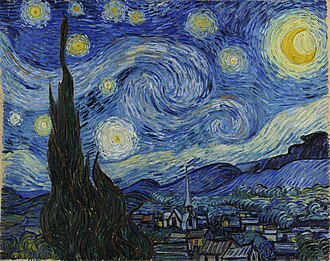 La noche estrellada - Vincent van Gogh (1889)
.jpg) Terraza de café por la noche - Vincent van Gogh (1888)
Terraza de café por la noche - Vincent van Gogh (1888)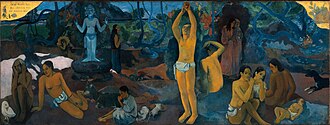 ¿De dónde venimos? ¿Qué somos? ¿Adónde vamos? - Paul Gauguin (1897-1898)
%201889.jpg) El Cristo amarillo - Paul Gauguin (1889)
El Cristo amarillo - Paul Gauguin (1889)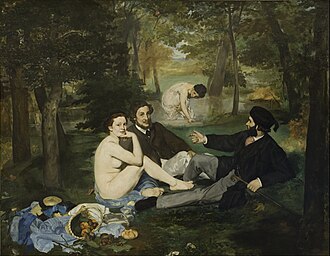 Almuerzo sobre la hierba - Édouard Manet (1863)
 Olympia - Édouard Manet (1863)