Calle de Paris, dia de lluvia
Gustave Caillebotte · 1877
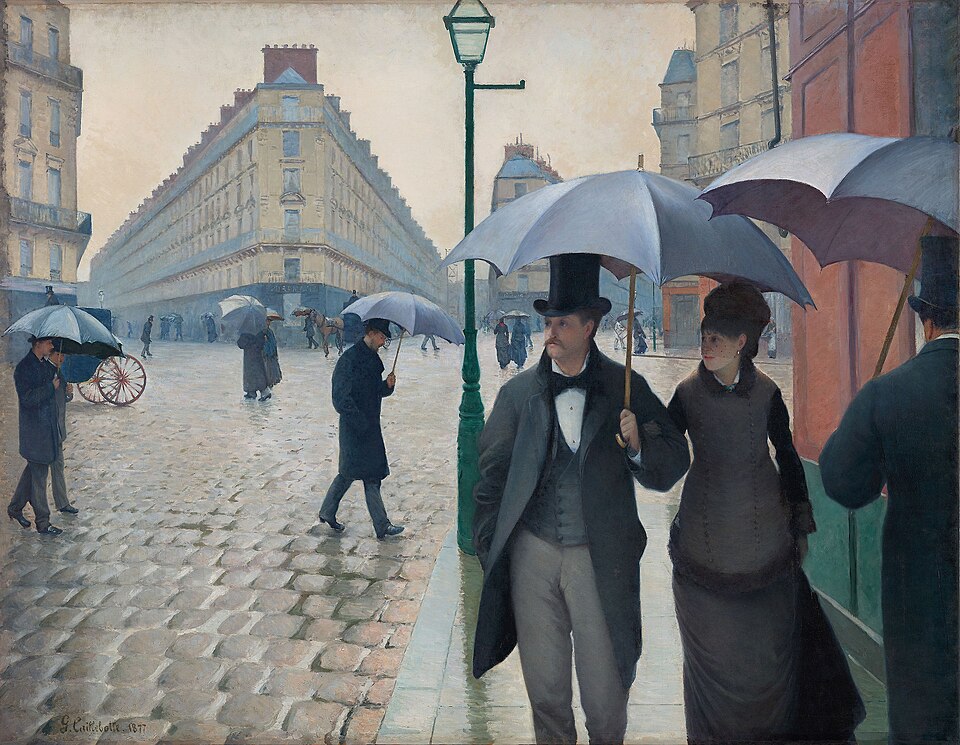
Umbrellas glisten over wet paving stones as a well-dressed couple walk towards you, eyes fixed on something you cannot see. Caillebotte painted this huge rainy crossroads of the new Paris in 1877, and it remains the best known of his city views.
The story behind the painting
Caillebotte, born in Paris in 1848 into a wealthy family, was close to the Impressionists and from 1877 used his inheritance to help fund their exhibitions. He grew up amid Haussmann's rebuilding of Paris under Napoleon III: parks, squares and about 137 km of boulevards, at the cost of displacing thousands of mostly working class residents. His family's mansion stood in the eighth arrondissement. For this painting he made 23 surviving studies in graphite and oil. Most scholars believe he used photography in some way, but a 2015 report by the Art Institute of Chicago concluded he more likely used a camera lucida.
What to look for
The canvas is about 212 by 276 cm, almost life-size. It shows the crossing of the Rue de Turin, Rue de Moscou, Rue Clapeyron and Rue de Saint-Pétersbourg, today's Place de Dublin. Twenty-four people in winter clothes cross the square, mostly bourgeois; a maid, two cab drivers and a house painter with a ladder are pushed to the back. In front, a man in a top hat, his coat open, and a woman in a brown wool gown with fur trim, a veil and an earring share one umbrella. They are the only figures who touch. The finish is smooth and precise, unlike typical Impressionist painting.
Meaning and intent
The painting is a portrait of modernity, of the new neighbourhoods around the Gare Saint-Lazare. The art historian Mary Morton sees in the foreground couple the impassivity, propriety and entitlement of Haussmann's Paris. The man is the classic flâneur, an idle stroller. Linear perspective and colour build a deep space, but the city it describes feels austere, even hostile to human contact: people pass each other under their umbrellas, each alone. The Art Institute's catalogue calls such pictures readily understandable images of upper-middle-class residents.
Legacy
Shown at the Third Impressionist Exhibition in April 1877, it was widely praised for its precision. Then it vanished from public view until a retrospective in 1894. Caillebotte left it to his youngest brother Martial, and it stayed obscure in the family before being sold to collectors in the mid-20th century. The Art Institute of Chicago acquired it in 1964, which accelerated a revival of Caillebotte's reputation. It has been restored, in 1964 and again after a 2012 to 2013 exhibition, removing the effects of a deteriorating early 1900s varnish.
¿Sabías que…?
- Painted in 1877; about 212 by 276 cm.
- Shown at the Third Impressionist Exhibition, April 1877.
- Set at today's Place de Dublin, Paris.
- Acquired by the Art Institute of Chicago in 1964.
Sobre el artista
Gustave Caillebotte (1848-1894)
mujer · varón · impresionismo · paisaje urbano · Instituto de Arte de Chicago · lluvia
Más obras de Gustave Caillebotte
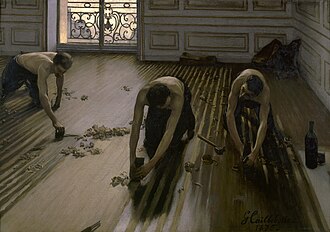 Los acuchilladores de parqué - Gustave Caillebotte (1875)
%20-%20Google%20Art%20Project.jpg) Vista sobre los techos, efecto de nieve - Gustave Caillebotte (1878)
Vista sobre los techos, efecto de nieve - Gustave Caillebotte (1878)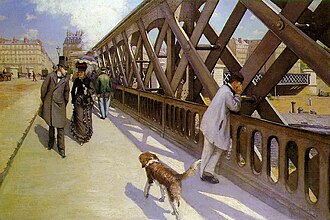 El puente de Europa - Gustave Caillebotte (1876)
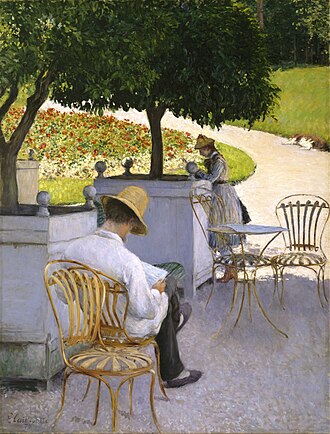 Los naranjos - Gustave Caillebotte (1878)
.jpg) Hombre joven en la ventana - Gustave Caillebotte (1876)
Hombre joven en la ventana - Gustave Caillebotte (1876)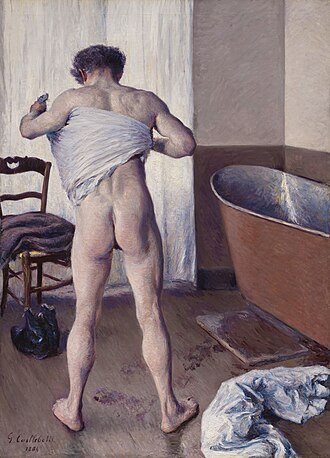 Hombre en el baño - Gustave Caillebotte (1884)
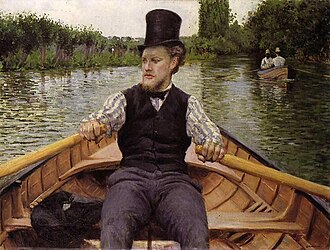 La partida del bote - Gustave Caillebotte (1878)
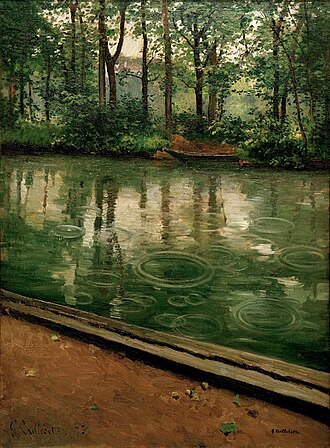 El Yerres, lluvia - Gustave Caillebotte (1875)
Obras de artistas relacionados
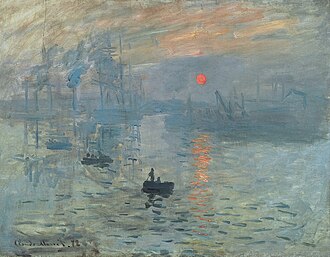 Impresión, sol naciente - Claude Monet (1872)
 Nenúfares - Claude Monet (1906)
 Almuerzo sobre la hierba - Édouard Manet (1863)
 Olympia - Édouard Manet (1863)
 Baile en el Moulin de la Galette - Pierre-Auguste Renoir (1876)
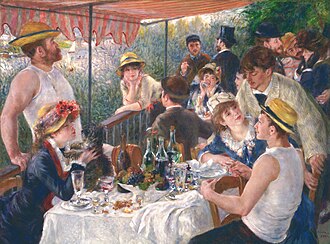 El almuerzo de los remeros - Pierre-Auguste Renoir (1881)
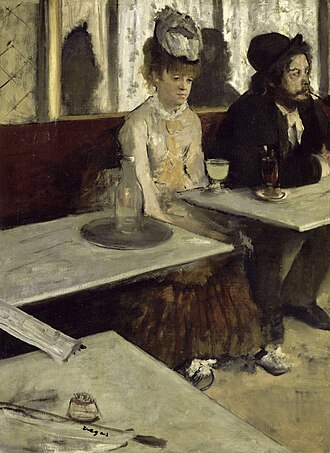 El ajenjo - Edgar Degas (1875)
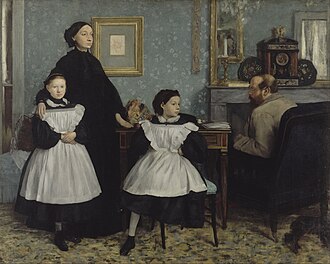 Die Bellelli Familie - Edgar Degas (1858)
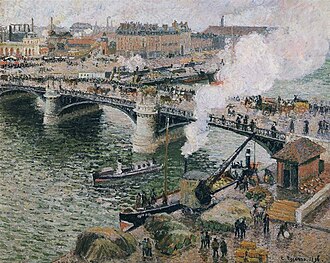 Pont Boieldieu in Rouen, Rainy Weather - Camille Pissarro (1896)
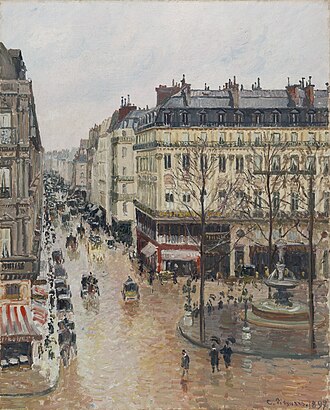 Rue Saint-Honoré por la tarde. Efecto de lluvia. - Camille Pissarro (1897)
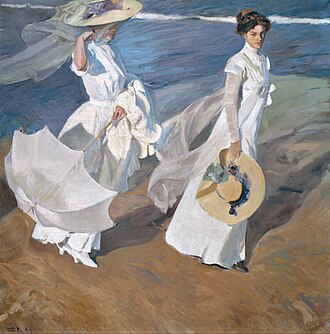 Paseo a orillas del mar - Joaquín Sorolla (1909)
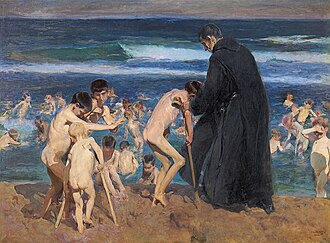 Triste herencia - Joaquín Sorolla (1898)