La cuna
Berthe Morisot · 1872
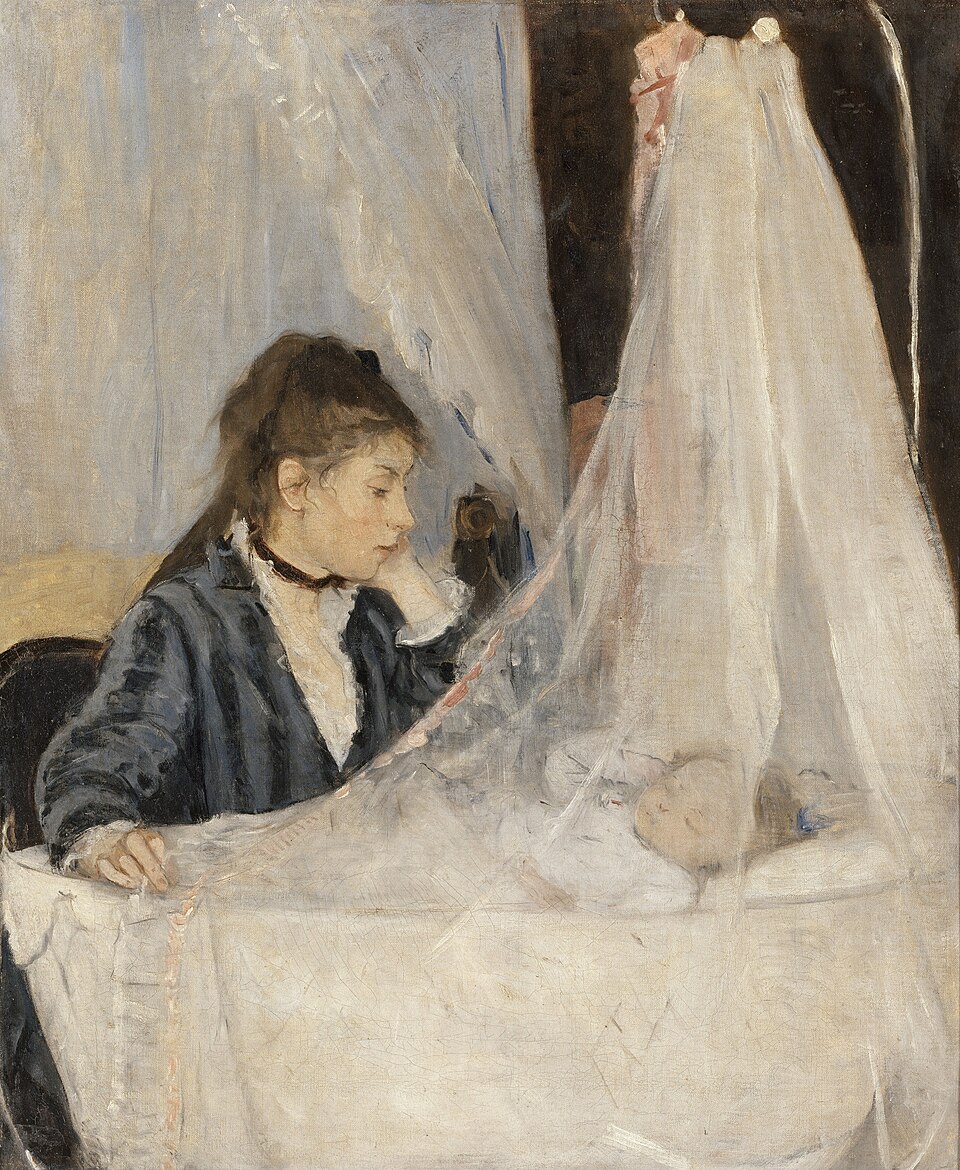
A young mother rests her chin on her hand and watches her baby sleep behind a veil of white muslin. Berthe Morisot painted her own sister and niece in 1872, and two years later hung the picture in the first Impressionist exhibition.
The story behind the painting
Morisot painted her sister Edma watching over her sleeping daughter Blanche. It was shown for the first time at the First Impressionist Exhibition, which opened on 15 April 1874 in the former studio of the photographer Nadar on the Boulevard des Capucines in Paris. Some critics praised its grace and beauty, but it drew little interest and did not sell. Morisot had set its price herself, but no buyer came, so the painting stayed with her family for decades.
What to look for
The composition rests on a diagonal formed by the mother's gaze toward her daughter and the fabric of the cradle. Her bent left arm strengthens it, and the baby's small bent arm answers it. Morisot uses few colours and a fluid brushstroke. Wikidata gives the size as 56 by 46.5 cm. The mother leans in on one side of the cradle, the sleeping child lies on the other, and the soft white curtain between them both connects and shelters, giving the scene its quiet, protective feeling.
Meaning and intent
This is the first time motherhood appears in Morisot's work, a theme she returned to often. The canvas shows the influence of Édouard Manet, whom she met at the Louvre in 1868 and whose brother Eugène she married in 1874. Its atmosphere is one of intimacy, sweetness and protective love, and with works such as Claude Monet's Jean Monet in his Cradle (1867) it seeks a new image of childhood. Dominique Lobstein notes that its simple title drops anecdote, inviting viewers to see it as part of their own daily life.
Legacy
The painting stayed in the family and passed to Blanche, the niece who was the sleeping baby. In 1930 the Louvre acquired it. From 1947 to 1986 it hung at the Jeu de Paume, where the Louvre gathered the major Impressionist works, and after the Musée d'Orsay was created it moved there, where it is on display today. The sleeping baby in the picture grew up to be the one who kept it for many years in the family.
¿Sabías que…?
- Painted in 1872; the models are Morisot's sister Edma and niece Blanche.
- Shown at the First Impressionist Exhibition in 1874.
- Morisot's first painting on the theme of motherhood.
- Acquired by the Louvre in 1930; now at the Musée d'Orsay.
Sobre el artista
Berthe Morisot (1841-1895)
retrato · escena de género · Departamento de Pinturas del Museo del Louvre · Museo de Orsay · impresionismo · madre · Edma Morisot
Más obras de Berthe Morisot
 Summer's Day - Berthe Morisot (1879)
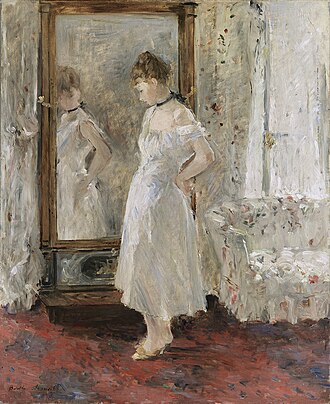 El espejo de vestir - Berthe Morisot (1876)
 The Port at Lorient - Berthe Morisot (1869)
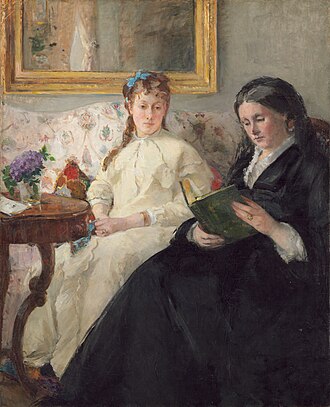 La hermana y la madre de la artista - Berthe Morisot
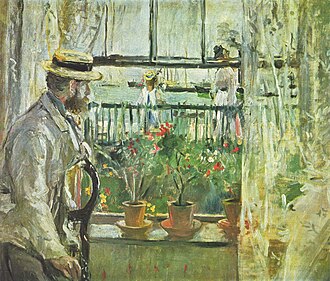 Eugène Manet on Isle of Wight - Berthe Morisot (1875)
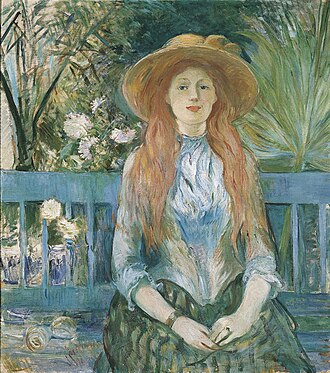 Young girl in a park - Berthe Morisot (1893)
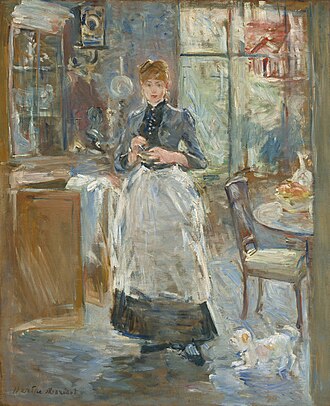 In the Dining Room - Berthe Morisot (1886)
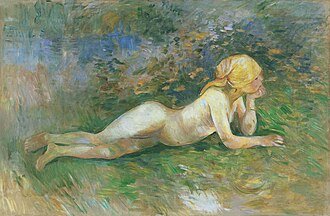 Pastora desnuda tumbada - Berthe Morisot (1891)
Obras de artistas relacionados
 Impresión, sol naciente - Claude Monet (1872)
 Nenúfares - Claude Monet (1906)
 Almuerzo sobre la hierba - Édouard Manet (1863)
 Olympia - Édouard Manet (1863)
 Baile en el Moulin de la Galette - Pierre-Auguste Renoir (1876)
 El almuerzo de los remeros - Pierre-Auguste Renoir (1881)
 El ajenjo - Edgar Degas (1875)
 Die Bellelli Familie - Edgar Degas (1858)
 El canal del Loing - Alfred Sisley (1892)
 The Watering Pond at Marly with Hoarfrost - Alfred Sisley (1876)
 Calle de Paris, dia de lluvia - Gustave Caillebotte (1877)
 Los acuchilladores de parqué - Gustave Caillebotte (1875)