Baile en el campo
Pierre-Auguste Renoir · 1883
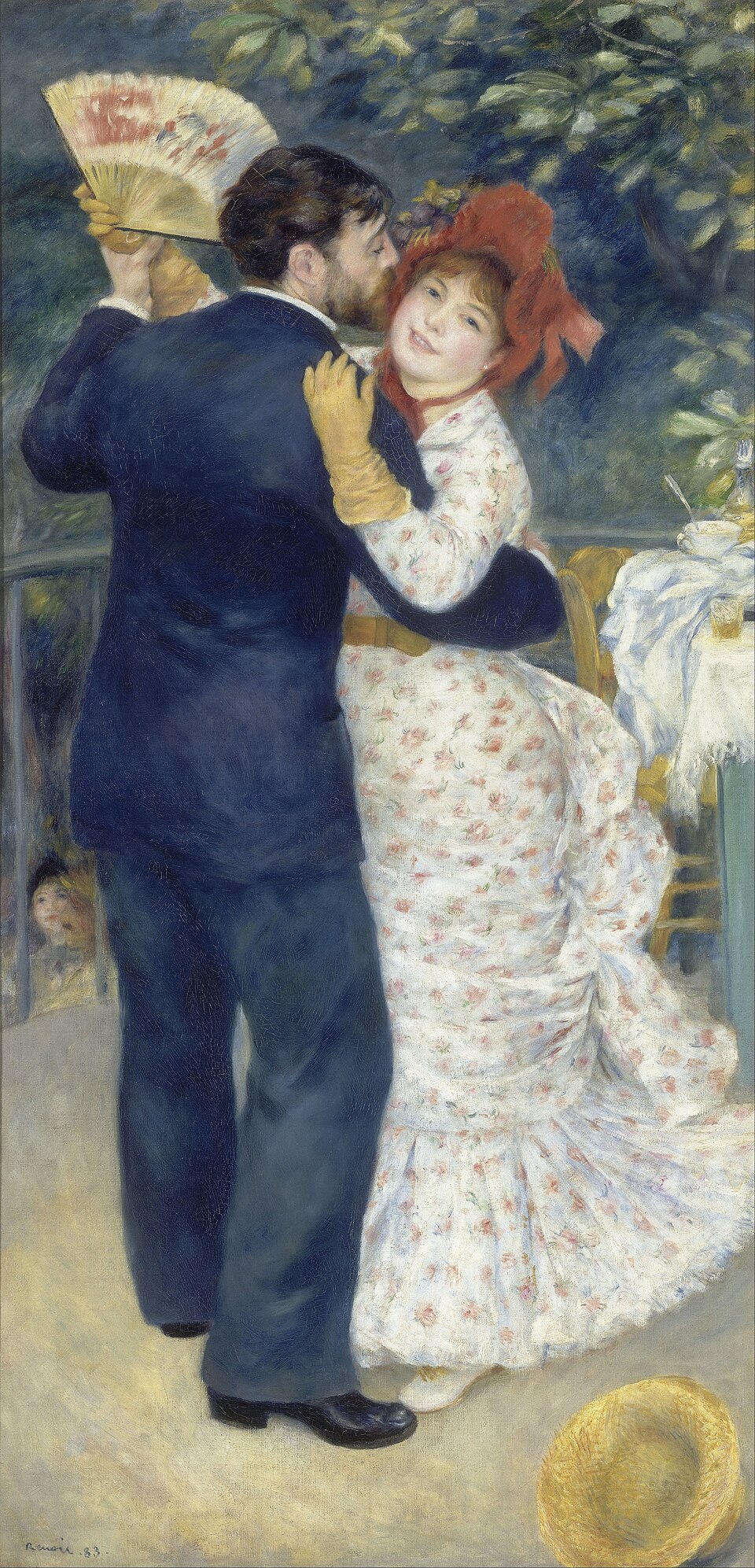
A woman laughs toward us over her partner's shoulder, fan in hand, red hat bright under a chestnut tree. Renoir painted this happy dance in 1883, and the woman was Aline Charigot, who would later become his wife.
The story behind the painting
In 1882 the dealer Paul Durand-Ruel commissioned works from Renoir on the theme of the ball. Renoir answered with three paintings in 1883: this one, Dance in the City and Dance at Bougival. Durand-Ruel first exhibited Dance in the Country in April 1883, bought it in 1886, and kept it until Renoir's death in 1919. The ball was a theme the dealer clearly believed in, and Renoir gave him three couples, each in a different setting.
What to look for
A couple dances under a chestnut tree, both figures life-size, filling almost the whole canvas of about 180 by 90 cm. Look past them for small details: a table in the background on the right, a hat dropped on the ground, and a pair of faces below the level of the dance floor. The woman holds a fan in her right hand and smiles straight at the viewer. Her clothes glow with warm colours, yellow gloves and a red hat, and the whole scene is bathed in bright, cheerful light.
Meaning and intent
The dancers are real people from Renoir's life: the man is his friend Paul Lhôte, the woman Aline Charigot. The picture follows Renoir's trip to Italy in 1881, where he found inspiration in Raphael, and it marks the moment when he was trying to break away from Impressionism. The warm, open joy of the country dance stands beside the formal ball of its companion piece, Dance in the City. Here the dance is personal.
Legacy
Durand-Ruel held on to the painting for decades, until Renoir's death in 1919. Today it hangs in the Musée d'Orsay in Paris. Its two companion pieces, Dance in the City and Dance at Bougival, also show a couple dancing, so the three are best understood as one set of variations on the same dance. Wikidata confirms the date of 1883 given by Wikipedia. Seen together, they show how one theme could carry very different moods.
¿Sabías que…?
- Commissioned by Paul Durand-Ruel in 1882 on the theme of the ball.
- Painted in 1883 and first shown in April 1883.
- The dancers are Paul Lhôte and Aline Charigot, Renoir's future wife.
- Kept at the Musée d'Orsay in Paris.
Sobre el artista
Pierre-Auguste Renoir (1841-1919)
mujer · varón · escena de género · Museo de Orsay · sombrero · planifolio · abanico · guante · danza folclórica · fiesta de baile
Más obras de Pierre-Auguste Renoir
 Baile en el Moulin de la Galette - Pierre-Auguste Renoir (1876)
 El almuerzo de los remeros - Pierre-Auguste Renoir (1881)
 El columpio - Pierre-Auguste Renoir (1876)
 Las grandes bañistas - Pierre-Auguste Renoir (1884)
 Muchachas al piano - Pierre-Auguste Renoir (1892)
 Los paraguas - Pierre-Auguste Renoir (1880s)
%20(46499625955).jpg) El palco - Pierre-Auguste Renoir (1874)
El palco - Pierre-Auguste Renoir (1874)%20-%201933.455%20-%20Art%20Institute%20of%20Chicago.jpg) En la terraza - Pierre-Auguste Renoir (1881)
En la terraza - Pierre-Auguste Renoir (1881)
Obras de artistas relacionados
 Impresión, sol naciente - Claude Monet (1872)
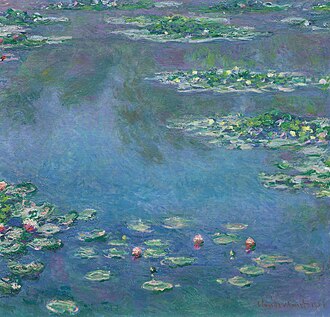 Nenúfares - Claude Monet (1906)
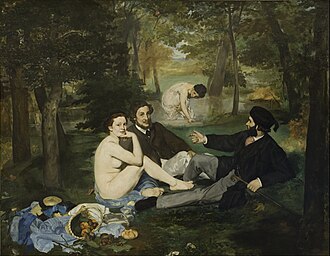 Almuerzo sobre la hierba - Édouard Manet (1863)
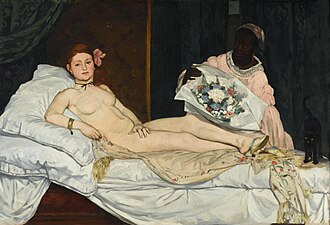 Olympia - Édouard Manet (1863)
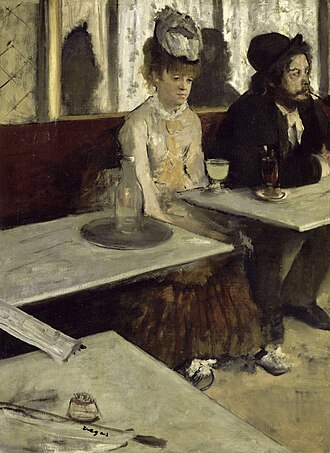 El ajenjo - Edgar Degas (1875)
 Die Bellelli Familie - Edgar Degas (1858)
 La noche estrellada - Vincent van Gogh (1889)
.jpg) Terraza de café por la noche - Vincent van Gogh (1888)
Terraza de café por la noche - Vincent van Gogh (1888) El Temerario remolcado - J. M. W. Turner (1839)
 Lluvia, vapor y velocidad. El gran ferrocarril del Oeste - J. M. W. Turner (1844)
 ¿De dónde venimos? ¿Qué somos? ¿Adónde vamos? - Paul Gauguin (1897-1898)
%201889.jpg) El Cristo amarillo - Paul Gauguin (1889)
El Cristo amarillo - Paul Gauguin (1889)