Ruggiero Rescuing Angelica
Jean Auguste Dominique Ingres · 1819
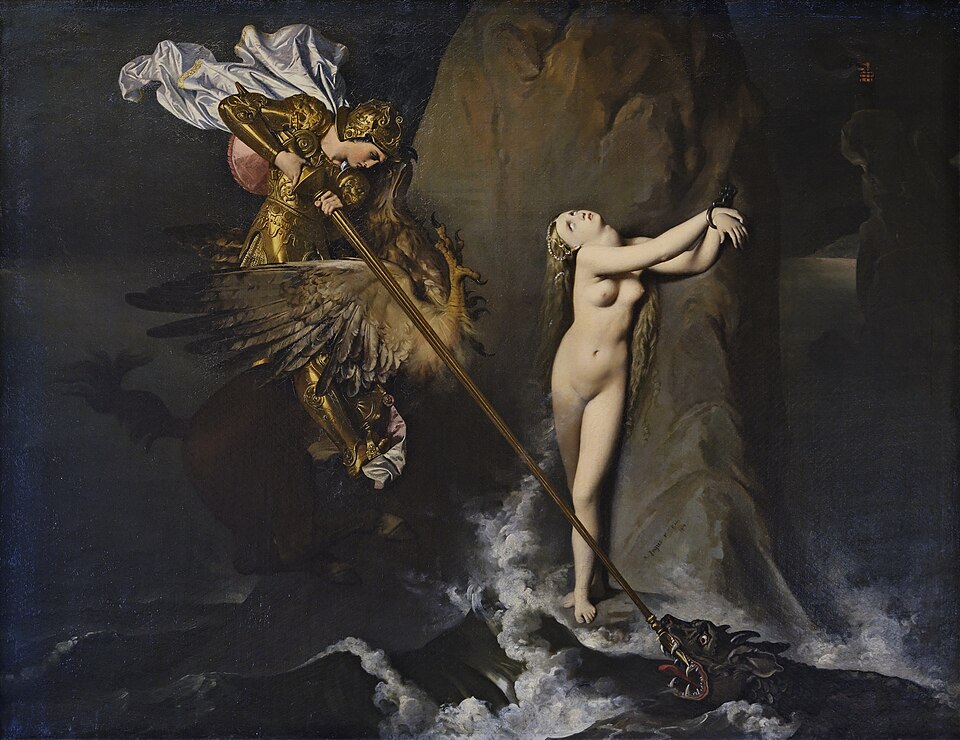
A knight on a hippogriff drives his lance into a sea monster while a pale, chained woman twists on the rock beside him. Critics mocked Angelica's neck in 1819, yet this was the first Ingres to enter a public collection.
The story behind the painting
The story comes from Orlando Furioso, Ariosto's 16th-century epic poem. The knight Roger, riding a hippogriff, half horse and half eagle, flies near the coast of Brittany and sees Angelica chained to a rock on the Isle of Tears. Barbarians have abducted her, stripped her and left her as a sacrifice to a sea monster. As the water churns with the approaching beast, Roger drives his lance between its eyes and frees her. The tale is a variant of the Greek myth of Perseus and Andromeda. Ingres received the commission in 1817 and finished the painting in 1819.
What to look for
Angelica stands bound to the rock, her pale body arched, while Roger rushes in from above on his winged mount and strikes downward at the monster. Ingres worked with his usual care, and many preparatory drawings for the whole composition and for single figures survive. Look at Angelica's throat and neck: this is exactly what critics seized on, the historian Théophile Silvestre calling her Angelica with goitres, the painter Henry de Waroquier triple-breasted Angelica. On size, the sources differ: Wikipedia gives 147 by 199 cm, while Wikidata gives 147 by 190 cm.
Meaning and intent
Ingres shows a single, frozen instant between terror and rescue, with the helpless nude and the armoured hero set against each other. He was drawn to this scene more than once: in the same year he painted Perseus and Andromeda, now in Detroit, which also has a nude woman chained to a rock and a hero slaying a sea monster. The Louvre painting was shown at the Salon of 1819 next to his Grande Odalisque, and both drew criticism for how they treated the female body.
Legacy
The Comte de Blacas, French ambassador to the Vatican, acquired the painting for King Louis XVIII. It hung above a doorway in the throne room at Versailles from 1820 to 1823 before moving to the Musée du Luxembourg, making it Ingres' first painting in a public collection. He later painted several variants, none known to be commissioned: a smaller vertical copy made before 1839, which Edgar Degas bought in 1894 and which is now in the National Gallery, London; an oval replica of 1841 in the Musée Ingres; and an oval of 1859 where only Roger's shield remains.
¿Sabías que…?
- Inspired by Ariosto's Orlando Furioso.
- Commissioned in 1817, completed in 1819.
- Shown at the Salon of 1819 beside the Grande Odalisque.
- Ingres' first painting to enter a public collection.
Sobre el artista
Jean Auguste Dominique Ingres (1780-1867)
mujer · Departamento de Pinturas del Museo del Louvre · desnudo · neoclasicismo · desnudo · pintura de historia · armadura · lanza · hombre vestido, mujer desnuda
Más obras de Jean Auguste Dominique Ingres
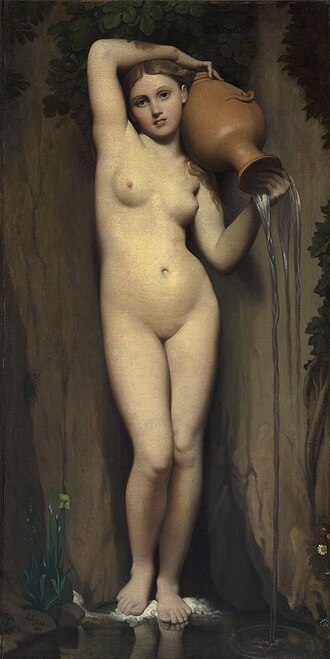 La fuente - Jean-Auguste-Dominique Ingres (1856)
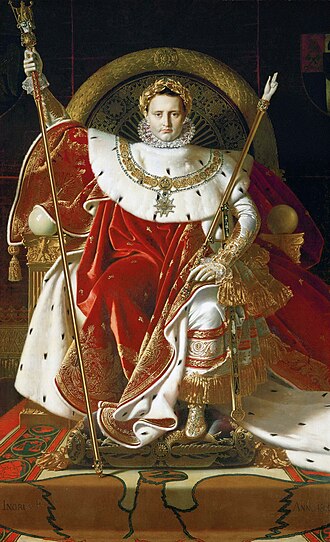 Napoleón en su trono imperial - Jean-Auguste-Dominique Ingres (1806)
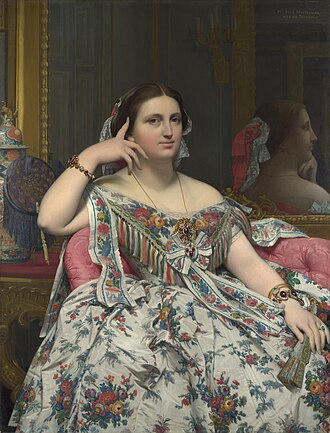 Madame Moitessier - Jean-Auguste-Dominique Ingres (1856)
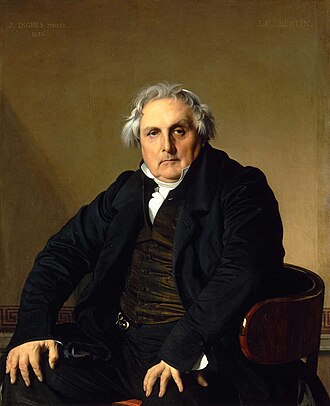 Monsieur Bertin - Jean-Auguste-Dominique Ingres (1832)
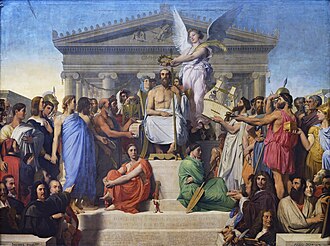 La apoteosis de Homero - Jean-Auguste-Dominique Ingres (1827)
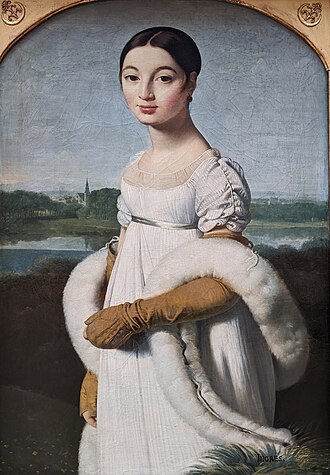 Mademoiselle Caroline Rivière - Jean-Auguste-Dominique Ingres (1806)
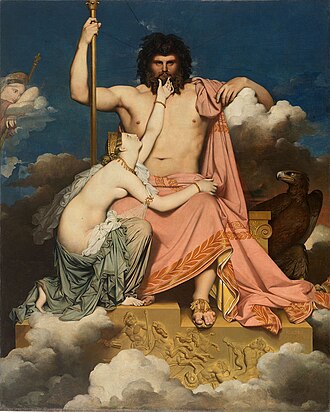 Júpiter y Tetis - Jean-Auguste-Dominique Ingres (1811)
 The Death of Leonardo da Vinci - Jean-Auguste-Dominique Ingres (1818)
Obras de artistas relacionados
 Juramento de los Horacios - Jacques-Louis David (1784)
.jpg) La intervención de las sabinas - Jacques-Louis David (1799)
La intervención de las sabinas - Jacques-Louis David (1799) El tres de mayo de 1808 - Francisco Goya (1814)
.jpg) La Maja desnuda - Francisco Goya (1800)
La Maja desnuda - Francisco Goya (1800)