Portrait of Jan Six
Rembrandt van Rijn · 1654
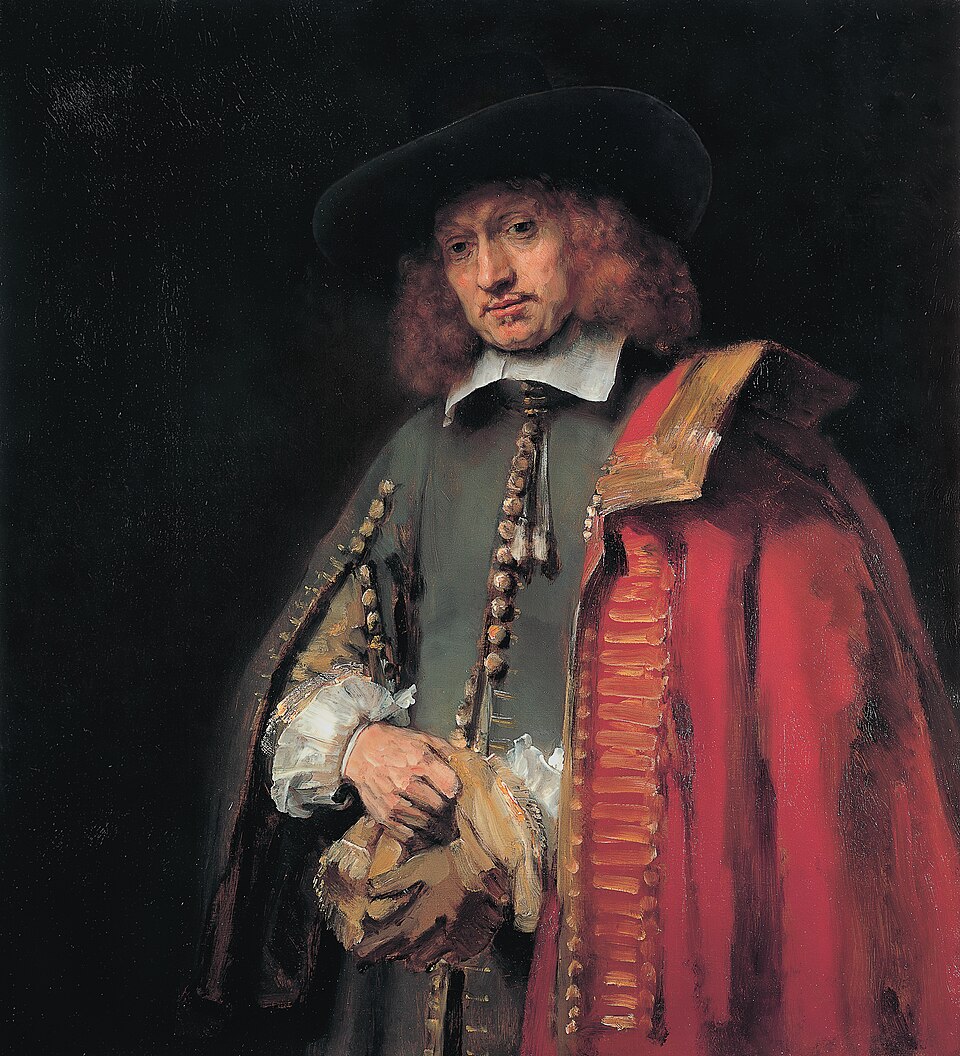
A man pauses on his way out, pulling on a glove, a red cloak slung over his shoulder. Rembrandt painted his friend Jan Six in 1654, and the picture has never left the family: it still hangs with his descendants in Amsterdam.
The story behind the painting
Portrait of Jan Six is a 1654 oil on canvas by Rembrandt van Rijn of Jan Six, who lived from 1618 to 1700. It was painted for the sitter himself and has been handed down through many generations of his direct descendants, so it remains in the Six Collection in Amsterdam. The date is known from a Latin couplet written by Jan Six himself, in which certain letters are capitals; added together as Roman numerals, M, D, L, X, V and I, they give the year 1654.
What to look for
The figure is more than half-length and life size, on a canvas of about 112 by 102 cm. Six stands facing us, turned slightly to the left, his head tilted a little toward his right shoulder, and looks straight out. He is about to go out: his large black felt hat sits on long reddish fair hair, and with his right hand, holding one glove, he draws the other onto his left hand. He wears a light grey coat with yellow buttons, and a short bright red cloak trimmed with gold lace hangs from his left shoulder. Light falls from the upper left against a dark grey background.
Meaning and intent
Hofstede de Groot, cataloguing the painting in 1915, explained why it feels so free. By then Rembrandt had become one of the most famous painters of his century, and sitters had to plead to be painted. He could set his own terms: light his models as he found most beautiful, dress them to suit their character, choose the pose and decide how finished the work would be. Freed from those constraints, he no longer aimed at an exact likeness, and the result is a portrait of a moment and a mood.
Legacy
Among the masterpieces of that freedom, Hofstede de Groot named portraits of married couples in the Duke of Westminster's collection and in the Metropolitan Museum, and the Nicolaes Bruyningh in Kassel, but above all the Jan Six, which he called perhaps the finest and most expressive of all. The painting was exhibited in Amsterdam in 1872 and 1900, engraved by J. W. Kaiser and etched by several artists. Still in private family hands after more than three and a half centuries, it is a rare portrait that never left home.
¿Sabías que…?
- Painted by Rembrandt in 1654.
- The date is hidden in a Latin couplet by Jan Six.
- Shown pulling on a glove, about to go out.
- Still owned by the sitter's descendants in Amsterdam.
Sobre el artista
Rembrandt van Rijn (1606-1669)
retrato · pintura del Siglo de oro neerlandés
Más obras de Rembrandt van Rijn
 La ronda de noche - Rembrandt van Rijn (1642)
 Autorretrato - Rembrandt van Rijn (1659)
 Lección de anatomía del Dr. Nicolaes Tulp - Rembrandt van Rijn (1632)
 La novia judía - Rembrandt van Rijn (1660s)
 La tormenta en el mar de Galilea - Rembrandt van Rijn (1633)
 El retorno del hijo pródigo - Rembrandt van Rijn (1668)
 Dánae - Rembrandt van Rijn (1636)
 Banquete de Belsasar - Rembrandt van Rijn (1636)
Obras de artistas relacionados
 La joven de la perla - Johannes Vermeer (1665)
 La lechera - Johannes Vermeer (c. 1658)
 La fiesta de San Nicolás - Jan Steen (1660s)
 Joven comiendo ostras - Jan Steen (1658)
 El alegre bebedor - Frans Hals (1620s)
 Caballero sonriente - Frans Hals (1624)
 El molino de Wijk bij Duurstede - Jacob van Ruisdael (1670)
 El cementerio judío - Jacob van Ruisdael (1650s)
 Patio de una casa de Delft - Pieter de Hooch (1658)
 Mujer pelando manzanas - Pieter de Hooch (1663)