El constructor naval y su esposa
Rembrandt van Rijn · 1633
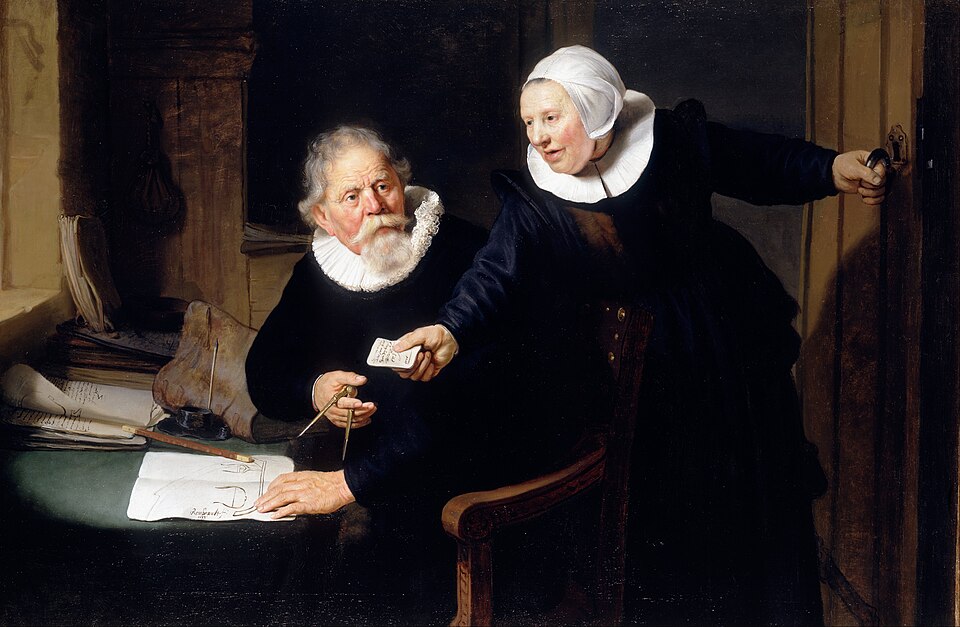
A wife bursts into the room with a note, and her shipbuilder husband looks up from his drawings, compasses still in hand. In 1633 Rembrandt turned the usual pair of stiff marriage portraits into one living moment.
The story behind the painting
The sitters were identified in 1970 as Jan Rijcksen, born in 1560 or 1562 and died in 1637, and his wife Griet Jans. Rijcksen was a shareholder in the Dutch East India Company and became its master shipbuilder in 1620. Rembrandt painted them in 1633, when he was still young but already a fashionable portrait painter, skilled at the surfaces of wood, leather, skin and hair. The painting is also known as The Shipbuilder and his Wife, and is among the best documented of all his works.
What to look for
Rijcksen sits at a desk where he has been drawing ship designs, holding a pair of compasses. His wife has just come in to hand him a written note, and the letter is addressed to Jan ryensz, as spelled in the picture. Look closely at the drawing of a ship on the desk: it carries Rembrandt's signature and the date 1633. The canvas is wide, 113.8 by 169.8 cm, but it may once have been larger, since an etching dated 1800 shows more space above the two heads.
Meaning and intent
Rather than painting two separate portraits of husband and wife, as in his more typical Portrait of a Man Rising from His Chair and Portrait of a Young Woman with a Fan, Rembrandt joined them in one double portrait in which they interact. The result feels like a scene caught in passing, a working life and a long marriage shown in one gesture. Its intense effect is even noted in Zadie Smith's 2005 novel On Beauty, carrying the couple into modern fiction.
Legacy
The painting was recorded in the estate of the couple's son Cornelis Jansz. Reijckx at his death in November 1659, then at two Amsterdam sales, from Jan Gildemeester's collection to Pieter de Smeth in June 1800 and again in August 1810. It was brought to England and bought at Christie's in London in 1811 by the Prince Regent, later King George IV. It has remained in the Royal Collection ever since, and was restored by Karen Ashworth for the collection.
¿Sabías que…?
- Painted by Rembrandt in 1633.
- Rijcksen became the Dutch East India Company's master shipbuilder in 1620.
- Sitters identified in 1970.
- In the Royal Collection since 1811.
Sobre el artista
Rembrandt van Rijn (1606-1669)
Más obras de Rembrandt van Rijn
 La ronda de noche - Rembrandt van Rijn (1642)
 Autorretrato - Rembrandt van Rijn (1659)
 Lección de anatomía del Dr. Nicolaes Tulp - Rembrandt van Rijn (1632)
 La novia judía - Rembrandt van Rijn (1660s)
 La tormenta en el mar de Galilea - Rembrandt van Rijn (1633)
 El retorno del hijo pródigo - Rembrandt van Rijn (1668)
 Dánae - Rembrandt van Rijn (1636)
 Banquete de Belsasar - Rembrandt van Rijn (1636)
Obras de artistas relacionados
 La joven de la perla - Johannes Vermeer (1665)
 La lechera - Johannes Vermeer (c. 1658)
 La fiesta de San Nicolás - Jan Steen (1660s)
 Joven comiendo ostras - Jan Steen (1658)
 El alegre bebedor - Frans Hals (1620s)
 Caballero sonriente - Frans Hals (1624)
 El molino de Wijk bij Duurstede - Jacob van Ruisdael (1670)
 El cementerio judío - Jacob van Ruisdael (1650s)
 Patio de una casa de Delft - Pieter de Hooch (1658)
 Mujer pelando manzanas - Pieter de Hooch (1663)