Retrato del Conde Nicolai Guryev
Jean Auguste Dominique Ingres · 1821
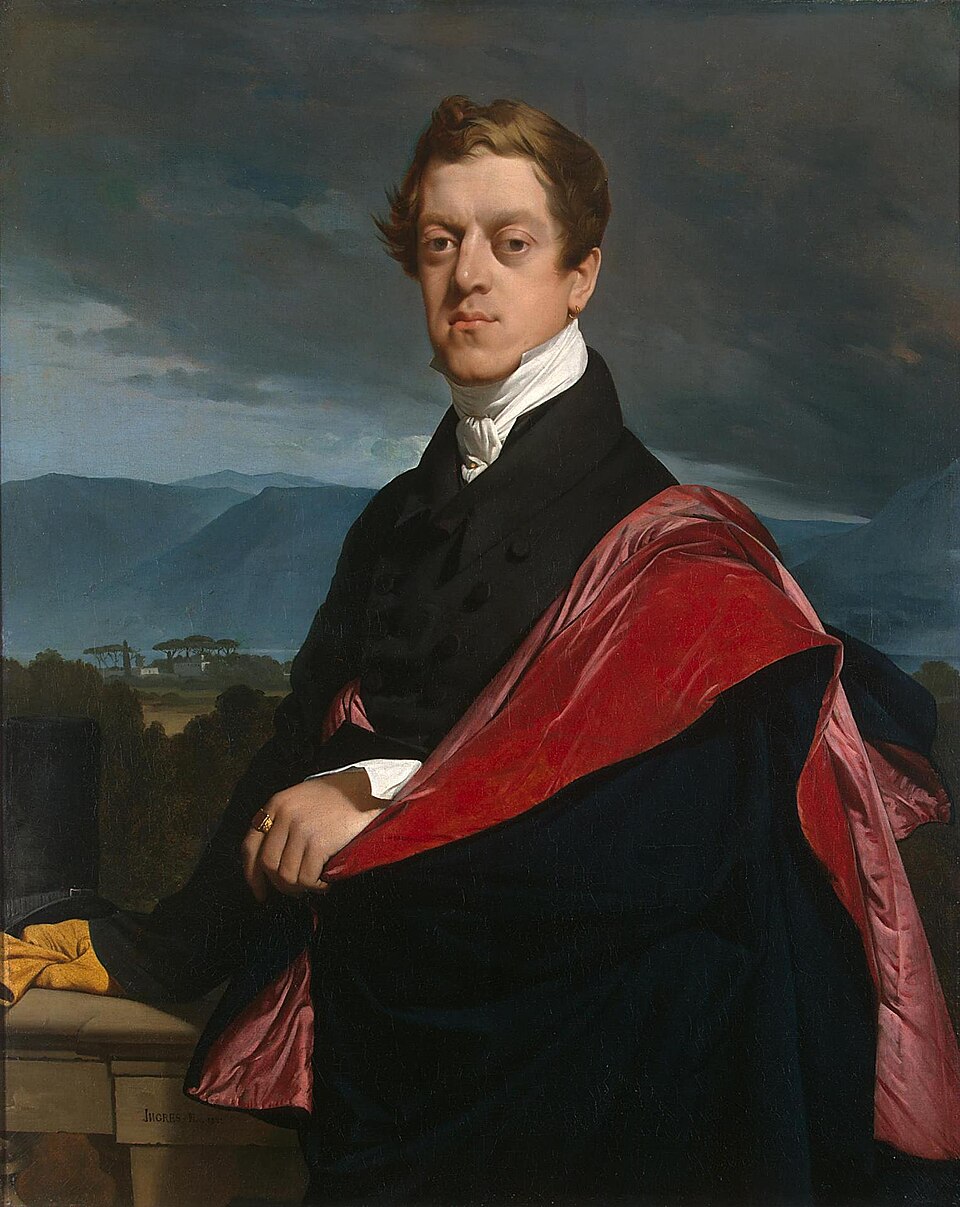
A Russian count leans on a balustrade in Italy, stiff in black, a crimson lining and a pink scarf flaring at his side, a storm gathering behind him. Ingres painted him in Florence in 1821, as one half of a contest with a rival painter.
The story behind the painting
Count Nikolay Dmitrievich Guryev was the son of Dmitry Guryev, finance minister to Tsar Alexander I. He fought in the Russian Imperial Guard from 1810 to 1814 against Napoleon, including the Russian campaign, left the army as a colonel in 1816, and became the tsar's aide-de-camp in 1818. At the end of 1821 he entered diplomacy, serving in The Hague, Naples and Rome. On his honeymoon in Rome and Florence he commissioned artists, including a bust of his wife by Lorenzo Bartolini, Ingres's friend.
What to look for
The count is shown half length, three-quarters to the left, leaning on a balustrade. Behind him is an Italian landscape with umbrella pines and hills under a stormy sky. He wears a black jacket and a black coat whose crimson lining, with a pink scarf, creates in Robert Rosenblum's words a barrier between viewer and sitter. His left hand holds the edge of his coat, his right a chamois glove, and his black top hat sits on the balustrade. His stiff head rises from a white collar and scarf; he has a firm chin and a slight squint.
Meaning and intent
The portrait belongs to Ingres's Tuscan period, 1820 to 1824, between the portrait of Jeanne Gonin and those of the Leblanc couple. Ingres had moved to Florence at Bartolini's invitation, but these were hard years: fewer tourists ordered portraits than in Rome, money was short, and the painter François-Xavier Fabre, already established in Florence, was a rival who may have caused some of his troubles. Guryev ordered his own portrait from Ingres while ordering his wife's from Fabre, at the same size, to make a matching pair.
Legacy
In the end, Guryev refused Fabre's portrait of the countess, finding its composition stiff and frozen. The count kept Ingres's painting until his death in 1849. It then passed to his widow until 1871, and to members of the Naryshkin family until 1922, when it entered the Hermitage Museum as inventory 5678. It is signed Ingres Fl. 1821, for Florence, carved at lower left on the parapet. It measures 107 by 86 cm.
¿Sabías que…?
- Painted in Florence in 1821.
- The sitter was a Russian officer and later diplomat.
- Commissioned in competition with a portrait of his wife by Fabre.
- In the Hermitage Museum since 1922.
Sobre el artista
Jean Auguste Dominique Ingres (1780-1867)
retrato · neoclasicismo · Museo del Hermitage · sombrero · nube · capote · banda · chaqueta
Más obras de Jean Auguste Dominique Ingres
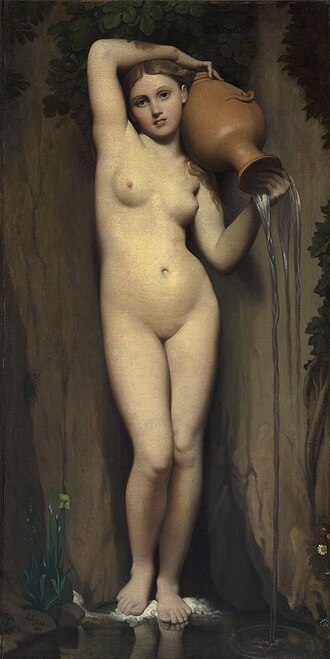 La fuente - Jean-Auguste-Dominique Ingres (1856)
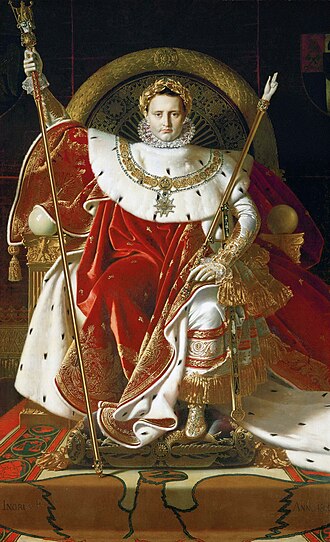 Napoleón en su trono imperial - Jean-Auguste-Dominique Ingres (1806)
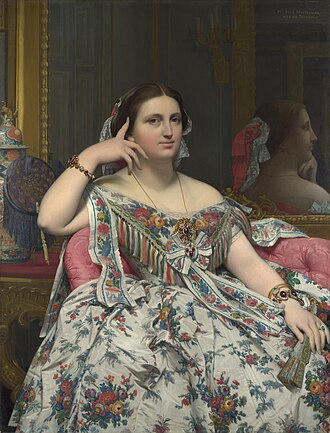 Madame Moitessier - Jean-Auguste-Dominique Ingres (1856)
 Monsieur Bertin - Jean-Auguste-Dominique Ingres (1832)
 La apoteosis de Homero - Jean-Auguste-Dominique Ingres (1827)
 Mademoiselle Caroline Rivière - Jean-Auguste-Dominique Ingres (1806)
 Júpiter y Tetis - Jean-Auguste-Dominique Ingres (1811)
 The Death of Leonardo da Vinci - Jean-Auguste-Dominique Ingres (1818)
Obras de artistas relacionados
 Juramento de los Horacios - Jacques-Louis David (1784)
.jpg) La intervención de las sabinas - Jacques-Louis David (1799)
La intervención de las sabinas - Jacques-Louis David (1799) El tres de mayo de 1808 - Francisco Goya (1814)
.jpg) La Maja desnuda - Francisco Goya (1800)
La Maja desnuda - Francisco Goya (1800)