Rosa y Azul
Pierre-Auguste Renoir · 1881
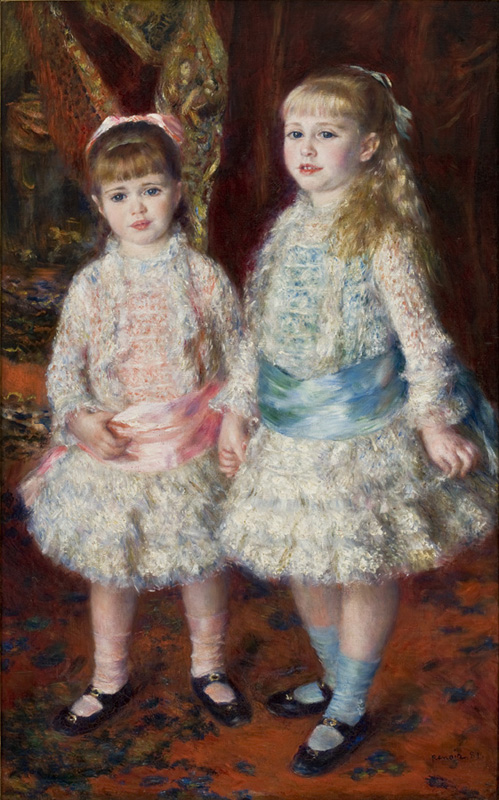
Two little sisters in lace dresses, one in pink, one in blue, stand hand in hand for Renoir. The younger later remembered the dresses more than the boredom. Their lives went on to very different ends.
The story behind the painting
In Paris in 1881 Renoir painted Alice and Elisabeth, daughters of Louise Cahen d'Anvers and her husband, the Jewish banker Louis Raphaël Cahen d'Anvers. He had met the family through the collector Charles Ephrussi, owner of the Gazette des Beaux-Arts. The first plan was a separate portrait of each daughter, and Renoir painted the eldest, Irène, in Little Irène; the family then decided the two younger girls would be painted together.
What to look for
Elisabeth, the blonde, was born in December 1874, and Alice in February 1876, so they were about six and five. According to Camesasca there were many sittings until the end of February 1881, after which Renoir left for Algiers. Decades later the younger model remembered that the boredom of the sittings was made up for by the pleasure of wearing the elegant lace dress. The painting is about 119 by 74 cm.
Meaning and intent
The work is commonly known simply as Pink and Blue, after the two dresses that set the sisters apart. Renoir painted many portraits at the time for families of the Parisian Jewish community, and Louis Cahen d'Anvers was among the wealthiest of them. He had married Louise de Morpurgo, from a rich family of Trieste, and the family commissioned many portraits from Renoir. Charles Ephrussi, who had introduced the painter, was also Louise's lover, a detail that adds a private shadow to this bright family picture.
Legacy
Alice married the British officer Charles Townshend in 1895 and died in Nice in 1965. Elisabeth, though converted to Catholicism young, was deported because of her Jewish descent and died on the way to Auschwitz in March 1944, aged 69; her nephew told the museum this in 1987. The painting has been at the São Paulo Museum of Art since 1952, where it is one of the most popular works.
¿Sabías que…?
- Painted in Paris in 1881.
- Shows Alice and Elisabeth Cahen d'Anvers, aged about five and six.
- Sittings lasted until the end of February 1881.
- In the São Paulo Museum of Art since 1952.
Sobre el artista
Pierre-Auguste Renoir (1841-1919)
retrato · Museo de Arte de São Paulo
Más obras de Pierre-Auguste Renoir
 Baile en el Moulin de la Galette - Pierre-Auguste Renoir (1876)
 El almuerzo de los remeros - Pierre-Auguste Renoir (1881)
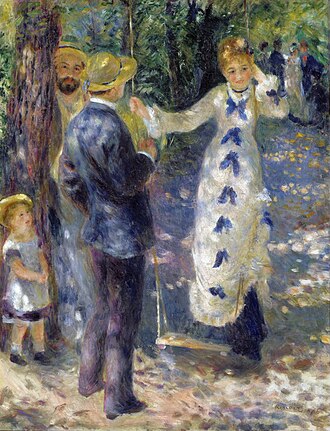 El columpio - Pierre-Auguste Renoir (1876)
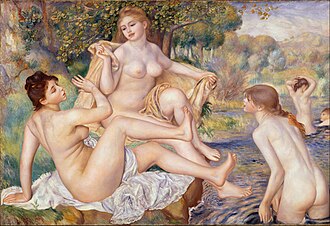 Las grandes bañistas - Pierre-Auguste Renoir (1884)
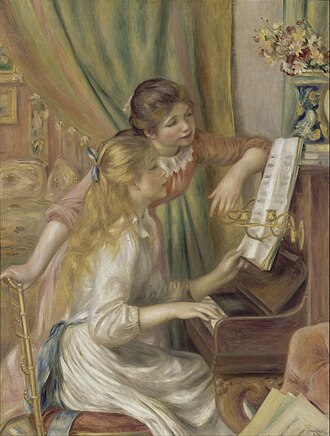 Muchachas al piano - Pierre-Auguste Renoir (1892)
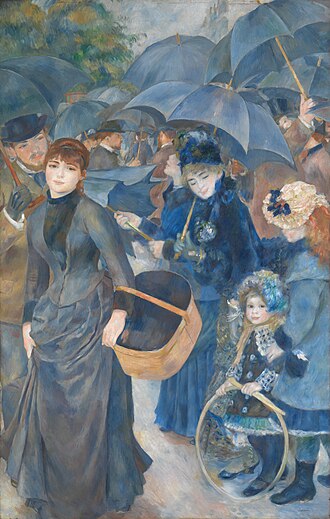 Los paraguas - Pierre-Auguste Renoir (1880s)
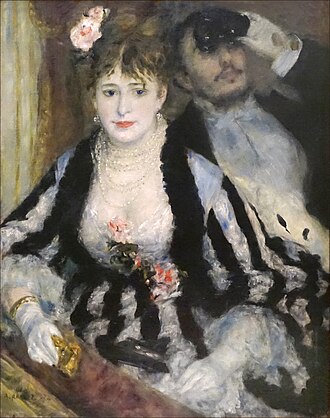 El palco - Pierre-Auguste Renoir (1874)
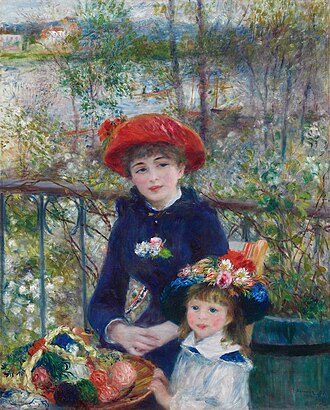 En la terraza - Pierre-Auguste Renoir (1881)
Obras de artistas relacionados
 Impresión, sol naciente - Claude Monet (1872)
 Nenúfares - Claude Monet (1906)
 Almuerzo sobre la hierba - Édouard Manet (1863)
 Olympia - Édouard Manet (1863)
 La cuna - Berthe Morisot (1872)
 Summer's Day - Berthe Morisot (1879)
 El ajenjo - Edgar Degas (1875)
 Die Bellelli Familie - Edgar Degas (1858)
 El canal del Loing - Alfred Sisley (1892)
 The Watering Pond at Marly with Hoarfrost - Alfred Sisley (1876)
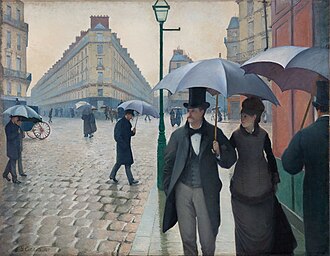 Calle de Paris, dia de lluvia - Gustave Caillebotte (1877)
 Los acuchilladores de parqué - Gustave Caillebotte (1875)