Peeckelhaeringh
Frans Hals · 1620s
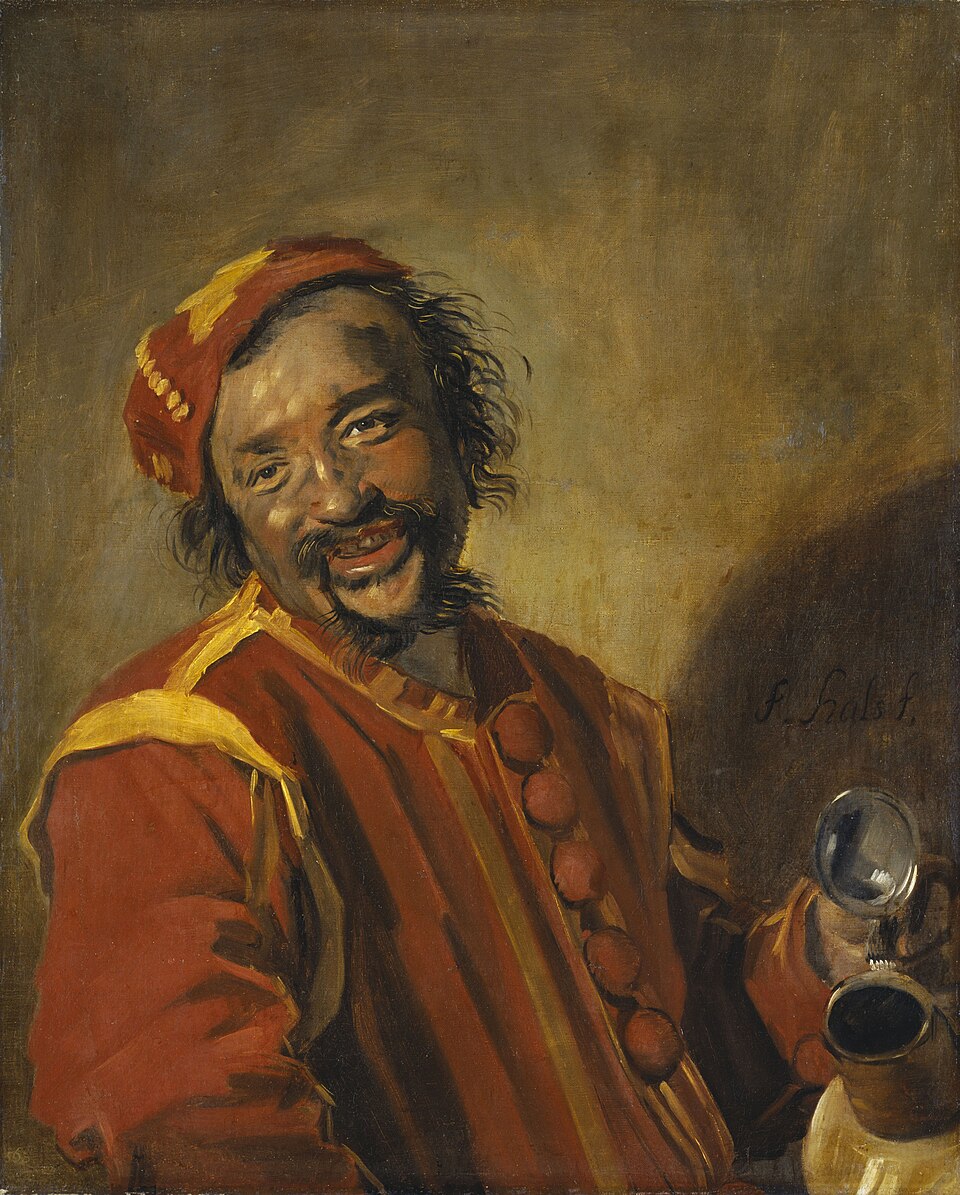
A laughing man in a red cap tips his head and lifts a mug with its lid open. He is Peeckelhaering, a stage clown named after pickled herring, and Frans Hals caught him mid-grin.
The story behind the painting
Peeckelhaeringh, or Pekelharing, is an old Dutch word for pickled herring. In 17th-century comic plays it was the name of a stock character, a gluttonous buffoon whose diet of herring gave him an insatiable thirst. Frans Hals painted him in oil on canvas, around 1628 to 1630 according to Wikipedia, while Wikidata gives simply the 1620s. In 1910 the scholar Cornelis Hofstede de Groot documented the picture under the title The Merry Toper, and noted that it is signed f. hals f. on the right, above the mug.
What to look for
Hofstede de Groot described a half-length, life-size figure: a laughing man with a brown face, turned half right, his head slightly inclined to the left as he looks straight at us. He has a slight beard and moustache, and rough hair sticks out from under a flat red cap trimmed in yellow. His costume is red and yellow too. In his left hand he holds a mug with its lid open. The canvas measures about 75 by 61.5 cm. Look at the direct gaze and the open mouth: he seems to be sharing the joke with the viewer.
Meaning and intent
The engraver Jonas Suyderhoef made a print of the painting titled Monsieur Peeckelhaering, published with a poem saying that his wet lips show how he enjoys a fresh mug of beer, because his throat is always dry. That is the whole joke of the character: the salty herring, the endless thirst, the beer. Hals does not moralise. He paints appetite and laughter at life size, with a face that seems caught in a moment and not posed, so the theatre clown becomes a living neighbour across the table.
Legacy
Paintings called Peeckelhaering appear in Dutch inventories in Leiden in 1666, Nijmegen in 1669 and Amsterdam around 1690. The Leiden painter Jan Steen owned this painting and painted it on the background walls of some of his household scenes, including The Doctor's Visit and The Christening, a painting inside paintings. By 1749 it was recorded in the main inventory at Kassel, and it remains there today with Hessen Kassel Heritage. A copy signed with a monogram was also documented in Brussels in 1891.
¿Sabías que…?
- Peeckelhaering means pickled herring, the name of a stage clown.
- Signed f. hals f. above the mug.
- Jan Steen owned it and painted it into his own scenes.
- In Kassel since at least 1749.
Sobre el artista
Frans Hals (1591-1666)
escena de género · Museumslandschaft Hessen Kassel · bufón
Más obras de Frans Hals
 El alegre bebedor - Frans Hals (1620s)
 Caballero sonriente - Frans Hals (1624)
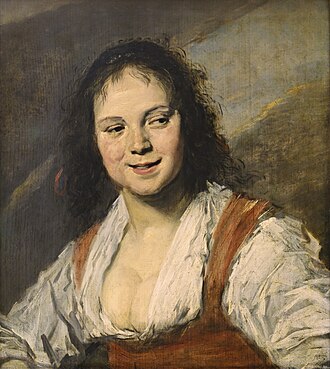 La gitana - Frans Hals (1628)
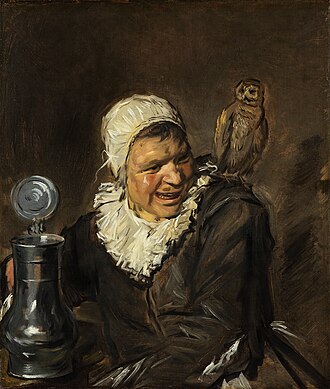 Malle Babbe - Frans Hals (1640s)
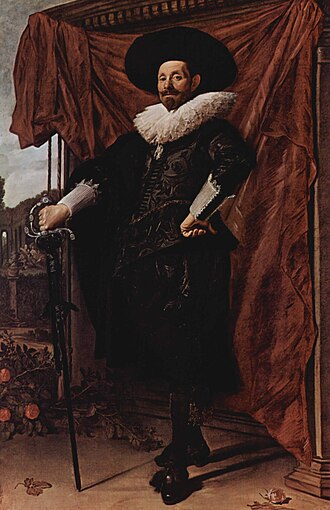 Retrato de Willem van Heythuysen - Frans Hals (1625)
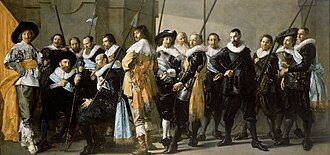 La compañía del capitán Reijnier Reael y el teniente Cornelis Michielsz Blaeuw - Frans Hals (1630s)
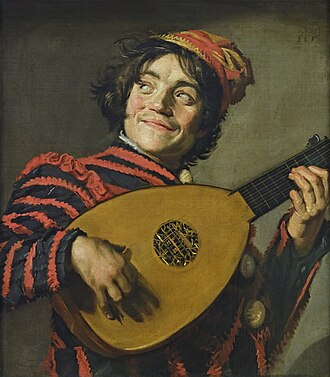 El tocador de laúd - Frans Hals (1623)
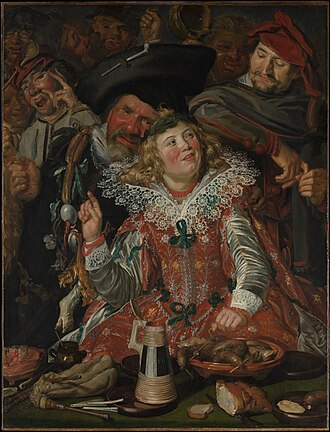 Juerguistas en el martes de Carnaval - Frans Hals (1610s)
Obras de artistas relacionados
 La ronda de noche - Rembrandt van Rijn (1642)
 Autorretrato - Rembrandt van Rijn (1659)
 La joven de la perla - Johannes Vermeer (1665)
 La lechera - Johannes Vermeer (c. 1658)
 La fiesta de San Nicolás - Jan Steen (1660s)
 Joven comiendo ostras - Jan Steen (1658)
 El molino de Wijk bij Duurstede - Jacob van Ruisdael (1670)
 El cementerio judío - Jacob van Ruisdael (1650s)
 Patio de una casa de Delft - Pieter de Hooch (1658)
 Mujer pelando manzanas - Pieter de Hooch (1663)