Odalisca con esclava
Jean Auguste Dominique Ingres · 1839
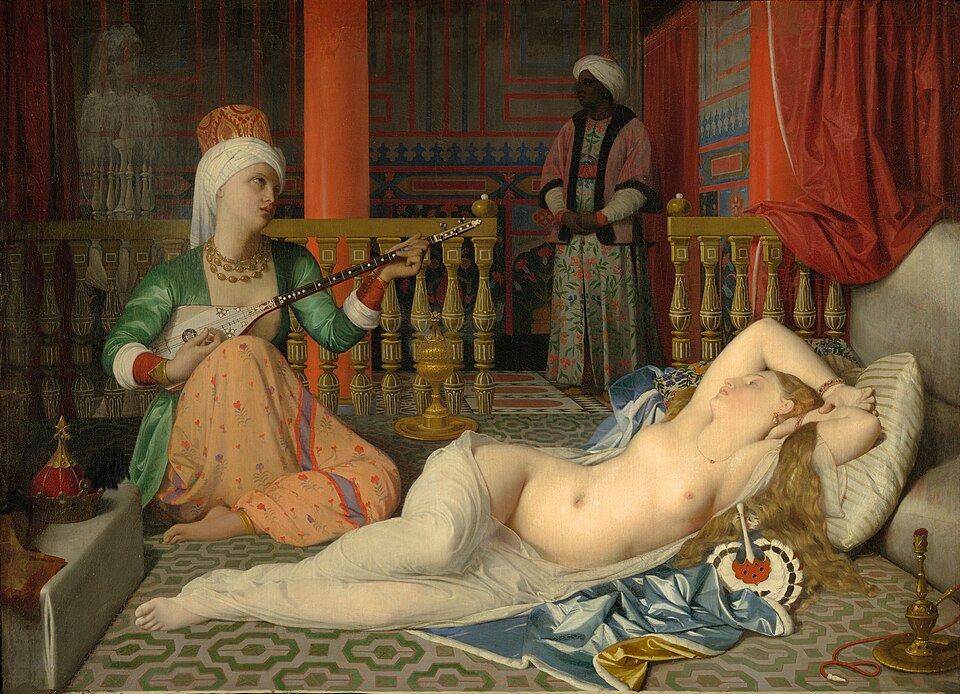
A nude odalisque lies stretched out while a musician plays and a eunuch stands guard. Ingres never travelled to the Near East: this harem is imagined, painted in Rome with his students' help.
The story behind the painting
Ingres painted harem scenes throughout his long career, beginning with the Grande Odalisque of 1814. Odalisque with Slave, of 1839, was commissioned by Charles Marcotte. Ingres composed it in Rome, where he lived from 1835 to 1841 as director of the French Academy. Since he never visited the Near East, the scene is imaginary. The odalisque was painted from a life drawing he had made years earlier, the musician from a model posed in the studio, and many details, such as the tanbour, the musician's instrument, were taken from engravings.
What to look for
The painting shows three figures in a harem interior: a nude odalisque, a musician and a eunuch. Look at the finish of the surroundings, the architecture, mosaics, rugs, furniture and instruments, all carried out with great care. Behind the figures rises a wall that the art historian Karin Grimme described as shutting the odalisque into a room with no exit. The whole is unified by thin layers of colour that Ingres himself laid over the work at the end, which his student called onion skins of colour.
Meaning and intent
Ingres worked on the painting with his usual attention to detail and brought in students as assistants. One of them, Raymond Balze, described the method: Ingres began from nature and sketched on the canvas, then had his students paint the less important parts, highly finished, which he often made them reposition. When everything was done, he alone harmonised the whole. The painting is a classic of French Orientalism, a taste for Eastern subjects that Ingres shared with many painters of the Romantic era, notably his rival Eugène Delacroix.
Legacy
In September 1840 the painting reached Paris, where critics admired it in the owner's home. When it was shown publicly in 1845 it was widely praised, and Baudelaire and Théophile Thoré-Bürger wrote about it. Ingres made a second version in 1842 with his students Paul and Jean-Hippolyte Flandrin, now in the Walters Art Museum in Baltimore. There the closed wall became a garden painted by Paul Flandrin, inspired by the park at the Château de Dampierre. The Louvre owns an 1858 drawing that repeats the composition. The 1839 original is in the Fogg Museum, Harvard Art Museums.
¿Sabías que…?
- Painted in Rome in 1839, commissioned by Charles Marcotte.
- An imagined scene: Ingres never visited the Near East.
- Admired by Baudelaire when shown in 1845.
- A 1842 second version with a garden is in Baltimore.
Sobre el artista
Jean Auguste Dominique Ingres (1780-1867)
mujer · varón · escena de género · desnudo · desnudo · neoclasicismo · hombre vestido, mujer desnuda · tiziano · Harvard Art Museums · turbante
Más obras de Jean Auguste Dominique Ingres
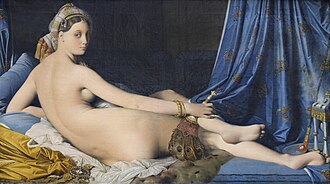 La gran odalisca - Jean-Auguste-Dominique Ingres (1814)
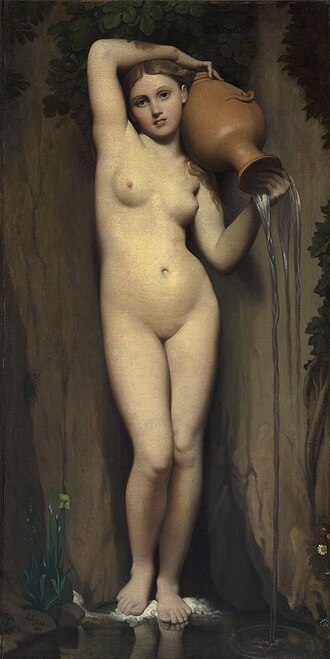 La fuente - Jean-Auguste-Dominique Ingres (1856)
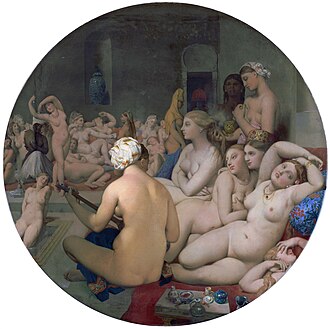 El baño turco - Jean-Auguste-Dominique Ingres (1862)
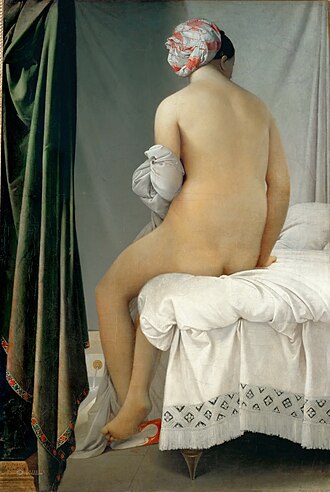 La bañista de Valpinçon - Jean-Auguste-Dominique Ingres (1808)
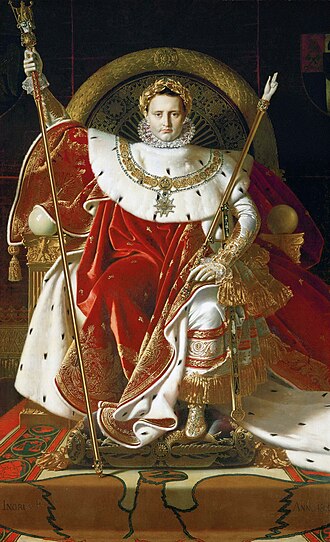 Napoleón en su trono imperial - Jean-Auguste-Dominique Ingres (1806)
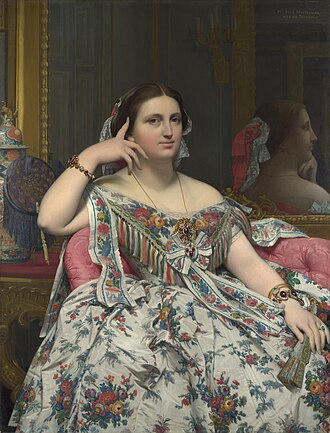 Madame Moitessier - Jean-Auguste-Dominique Ingres (1856)
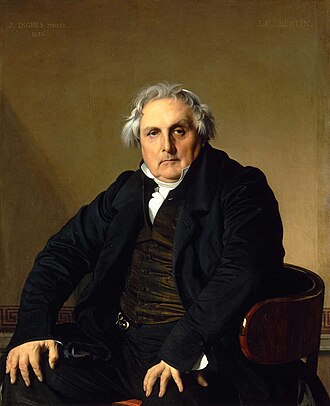 Monsieur Bertin - Jean-Auguste-Dominique Ingres (1832)
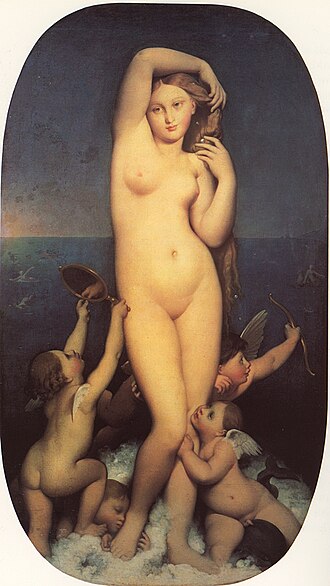 Venus Anadiómena - Jean-Auguste-Dominique Ingres (1808)
Obras de artistas relacionados
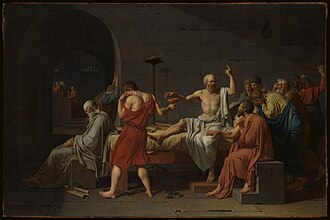 La muerte de Sócrates - Jacques-Louis David (1787)
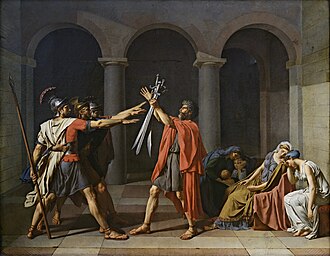 Juramento de los Horacios - Jacques-Louis David (1784)
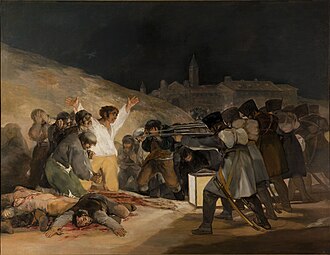 El tres de mayo de 1808 - Francisco Goya (1814)
.jpg) La Maja desnuda - Francisco Goya (1800)
La Maja desnuda - Francisco Goya (1800)