Charles Marcotte d'Argenteuil
Jean Auguste Dominique Ingres · 1810
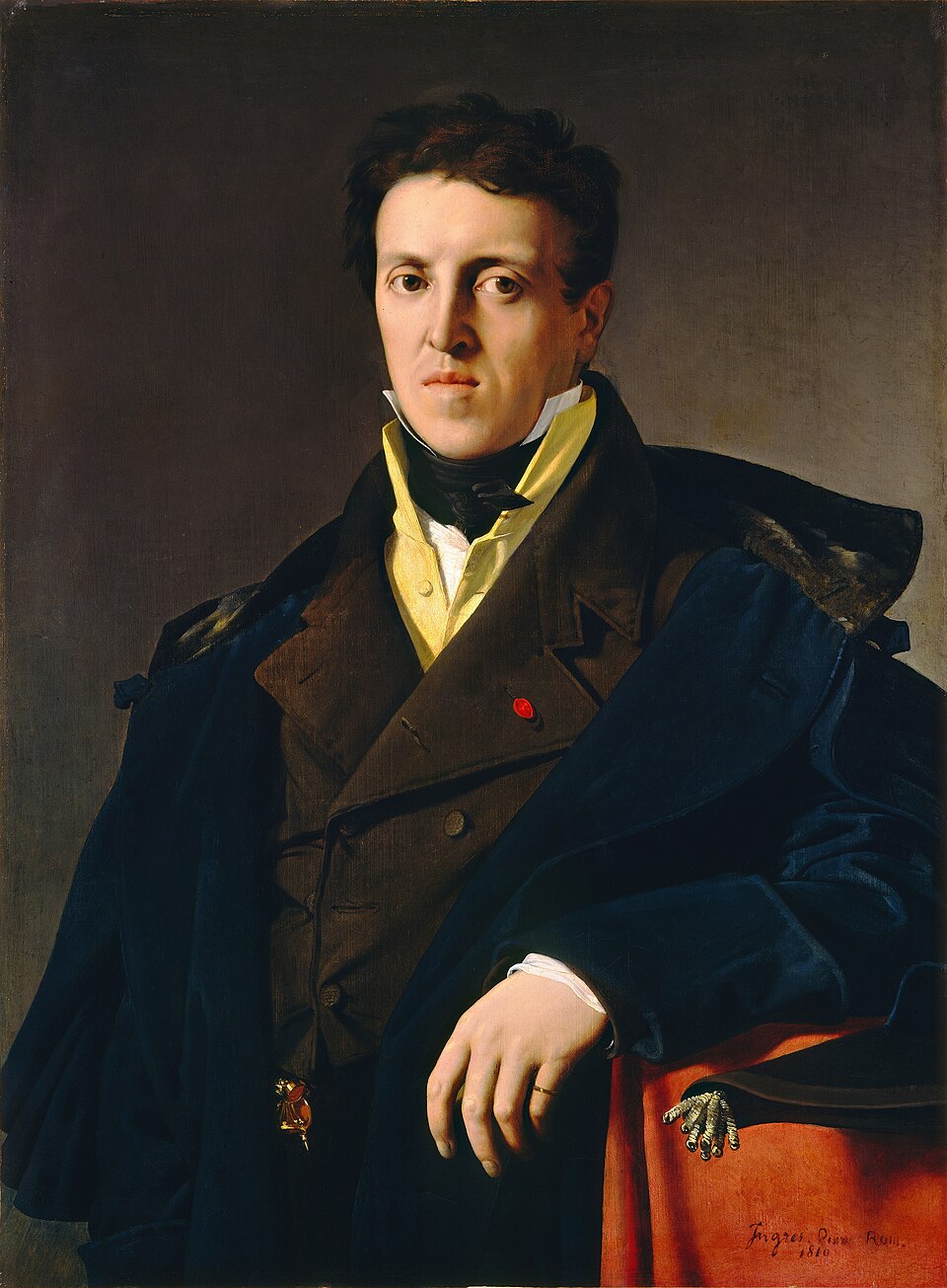
A handsome man in a blue carrick stares out with tight, downturned lips, his hair a little ruffled. He ordered this portrait as a gift for his mother, and did not like it.
The story behind the painting
Ingres painted this portrait in 1810, during his first stay in Rome. Charles Marie Jean Baptiste Marcotte, 36 or 37 at the time, was inspector general of Waters and Forests in the Napoleonic department of Rome. He became one of the most significant French art patrons of the nineteenth century and a loyal friend and adviser to Ingres, later commissioning portraits of his family, friends and mistress, and works such as Odalisque with Slave of 1839.
What to look for
Marcotte stands against a plain grey-green background, leaning on a table draped in red cloth. His starched white and yellow collar looks tight. He wears a blue carrick with a cape and velvet collar over a white shirt and yellow waistcoat. His slightly ruffled hair softens the grim tone. Look at his claw-like left hand with long sinuous fingers, echoed by the tassels of the bicorne beside him. Ingres signed and dated the picture at lower right, over the red cloth. The canvas measures about 93.7 by 69.4 cm.
Meaning and intent
Though handsome and strong-boned, Marcotte is shown dour and serious, his lips pursed and turned down. Several art historians have noted that his stiffness resembles Ingres's own early self-portraits, especially that of 1804, as if the painter saw something of himself in his sitter. The result is a portrait of a man who would become one of Ingres's closest supporters, painted with none of the flattery he might have hoped for.
Legacy
Marcotte commissioned the portrait as a gift to his mother, but found it too stern, and Ingres asked him to keep that to himself. It stayed with Marcotte until his death in 1864, then passed to his son Joseph, his widow and his daughter Elisabeth Pougin de la Maisonneuve until 1935. Samuel H. Kress acquired it in 1949 and gave it to the National Gallery of Art in Washington in 1952.
¿Sabías que…?
- Painted by Ingres in Rome in 1810.
- Marcotte became a lifelong patron of Ingres.
- Marcotte found it too stern.
- In the National Gallery of Art, Washington, since 1952.
Sobre el artista
Jean Auguste Dominique Ingres (1780-1867)
retrato · Galería Nacional de Arte · Samuel H. Kress Collection
Más obras de Jean Auguste Dominique Ingres
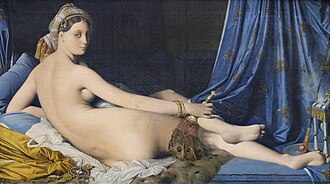 La gran odalisca - Jean-Auguste-Dominique Ingres (1814)
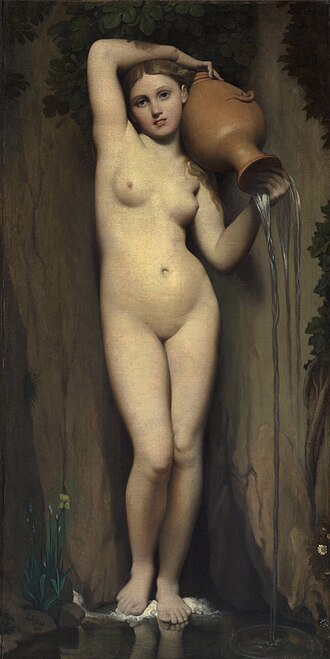 La fuente - Jean-Auguste-Dominique Ingres (1856)
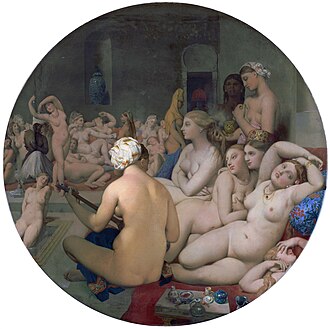 El baño turco - Jean-Auguste-Dominique Ingres (1862)
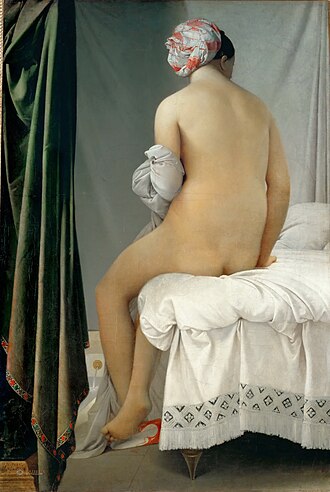 La bañista de Valpinçon - Jean-Auguste-Dominique Ingres (1808)
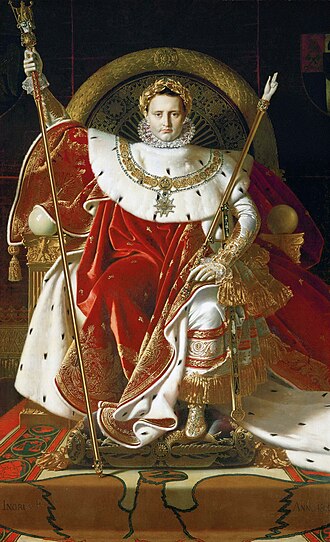 Napoleón en su trono imperial - Jean-Auguste-Dominique Ingres (1806)
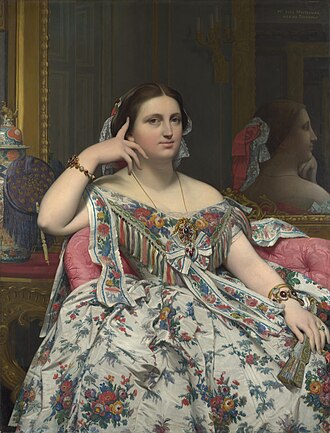 Madame Moitessier - Jean-Auguste-Dominique Ingres (1856)
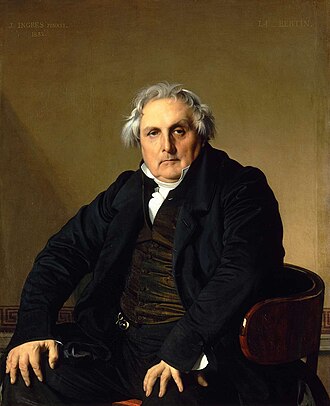 Monsieur Bertin - Jean-Auguste-Dominique Ingres (1832)
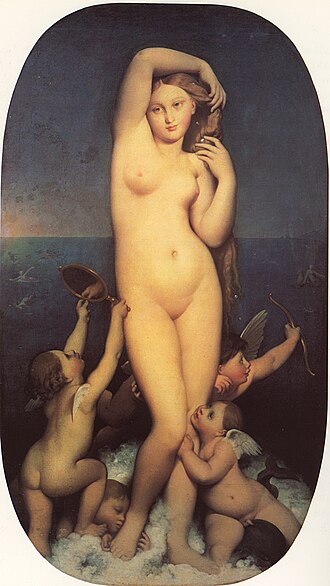 Venus Anadiómena - Jean-Auguste-Dominique Ingres (1808)
Obras de artistas relacionados
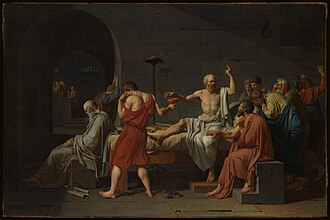 La muerte de Sócrates - Jacques-Louis David (1787)
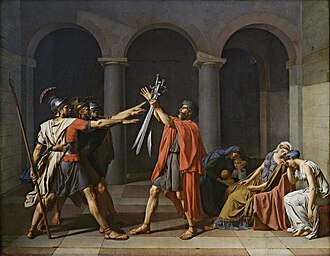 Juramento de los Horacios - Jacques-Louis David (1784)
 El tres de mayo de 1808 - Francisco Goya (1814)
 La Maja desnuda - Francisco Goya (1800)