Mademoiselle Caroline Rivière
Jean Auguste Dominique Ingres · 1806
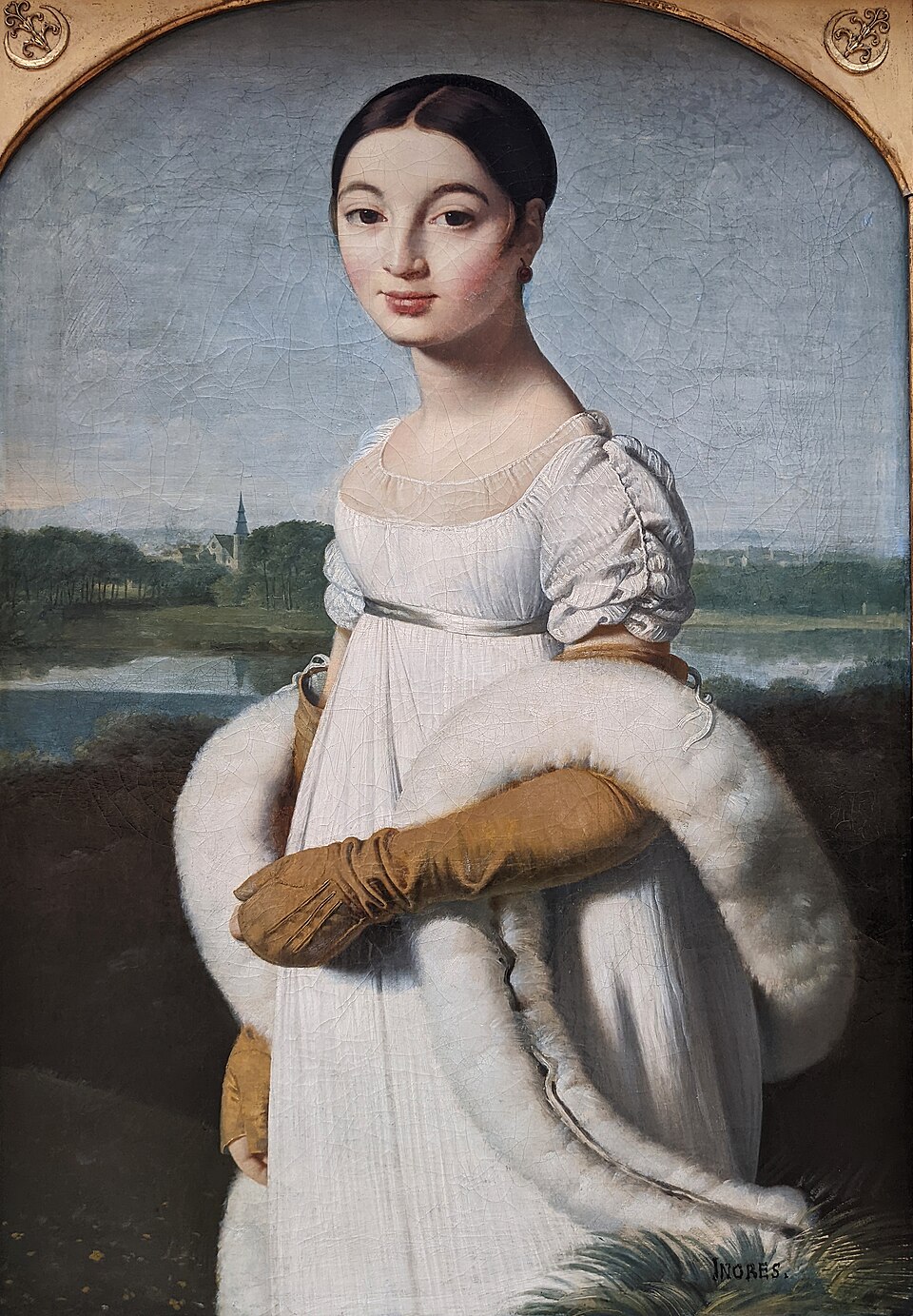
A girl of thirteen or fifteen in a white dress, long gloves and a curling fur boa, against a pale spring landscape. Ingres called her the ravishing daughter. Within a year of the portrait, she was dead.
The story behind the painting
In 1806 Philibert Rivière, a successful court official under Napoleon, commissioned the young Ingres to paint himself, his wife and their daughter. This is the third of the three portraits, and all of them survive. Ingres preferred subjects from history and Greek legend, but at this early stage he earned his living mainly from portraits for wealthy patrons. The family lived at Saint-Germain-en-Laye, outside Paris. Caroline was between 13 and 15 when she sat for him, and he described her as the ravishing daughter.
What to look for
The colours are bright and the background is a serene white and blue early spring landscape, meant to reflect the sitter's youth. The perspective is shallow and rises, in the words of Robert Rosenblum, in flattened horizontal tiers, so the figure stands out crisply as if in low relief. Look at the anatomy: her neck is too long and the bridge of her nose extends too far, typical of Ingres's portraits at the time. Notice the white dress against the curve of the boa, a contrast that offended some viewers in 1806.
Meaning and intent
The stiffness and awkwardness of her pose were meant to suggest the purity and simplicity of youth, and the portrait hints at a hesitant openness. Yet it is usually seen through pathos and tragedy, because Caroline died within a year of its completion. In 2003 the critic Jonathan Jones saw something more charged: an intense looking at her full lips, bare neck, long gloves and spectacularly serpentine boa. Today the painting is often considered a peak of Ingres's career, linking figure and landscape in shared rhythms.
Legacy
All three Rivière portraits were shown at the Salon of 1806 and poorly received. Critics found them Gothic, because of the precise line and enamel finish, and too close to Jan van Eyck and the early Netherlandish painters, who were only then being rediscovered. Today it is often seen as a peak of his career. Caroline's sister-in-law bequeathed the portrait to the Louvre in 1870, and it still hangs there today, more than two centuries after it was painted. Wikidata gives its size as 100 by 70 cm.
¿Sabías que…?
- Painted in 1806, the third of three Rivière family portraits.
- The sitter was 13 to 15 and died within a year.
- Poorly received at the Salon of 1806.
- Bequeathed to the Louvre in 1870.
Sobre el artista
Jean Auguste Dominique Ingres (1780-1867)
mujer · retrato · Departamento de Pinturas del Museo del Louvre · neoclasicismo · vestido · de pie · niña · castaño · 1795-1820 in Western fashion
Más obras de Jean Auguste Dominique Ingres
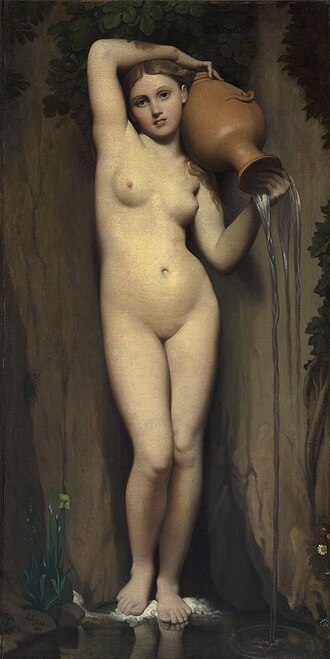 La fuente - Jean-Auguste-Dominique Ingres (1856)
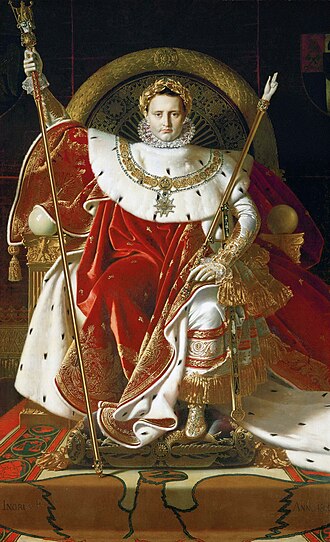 Napoleón en su trono imperial - Jean-Auguste-Dominique Ingres (1806)
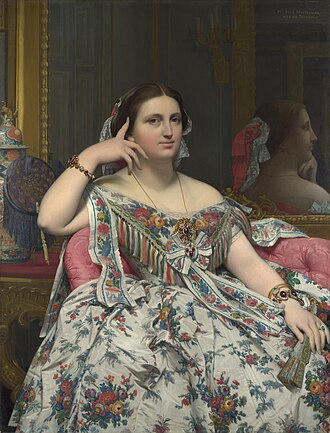 Madame Moitessier - Jean-Auguste-Dominique Ingres (1856)
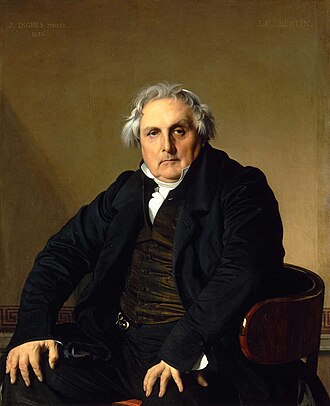 Monsieur Bertin - Jean-Auguste-Dominique Ingres (1832)
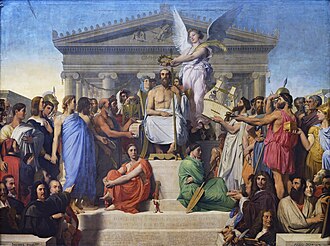 La apoteosis de Homero - Jean-Auguste-Dominique Ingres (1827)
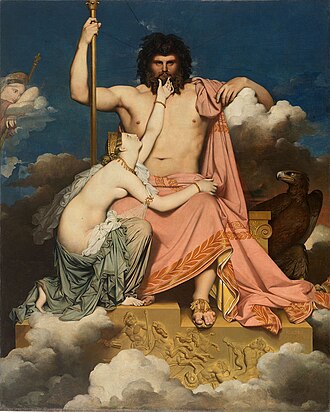 Júpiter y Tetis - Jean-Auguste-Dominique Ingres (1811)
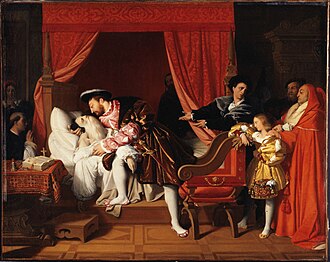 The Death of Leonardo da Vinci - Jean-Auguste-Dominique Ingres (1818)
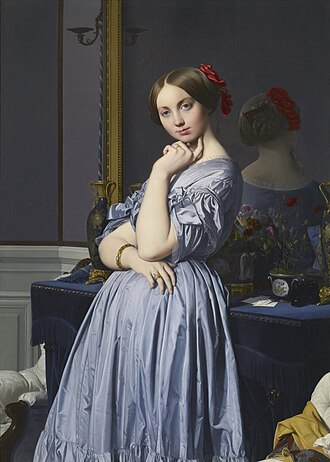 Condesa de Haussonville - Jean-Auguste-Dominique Ingres (1845)
Obras de artistas relacionados
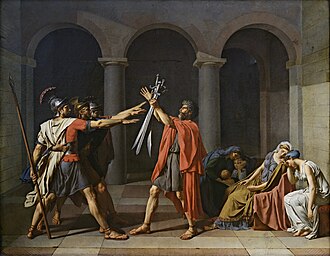 Juramento de los Horacios - Jacques-Louis David (1784)
.jpg) La intervención de las sabinas - Jacques-Louis David (1799)
La intervención de las sabinas - Jacques-Louis David (1799)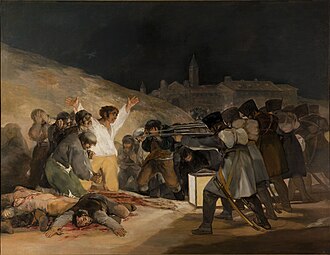 El tres de mayo de 1808 - Francisco Goya (1814)
.jpg) La Maja desnuda - Francisco Goya (1800)
La Maja desnuda - Francisco Goya (1800)