Lise
Pierre-Auguste Renoir · 1867
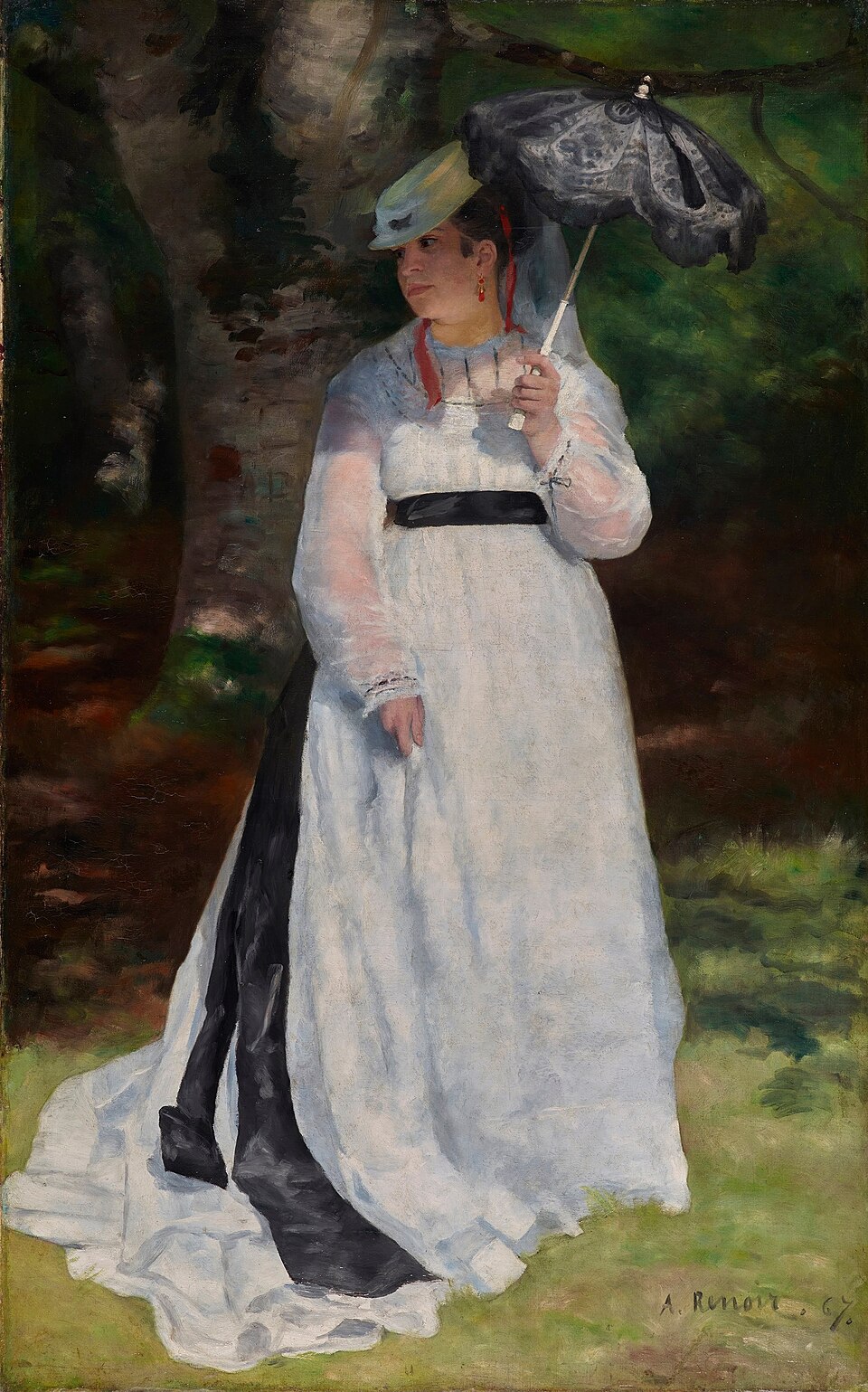
Her face sits in shadow while sunlight floods her white dress. Critics laughed at the contrast, yet this was the painting that first won Renoir real success.
The story behind the painting
Renoir began Lise with a Parasol in the summer of 1867, when he was 26. He had struggled for years: his first Salon submission in 1863 was rejected, and he destroyed it. His model was Lise Tréhot, whom he met through his friend Jules Le Cœur; this article says she was his lover and companion from around 1865 to 1872, while the article on In Summer gives about 1866 to 1871. Where he painted is also debated: it was long assumed to be the Fontainebleau forest, as Wikidata still lists, but more recent scholarship points to the Chantilly Forest, from July to August.
What to look for
This is a full-length, almost life-size portrait; Wikidata gives 184 by 115.5 centimetres. Lise stands in a forest glade in a white muslin dress, holding a black lace parasol. Sunlight filters through the leaves above her. Notice the daring contrast: her face lies in shadow, while her body and dress are in light, so the dress, not the face, becomes the brightest thing on the canvas. Look at the folds of muslin catching the light, and at the dark lace against them. Wikidata also notes her straw hat and the grass around her.
Meaning and intent
The painting shows a young artist searching for his own way. His technique was still influenced by Gustave Courbet, but here he began developing what would become his signature: figures in filtered light, a theme he returned to in The Swing and Dance at Le Moulin de la Galette, both of 1876. His friend Narcisse Díaz had urged him to lighten his palette, and Monet's experiments with large outdoor figure paintings also helped shape this work. Lise is not only a portrait of a woman, but a study of what sunlight does to white cloth.
Legacy
Accepted at last, the painting was exhibited at the Salon in May 1868 and became one of Renoir's first critical successes, a triumph not surpassed until Madame Georges Charpentier and Her Children at the Salon of 1879. Still, its scale and unusual contrast led several critics to ridicule it. Renoir could not sell it, and the critic Théodore Duret, a passionate supporter of the young Impressionists, bought it from him. In 1901 the German patron Karl Ernst Osthaus acquired it for the Museum Folkwang, where it remains. There, Lise still stands in her pool of light.
¿Sabías que…?
- Begun in summer 1867; shown at the Salon in May 1868 (Wikipedia).
- Sources differ on location: Fontainebleau (Wikidata) or Chantilly Forest per recent scholarship (Wikipedia).
- Canvas 184 x 115.5 cm (Wikidata).
- Acquired by Karl Ernst Osthaus in 1901 for the Museum Folkwang (Wikipedia).
Sobre el artista
Pierre-Auguste Renoir (1841-1919)
retrato · impresionismo · vestido · de pie · sombrilla · sombrero de paja
Más obras de Pierre-Auguste Renoir
 Baile en el Moulin de la Galette - Pierre-Auguste Renoir (1876)
 El almuerzo de los remeros - Pierre-Auguste Renoir (1881)
 El columpio - Pierre-Auguste Renoir (1876)
 Las grandes bañistas - Pierre-Auguste Renoir (1884)
 Muchachas al piano - Pierre-Auguste Renoir (1892)
 Los paraguas - Pierre-Auguste Renoir (1880s)
%20(46499625955).jpg) El palco - Pierre-Auguste Renoir (1874)
El palco - Pierre-Auguste Renoir (1874)%20-%201933.455%20-%20Art%20Institute%20of%20Chicago.jpg) En la terraza - Pierre-Auguste Renoir (1881)
En la terraza - Pierre-Auguste Renoir (1881)
Obras de artistas relacionados
 Impresión, sol naciente - Claude Monet (1872)
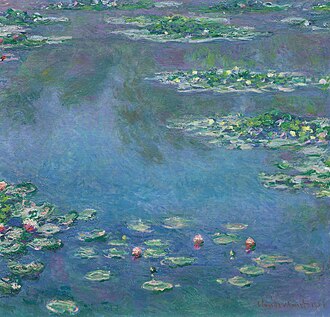 Nenúfares - Claude Monet (1906)
 La noche estrellada - Vincent van Gogh (1889)
.jpg) Terraza de café por la noche - Vincent van Gogh (1888)
Terraza de café por la noche - Vincent van Gogh (1888)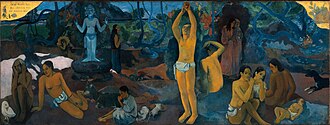 ¿De dónde venimos? ¿Qué somos? ¿Adónde vamos? - Paul Gauguin (1897-1898)
%201889.jpg) El Cristo amarillo - Paul Gauguin (1889)
El Cristo amarillo - Paul Gauguin (1889)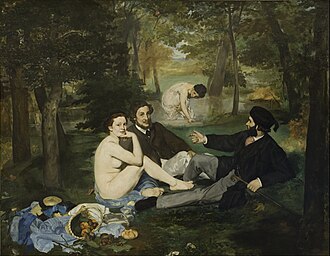 Almuerzo sobre la hierba - Édouard Manet (1863)
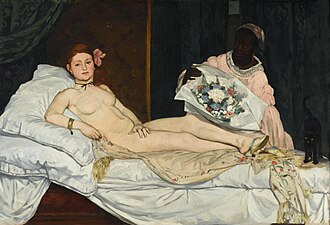 Olympia - Édouard Manet (1863)