Christ Driving the Money-changers from the Temple
Rembrandt van Rijn · 1626
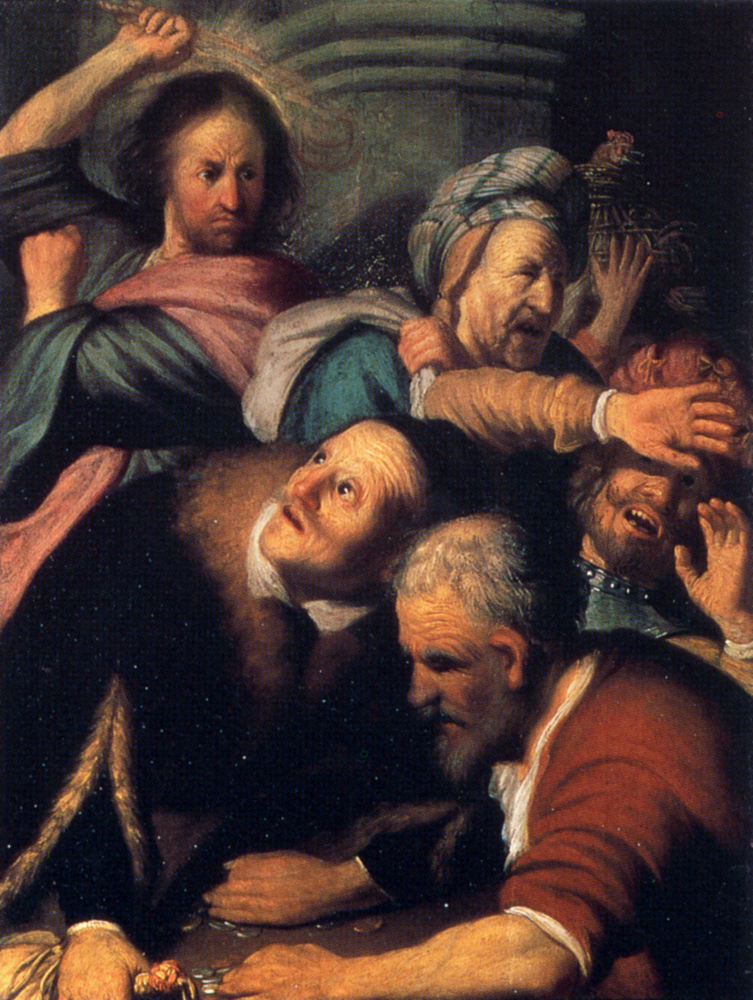
A whip raised high, coins clutched, a man hiding his face: the young Rembrandt crammed a whole uproar into a small oak panel. Its signature was found only during a restoration in 1930 to 1931.
The story behind the painting
This is one of the earliest works of the young Rembrandt, painted around 1624 or 1625. In 1620 he began three and a half years of training with Jacob van Swanenburgh in Leiden, and in 1624 he went to Amsterdam for half a year with Pieter Lastman, who influenced him more. The panel bears the date 1626, scratched into the almost dry paint above the turban of a fleeing man, read as RH 1626 or RHF 1626. Rembrandt sometimes added a current date to older works, and style links the panel to his Five Senses series, so it was probably painted before the date it carries.
What to look for
The scene follows the Gospel of John, with Jesus raising a whip. In front, three money changers sit at a table. A balding old man with a full beard sweeps up coins with his bare arm. A younger man in a fur-trimmed coat guards his money, grabs his purse and looks up in fear. A third, in a turban and a gorget that marks him as a soldier or temple guard, shields his head. A fourth squeezes past a column with a sack, and a fifth balances a basket of poultry. Jesus, beardless, in purple and dark green, shows anger and resolve.
Meaning and intent
The tightly packed, expressive faces and moving arms make an unusual composition, yet the strong colour and costumes match other early works by Rembrandt. Jesus with the whip echoes figures in The Stoning of Saint Stephen and Balaam and the Ass, and the frightened money changer recalls figures in paintings of 1626. A drawing, Two Studies of the Head of an Old Man, served for the seated money changer and was bought by the J. Paul Getty Museum in 1983. Kurt Bauch proposed as a model a print by Philips Galle after Jan van der Straet's Expulsion from the Temple of 1572.
Legacy
The oak panel, 43.1 by 32 cm, had been enlarged to 53.2 by 40.8 cm by the time it was recognised as a Rembrandt, with a man in a straw hat added, the table and purse extended and parts overpainted. A Russian scholar first gave it to Rembrandt's school, and Kurt Bauch introduced it as by Rembrandt in 1924. Abraham Bredius catalogued it in 1935, and in 1982 the Rembrandt Research Project accepted it as a certain early work. The Soviet art historian Kati Jegorowa claimed in 1971 that it was badly damaged, probably misreading X-rays. It is in the Pushkin Museum in Moscow.
¿Sabías que…?
- Painted around 1624-1625, though dated 1626 on the panel.
- Oil on oak, 43.1 x 32 cm, later enlarged.
- Signature found during the 1930-1931 restoration.
- Accepted by the Rembrandt Research Project in 1982.
Sobre el artista
Rembrandt van Rijn (1606-1669)
arte religioso · Museo Pushkin
Más obras de Rembrandt van Rijn
 La ronda de noche - Rembrandt van Rijn (1642)
 Autorretrato - Rembrandt van Rijn (1659)
 Lección de anatomía del Dr. Nicolaes Tulp - Rembrandt van Rijn (1632)
 La novia judía - Rembrandt van Rijn (1660s)
 La tormenta en el mar de Galilea - Rembrandt van Rijn (1633)
 El retorno del hijo pródigo - Rembrandt van Rijn (1668)
 Dánae - Rembrandt van Rijn (1636)
 Banquete de Belsasar - Rembrandt van Rijn (1636)
Obras de artistas relacionados
 La joven de la perla - Johannes Vermeer (1665)
 La lechera - Johannes Vermeer (c. 1658)
 La fiesta de San Nicolás - Jan Steen (1660s)
 Joven comiendo ostras - Jan Steen (1658)
 El alegre bebedor - Frans Hals (1620s)
 Caballero sonriente - Frans Hals (1624)
 El molino de Wijk bij Duurstede - Jacob van Ruisdael (1670)
 El cementerio judío - Jacob van Ruisdael (1650s)
 Patio de una casa de Delft - Pieter de Hooch (1658)
 Mujer pelando manzanas - Pieter de Hooch (1663)