Asuero y Hamán en la fiesta de Ester
Rembrandt van Rijn · 1660
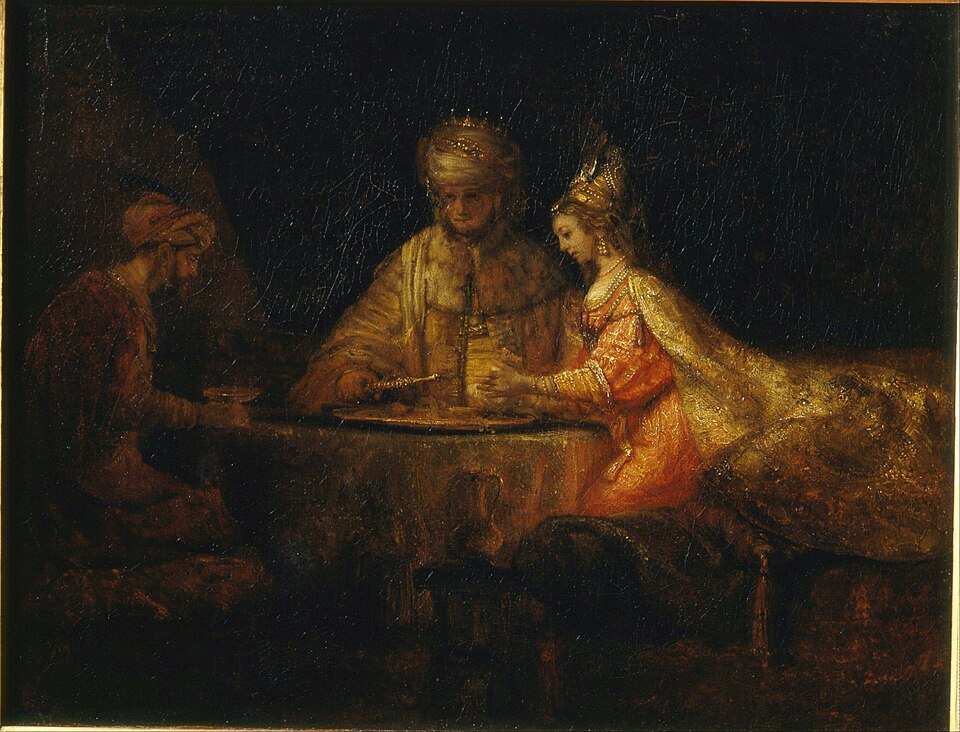
Three figures at a dim table: a queen who has just spoken, a king tight-lipped with rage, and a minister sinking into shadow, already sensing his doom. Rembrandt tells a whole biblical drama with almost nothing but gestures and light.
The story behind the painting
The subject comes from chapters 5 to 7 of the Book of Esther. Haman, adviser to King Ahasuerus, planned to hang Mordechai, who would not stand or greet him, and to destroy the whole Jewish people. Mordechai's cousin Esther, the king's wife, interceded and saved them, a rescue still celebrated at Purim. Rembrandt was inspired by Johannes Serwouters' play Hester, first staged in 1659 in Amsterdam, written as a response to pogroms in Eastern Europe. The painting was completed in 1660.
What to look for
There are only three figures, and the banquet itself is only sketched. Esther, radiant, lowers her arms apprehensively as she finishes her speech; her robe with its long train gleams as if set with precious stones. The king purses his lips in anger. Haman sits immersed in shadow, his pose full of foreboding. The distance between the king and his vizier seems enormous, while king and queen form one united pair. The canvas measures about 73 by 94 cm.
Meaning and intent
The conflict is expressed through restrained but eloquent gestures, and the scene is full of suspense. As in the Purim tradition, Haman is cast as the villain. The Pushkin Museum counts the picture among the best of Rembrandt's late period, praising how deeply he renders the inner life of his characters. In 1662 the poet Jan Vos described it in verse: Haman eats with the king and Esther, but in vain, his breast full of regret and pain, while the king is mad with revenge and rage.
Legacy
This is one of the few Rembrandts whose full provenance is known. He sold it to Jan J. Hinlopen. The husband of Leonore Huydecoper, to whom the play was dedicated, may have ordered it to help Rembrandt in his financial difficulties. It passed to Hinlopen's daughter Sara, then was sold at The Hague in 1760. In 1764 it reached Catherine the Great, probably through the merchant Johann Ernst Gotzkowsky, whose paintings helped found the Hermitage. In 1862 it went to the Rumyantsev Museum in Moscow, and since 1924 it has been in the Pushkin Museum.
¿Sabías que…?
- Painted by Rembrandt in 1660.
- Inspired by Serwouters' play Hester of 1659.
- Its full provenance is known from 1662 onward.
- In the Pushkin Museum, Moscow, since 1924.
Sobre el artista
Rembrandt van Rijn (1606-1669)
arte religioso · pintura del Siglo de oro neerlandés · Museo del Hermitage · Museo Pushkin · Asuero · Ester
Más obras de Rembrandt van Rijn
 La ronda de noche - Rembrandt van Rijn (1642)
 Autorretrato - Rembrandt van Rijn (1659)
 Lección de anatomía del Dr. Nicolaes Tulp - Rembrandt van Rijn (1632)
 La novia judía - Rembrandt van Rijn (1660s)
 La tormenta en el mar de Galilea - Rembrandt van Rijn (1633)
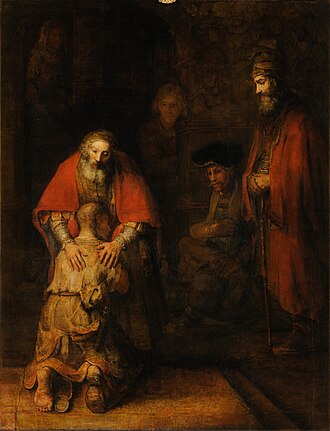 El retorno del hijo pródigo - Rembrandt van Rijn (1668)
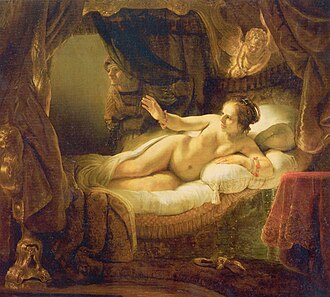 Dánae - Rembrandt van Rijn (1636)
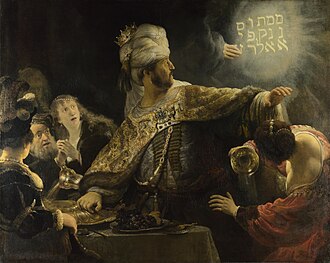 Banquete de Belsasar - Rembrandt van Rijn (1636)
Obras de artistas relacionados
 La joven de la perla - Johannes Vermeer (1665)
 La lechera - Johannes Vermeer (c. 1658)
 La fiesta de San Nicolás - Jan Steen (1660s)
 Joven comiendo ostras - Jan Steen (1658)
 El alegre bebedor - Frans Hals (1620s)
 Caballero sonriente - Frans Hals (1624)
 El molino de Wijk bij Duurstede - Jacob van Ruisdael (1670)
 El cementerio judío - Jacob van Ruisdael (1650s)
 Patio de una casa de Delft - Pieter de Hooch (1658)
 Mujer pelando manzanas - Pieter de Hooch (1663)