Mujer joven sentada ante el virginal
Johannes Vermeer · 1670
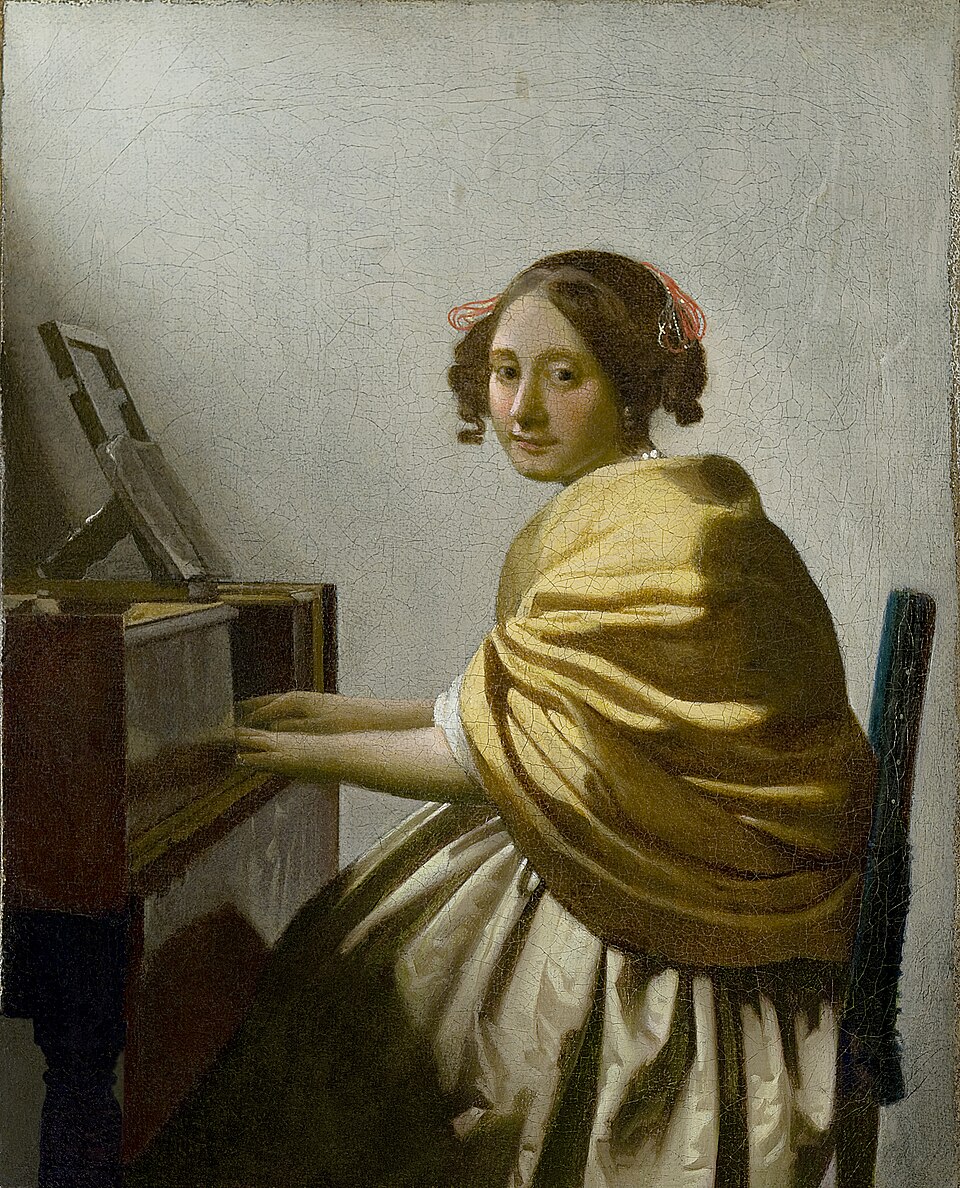
A young woman in a yellow shawl turns from her keyboard to look at us. For decades experts doubted that Vermeer painted this tiny picture, until a series of scientific tests brought it back into his small body of work.
The story behind the painting
A Young Woman Seated at the Virginals is thought to date from about 1670 and is unsigned. Its early history is unclear, though it may have belonged to Pieter van Ruijven and later Jacob Dissius. By 1904 it was owned by Alfred Beit, and it became known through the Beit collection catalogue published that year. At first it was widely accepted as a Vermeer, but in the mid twentieth century, after some Vermeers turned out to be forgeries by Han van Meegeren, it fell from favour. It should not be confused with Young Woman Seated at a Virginal in the National Gallery, London.
What to look for
The picture is small, about 25.2 by 20 cm. The young woman sits at the keyboard and turns toward the viewer, pearls in her hair. Her skirt, with its luminosity and finely modelled passages, recalls Lady Standing at a Virginal and is often called the best part of the painting. The yellow cloak or shawl is painted more roughly. Objects in the foreground are slightly blurred, and the light and the texture of the wall are typical of Vermeer. The hairstyle can be dated to around 1670, matching The Lacemaker.
Meaning and intent
In 1993 Baron Rolin, then the owner, asked Sotheby's to study the painting. The canvas appears to come from the same bolt as The Lacemaker, and the ground matches two Vermeers in London. X-rays revealed a pin-hole at the vanishing point, where Vermeer fixed a thread to set perspective. Ultramarine in the wall, green earth in the shadows and lead-tin yellow, which rules out a modern fake, all point to him. The cloak was painted over another garment later, but research for the Rijksmuseum exhibition of 2023 concluded that the yellow shawl is also by Vermeer.
Legacy
The Beit family kept the painting until it was sold to Baron Rolin in 1960. Rolin's heirs sold it through Sotheby's in 2004 to Steve Wynn, and it was later purchased for the Leiden Collection of Thomas Kaplan in New York. Walter Liedtke called it a minor late work, yet it has since appeared in Vermeer exhibitions in the United States, Britain, Japan, Italy, France and the Netherlands. It is not clear whether it was painted before or after the larger London picture.
¿Sabías que…?
- Dated to about 1670; unsigned.
- Its attribution was doubted for decades and confirmed by technical studies from 1993.
- The canvas seems to come from the same bolt as The Lacemaker.
- Now in the Leiden Collection, New York.
Sobre el artista
Johannes Vermeer (1632-1675)
mujer · escena de género · pintura del Siglo de oro neerlandés
Más obras de Johannes Vermeer
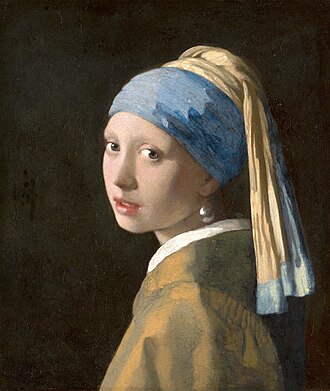 La joven de la perla - Johannes Vermeer (1665)
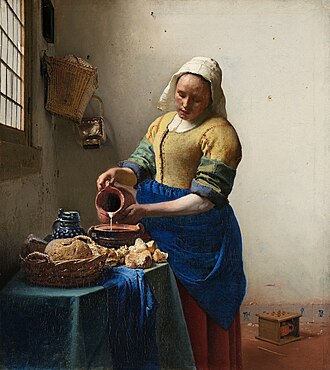 La lechera - Johannes Vermeer (c. 1658)
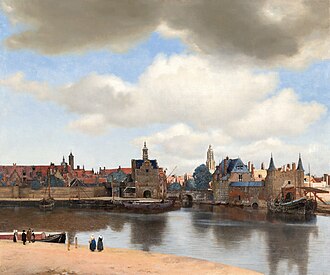 Vista de Delft - Johannes Vermeer (1660s)
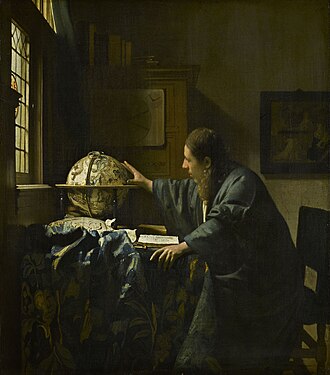 El astrónomo - Johannes Vermeer (1664)
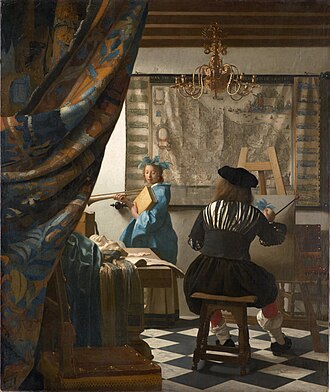 El arte de la pintura - Johannes Vermeer (1660s)
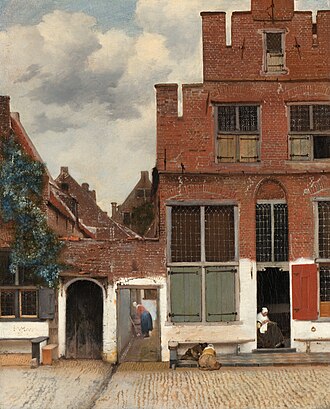 La callejuela - Johannes Vermeer (1658)
.jpg) Muchacha leyendo una carta - Johannes Vermeer (1650s)
Muchacha leyendo una carta - Johannes Vermeer (1650s)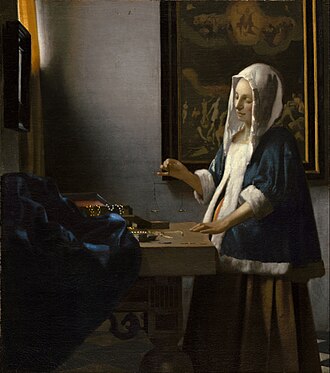 La tasadora de perlas - Johannes Vermeer (1665)
Obras de artistas relacionados
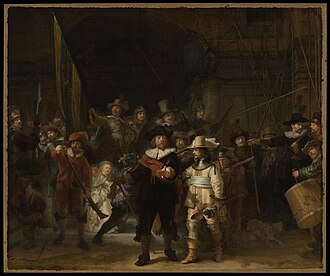 La ronda de noche - Rembrandt van Rijn (1642)
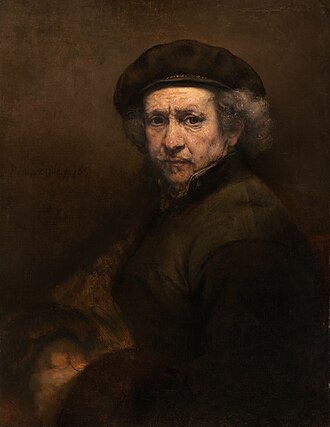 Autorretrato - Rembrandt van Rijn (1659)