Gustave Courbet
1819-1877
Gustave Courbet, the proud son of Ornans, painted stone breakers and village mourners on canvases once reserved for kings and saints. Leader of Realism, he wanted to paint only what he could see, and to be not only a painter but a man as well.
Origins
Courbet was born on 10 June 1819 in Ornans, in the Doubs, to Régis and Sylvie Oudot Courbet. Anti-monarchist feeling ran through the household; his maternal grandfather had fought in the French Revolution. His sisters Zoé, Zélie and Juliette were his first models. In 1839 he went to Paris and worked in the studio of Steuben and Hesse, but an independent spirit, he soon left to teach himself by copying Spanish, Flemish and French masters in the Louvre. His first pictures drew on literature, an Odalisque inspired by Victor Hugo and a Lélia after George Sand, but he soon turned to observed reality. In the early 1840s he painted himself again and again in Romantic roles, as in Self-Portrait with Black Dog and the theatrical Desperate Man. All his life he went home to Ornans to hunt, fish and find inspiration, and his attachment to the Franche-Comté became a defining part of his Realism.
Life and turning points
Trips to the Netherlands and Belgium in 1846 and 1847 convinced him that painters should show the life around them, as Rembrandt and Hals had. At the Salon of 1849, After Dinner at Ornans won him a gold medal, exempting his work from jury approval until the rule changed in 1857. The Salon of 1850 to 1851 brought The Stone Breakers and A Burial at Ornans, praised and fiercely denounced in equal measure, and Courbet became a celebrity, called a genius, a terrible socialist and a savage. In 1855, when his Burial and The Artist's Studio were rejected for the Exposition Universelle, he built his own Pavilion of Realism next door and showed forty paintings. In the late 1860s he painted seascapes on the northern French coast. In 1871 he was imprisoned for six months for his role in the Paris Commune, and from 1873 he lived in exile in Switzerland until his death on 31 December 1877.
Style and technique
Courbet belonged to neither the Romantic nor the Neoclassical school. History painting, the Salon's highest calling, did not interest him, because he believed the artists of one century could not truly reproduce another; the only source of living art was the artist's own experience. With Daumier and Millet he became known as a Realist, painting peasants, the rural middle class and the working poor. For him realism meant not perfect line but spontaneous, rough handling of paint that showed direct observation and the irregularities of nature. He painted ordinary rituals on the grand scale once reserved for religious or royal subjects: A Burial at Ornans measures about 3 by 6.7 metres. His later landscapes, seascapes, hunting scenes, nudes and still lifes were less openly political, yet his seas, from The Calm Sea to The Sailboat fighting violent tides, still show both the beauty and the danger of nature.
Stories and anecdotes
Courbet saw the scene for The Stone Breakers by a roadside near Ornans: an old man and a young one at backbreaking work. It is not often, he told friends, that one meets so complete an expression of poverty, and he asked them to come to his studio the next morning. The painting was destroyed in February 1945, with 153 other pictures, when a truck carrying them from Dresden was bombed. For A Burial at Ornans, recording his great-uncle's funeral, he painted the very townspeople who had been there; critics accused him of pursuing ugliness, and he declared that the painting was in reality the burial of Romanticism. In The Artist's Studio, X-rays show that a man with hunting dogs and a twirled moustache, read as Emperor Napoleon III, was added later, placed among the figures of trivial life and exploitation.
Legacy
Courbet's independence set an example for the Impressionists and later the Cubists, and he holds an important place in nineteenth-century French painting as an innovator willing to make bold social statements. Delacroix championed his efforts, Baudelaire and Champfleury recognised The Artist's Studio as a masterpiece, the American James McNeill Whistler admired him, and he inspired Édouard Manet and the Impressionists. His Realist manifesto of 1855 put his goal plainly: to translate the customs, ideas and appearance of his own time as he himself judged them, and to create living art. He encouraged the image of himself as an unschooled peasant and was often caricatured in the press, but behind the bravado was a painter who insisted that ordinary lives, grief and labour deserved the full dignity of a great canvas.
¿Sabías que…?
- His sisters Zoé, Zélie and Juliette were his first models.
- The Stone Breakers was destroyed in 1945 along with 153 other paintings from Dresden.
- In 1855 he built his own Pavilion of Realism next to the Exposition Universelle.
- He spent his last four years in exile in Switzerland.
pintura del Realismo · academicismo · realismo
Artistas relacionados
Claude Monet · Édouard Manet · Vincent van Gogh
Obras de Gustave Courbet
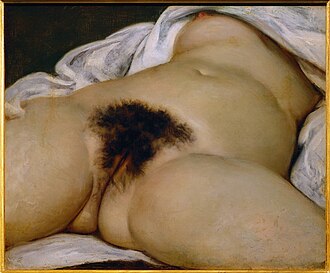 El origen del mundo - Gustave Courbet (1866)
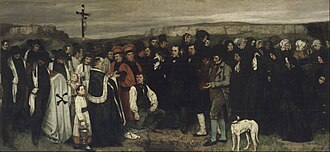 Entierro en Ornans - Gustave Courbet (2020)
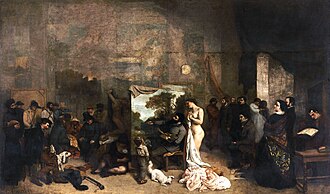 El taller del pintor - Gustave Courbet (1855)
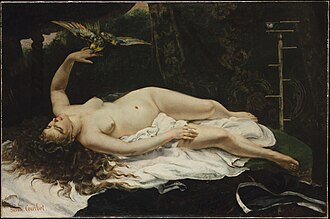 Mujer con loro - Gustave Courbet (1866)
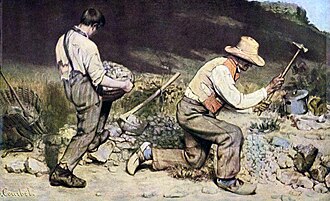 Los rompe piedras - Gustave Courbet (1850)
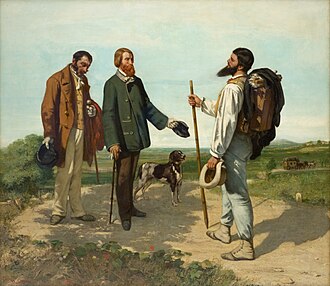 El encuentro - Gustave Courbet (1854)
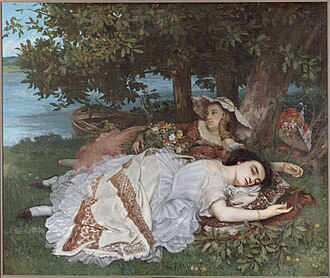 Cortesanas al borde del Sena - Gustave Courbet (1857)
.jpg) La fuente - Gustave Courbet (1862)
La fuente - Gustave Courbet (1862)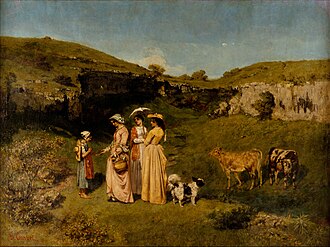 Señoritas del pueblo - Gustave Courbet (1850s)
%20MET%20DT1960.jpg) Madame Auguste Cuoq - Gustave Courbet (1852)
Madame Auguste Cuoq - Gustave Courbet (1852)