Caza del corzo en los bosques del Gran Jura
Gustave Courbet · 1857
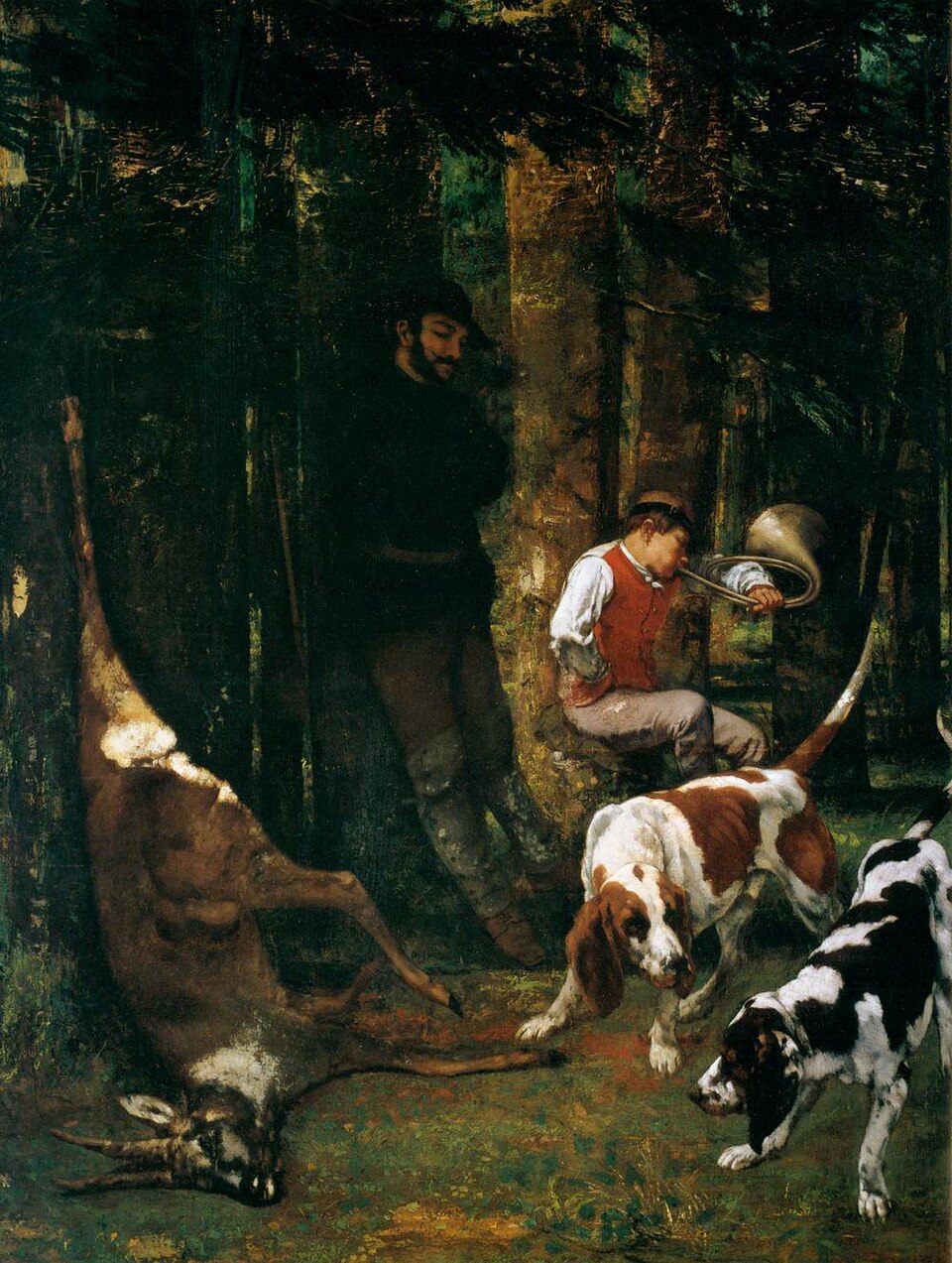
A dead roe deer hangs from a pine, two hounds hesitate below it, a young man blows his horn and the hunter, Courbet himself, leans against a tree and smokes. The Quarry was his first hunting picture and the first Courbet to cross to America.
The story behind the painting
Courbet was a passionate hunter in his native Franche-Comté, and The Quarry, set in the forests of the Jura Mountains, was the first of many works in which he painted the hunt. He did not compose it in one go. He built it up by successive additions: first the deer and the hunter, then the young man and the dogs, and then background areas on extra pieces of canvas sewn on. The finished painting, about 2.1 metres tall and 1.8 metres wide, was first shown at the Salon of 1857 in June of that year.
What to look for
On the left, two hunting dogs approach a roe deer hung from a pine tree by its hind leg, about to receive their share as French hunting tradition requires. One already laps at the deer's blood and may be trying to keep the other away. In the middle, a bearded man in a hat, a self-portrait of Courbet, leans against a second tree beside his rifle, arms crossed, smoking a pipe. On the right the young piqueur, the master of hounds, dressed in red, sits on a stump blowing his horn. Théophile Gautier praised the deer's wet black muzzle, deep eyes and thick, shimmering coat.
Meaning and intent
Critics wondered why nothing happens. Armand Barthet complained that the hunter turns his back on the scene and seems to sleep in indifference, while the hornsman puffs out his cheeks for an impossible fanfare. In 2008 Shao-Chien Tseng read the stillness differently: the horn seems to sound a dirge for the dead, and the hounds, with no signal to begin, hold back. Michael Fried sees the picture as a real allegory about painting itself, with Courbet as the beholder and the piqueur as the effort of painting, his red vest the same colour as Courbet's signature.
Legacy
The picture was better received at the 1857 Salon than Young Ladies on the Banks of the Seine, which made its debut there too, though critics questioned its darkness. Célestin Nanteuil's lithograph, cropped above the hunter's head, appeared in L'Artiste in July 1858. That same year the dealers van Isachers and Jules Luquet bought the painting in Antwerp, and in 1866 they sold it to the Allston Club in Boston, making it the first Courbet to travel to the United States. After several more changes of hands it entered the Museum of Fine Arts, Boston, in 1918.
¿Sabías que…?
- Courbet's first painting on a hunting theme, dated 1857.
- The hunter leaning on the tree is a self-portrait.
- Shown at the Paris Salon of 1857.
- The first Courbet to go to the United States, now in the Museum of Fine Arts, Boston.
Sobre el artista
Gustave Courbet (1819-1877)
Museo de Bellas Artes de Boston
Más obras de Gustave Courbet
 El origen del mundo - Gustave Courbet (1866)
 Entierro en Ornans - Gustave Courbet (2020)
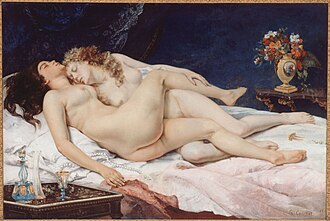 El sueño - Gustave Courbet (1866)
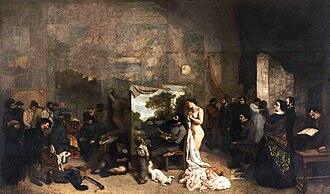 El taller del pintor - Gustave Courbet (1855)
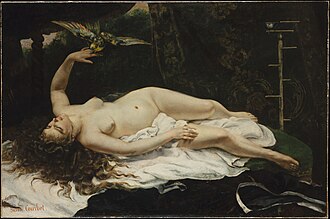 Mujer con loro - Gustave Courbet (1866)
 Los rompe piedras - Gustave Courbet (1850)
 El encuentro - Gustave Courbet (1854)
 Cortesanas al borde del Sena - Gustave Courbet (1857)
Obras de artistas relacionados
 Impresión, sol naciente - Claude Monet (1872)
 Nenúfares - Claude Monet (1906)
 Almuerzo sobre la hierba - Édouard Manet (1863)
 Olympia - Édouard Manet (1863)
 Breezing Up - Winslow Homer (1873)
 The Fog Warning - Winslow Homer (1885)
 La noche estrellada - Vincent van Gogh (1889)
 Terraza de café por la noche - Vincent van Gogh (1888)