Francisco de Zurbarán
1598-1664
Francisco de Zurbarán painted monks, saints and silent still lifes in light so sharp against the dark that he earned the name Spanish Caravaggio. His white robes and stark, quiet figures still hold the eye with rare intensity.
Origins
Francisco de Zurbarán was born in 1598 in Fuente de Cantos, in Extremadura, and baptised on 7 November of that year. His parents were Luis de Zurbarán, a haberdasher, and his wife Isabel Márquez. As a child he began imitating objects with charcoal. In 1614 his father sent him to Seville to serve a three-year apprenticeship with Pedro Díaz de Villanueva, an artist of whom very little is known. Seville at that time had a highly refined tradition of painted sculpture, which surpassed the local painters, and this sculpture, especially the work of Juan Martínez Montañés, gave the young artist an important model. Some art historians also see the severe still lifes of Juan Sánchez Cotán behind his own austere compositions.
Life and turning points
In 1617 Zurbarán married María Paet, nine years older than him; she died in 1624 after the birth of their third child, and in 1625 he married the wealthy widow Beatriz de Morales. On 17 January 1626 he contracted with the Dominican monastery of San Pablo el Real in Seville to paint 21 pictures in eight months, a commission that established him. In 1629 the city elders invited him to settle in Seville, and he moved there with his household. Around 1630 he was appointed painter to Philip IV. Beatriz died in 1639, and in 1644 he married another wealthy widow, Leonor de Torder. After 1640 his austere style was unfavourably compared with Murillo's, and his reputation declined. In 1658 he moved to Madrid in search of work. He died on 27 August 1664.
Style and technique
Zurbarán is known for religious paintings of monks, nuns and martyrs, and for still lifes. It is unknown whether he ever saw Caravaggio's paintings, but he shared a forceful use of light and shadow. His style is more reserved than Caravaggio's, with colour often quite bluish, precisely finished foregrounds and dark, featureless backgrounds. He painted figures directly from nature and used a jointed lay figure to study drapery; he had a special gift for white robes, which is why the white-clad Carthusians appear so often in his work. His compositions are often reduced to a single figure. He struggled with deep space, so settings can resemble a shallow stage, and José Camón Aznar wrote that he succeeded in making a grace of his clumsiness.
Stories and anecdotes
There is a story that Philip IV once laid his hand on Zurbarán's shoulder and said, painter to the king, king of painters. Another popular myth has him dying in poverty, but the source notes that at his death his estate was worth about 20,000 reales. From the late 1630s his workshop produced many paintings for export to South America. One series, Jacob and his twelve sons, seems to have been aimed at that market, yet the originals ended up at Auckland Castle in County Durham, England. In the 1630s he also painted the Labours of Hercules for the Hall of Realms in Madrid, his only group of mythological subjects.
Legacy
His largest composition, The Apotheosis of Saint Thomas Aquinas of 1631, now in the Museum of Fine Arts of Seville, fills the canvas with Christ, the Madonna, saints and Charles V, the main figures larger than life. A life-sized kneeling Saint Francis holding a skull is in the National Gallery, London. Late works such as the Saint Francis in the Alte Pinakothek show softer contrasts and looser brushwork. In 1835 his paintings confiscated from monasteries were displayed in the new Museum of Cádiz. Major exhibitions followed at the Metropolitan Museum of Art in 1987, the Thyssen-Bornemisza Museum in 2015, and the National Gallery in London in 2026, its first major show of his work in the United Kingdom.
¿Sabías que…?
- He was the father of the painter Juan de Zurbarán.
- For the Mercedarians of Seville he was commissioned in 1628 to paint 22 pictures for their cloister.
- In Saint Paul's church in Seville he painted a Crucified Christ in grisaille that creates an illusion of marble.
- His pupils included Bernabé de Ayala, Juan Caro de Tavira and the Polanco brothers.
Artistas relacionados
Caravaggio · Diego Velázquez · Anton van Dyck · Pedro Pablo Rubens · Rembrandt van Rijn · Frans Hals · Johannes Vermeer · Artemisia Gentileschi
Obras de Francisco de Zurbarán
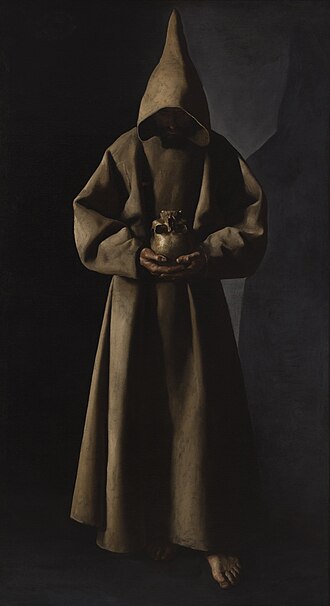 San Francisco - Francisco de Zurbarán (1635)
 Saint Francis in Meditation - Francisco de Zurbarán (1639)
 Inmaculada Concepción - Francisco de Zurbarán (1661)
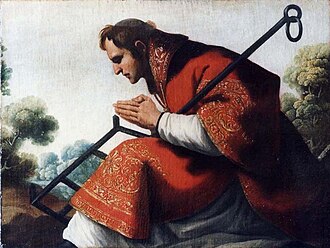 San Lorenzo - Francisco de Zurbarán (1630s)
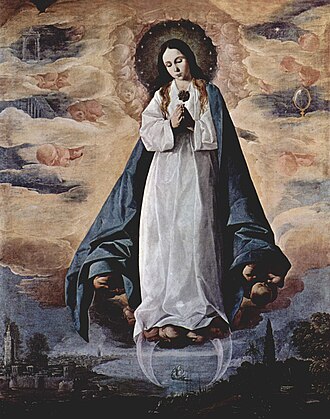 Inmaculada Concepcion - Francisco de Zurbarán (1630)
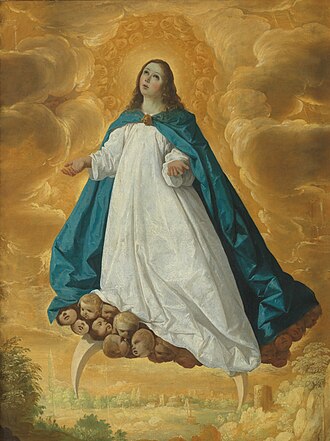 Inmaculada Concepción - Francisco de Zurbarán (1635)
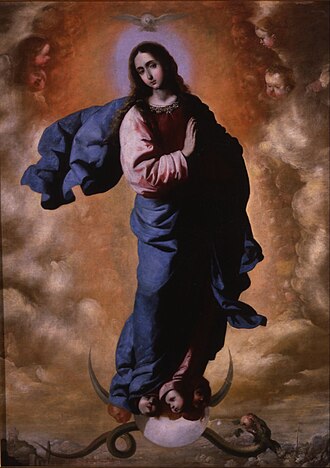 Inmaculada Concepción - Francisco de Zurbarán (1645)
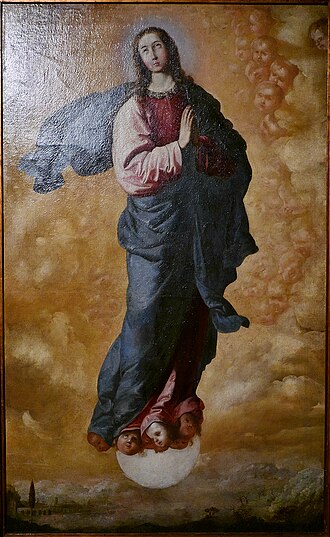 Inmaculada Concepción - Francisco de Zurbarán (1645)
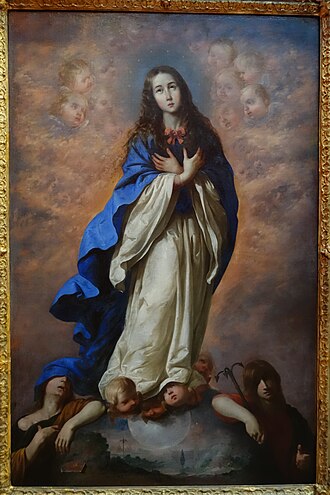 Inmaculada con dos figuras alegóricas - Francisco de Zurbarán (1658)
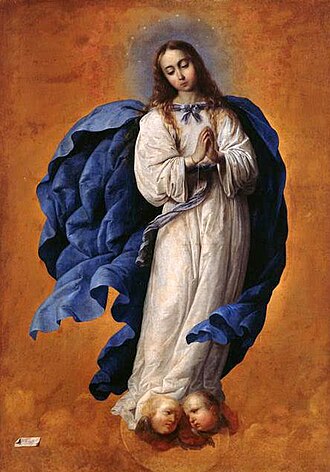 Inmaculada Concepción - Francisco de Zurbarán (1661)