Inmaculada con dos figuras alegóricas
Francisco de Zurbarán · 1658
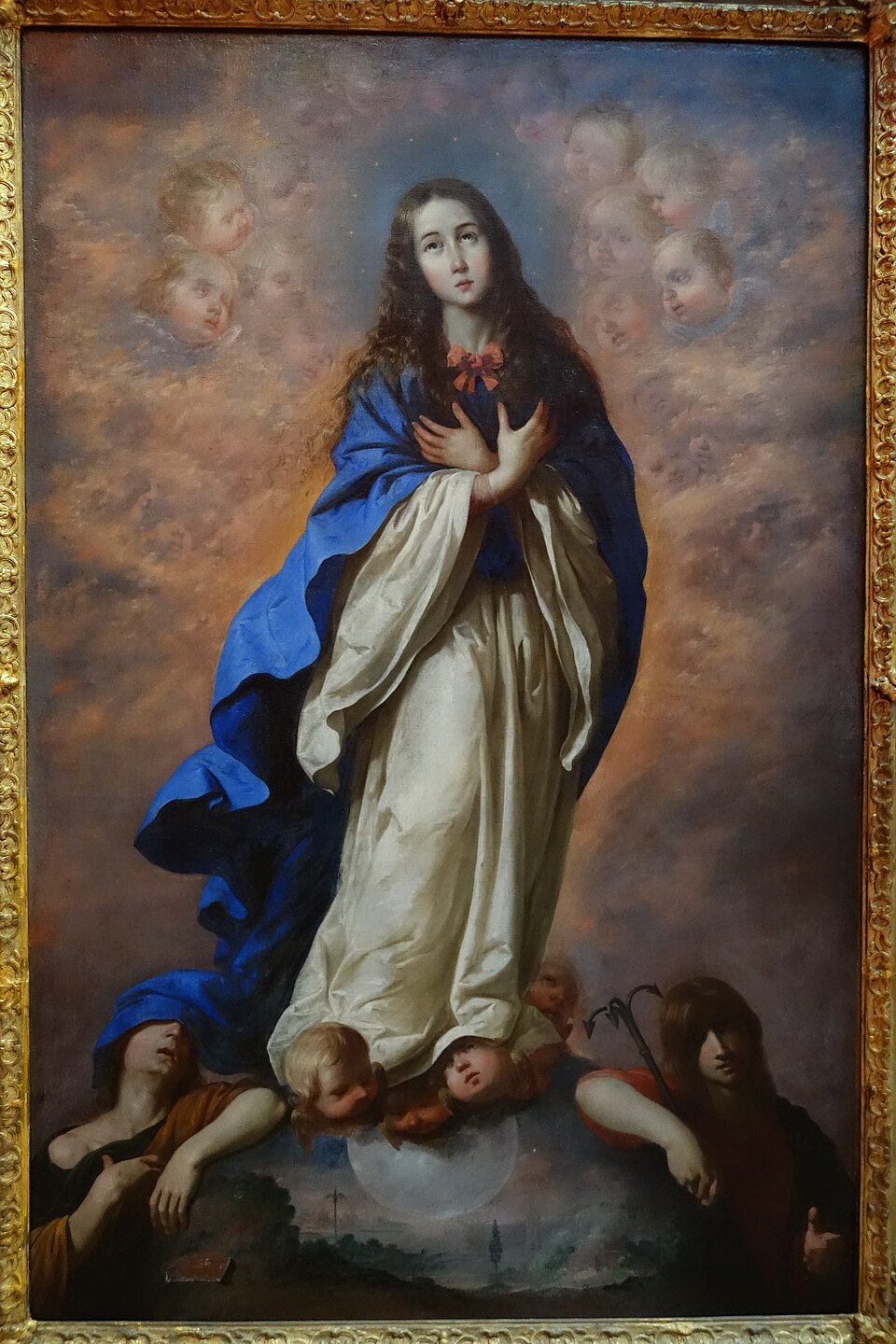
Below a dark-haired girl in a billowing blue mantle, two half-figures turn in opposite ways: one with her eyes covered, one speaking to us. Zurbarán's late Immaculate Conception in Dublin may be a picture about who was blind and who was hoping.
The story behind the painting
For years in Spain, to avoid quarrels between religious orders, with Franciscans in favour of the Immaculate Conception and Dominicans against it, even the phrase had been forbidden. In 1661 Pope Alexander VII issued a constitution approving the doctrine, banning writings against it and authorising its cult. Seville received this with great joy after years of enforced silence, though the dogma itself was only defined on 8 December 1854. Zurbarán painted this canvas, known in Spanish as Immaculate with Two Allegorical Figures, around 1658, in the last years of that waiting. It is number 253 in Odile Delenda's catalogue, and traces of a signature survive on a small cartouche, lower left.
What to look for
Mary appears as a teenage girl with long dark hair, hands crossed on her breast, looking slightly upward. She wears a very long white tunic with wide sleeves, and a large blue mantle tied at the neck with a pretty pink bow ripples in the air. Her face stands out against a bluish halo with the stars of her crown, inside a larger halo of golden angel heads, while faint angel faces drift in the clouds. She rests on a base of small angel heads above the sphere of the moon. The lower left edge of the mantle covers the eyes of an allegorical figure; on the right another half-length woman gestures toward the viewer. Between them lies a landscape with earthly symbols of the litany.
Meaning and intent
The source suggests that the figure with covered eyes may be Faith, and the gesturing woman Hope. The first may allude to the blindness of those who opposed approval of the cult, the second to those who longed for it. Read this way, the painting is not only a devotional image but a quiet comment on a debate that divided the Church. Benito Navarrete Prieto has pointed to a possible influence from an engraving by Juan de Jáuregui for Luis del Alcázar's book on the Apocalypse of 1614. Mary herself is very close to Zurbarán's other Immaculate Conception of 1658, but the rest of the composition is very different.
Legacy
The painting was in the sale of a Captain Larkyns in 1872 and then in the collection of William Graham in London. At Christie's on 10 April 1886, as lot 408, it was bought for the National Gallery of Ireland in Dublin, where it remains. It was cleaned and restored in 1981. Its allegorical figures make it unusual among Zurbarán's many versions of the theme, and a reminder that a devotional image could carry the arguments of its time.
¿Sabías que…?
- Painted around 1658, 166 by 108.5 cm.
- Number 253 in Odile Delenda's catalogue.
- Two allegorical figures, perhaps Faith and Hope, appear at the bottom.
- In the National Gallery of Ireland since 1886.
Sobre el artista
Francisco de Zurbarán (1598-1664)
arte religioso · barroco · Galería Nacional de Irlanda · Inmaculada Concepción
Más obras de Francisco de Zurbarán
 Saint Francis in Meditation - Francisco de Zurbarán (1639)
 Inmaculada Concepción - Francisco de Zurbarán (1661)
 San Francisco - Francisco de Zurbarán (1635)
 Inmaculada Concepción - Francisco de Zurbarán (1635)
 Inmaculada Concepción - Francisco de Zurbarán (1661)
 Inmaculada Concepcion - Francisco de Zurbarán (1630)
 San Lorenzo - Francisco de Zurbarán (1630s)
 Inmaculada Concepción - Francisco de Zurbarán (1645)
Obras de artistas relacionados
 La cena de Emaús - Caravaggio (1601)
 La vocación de San Mateo - Caravaggio (1609)
 Las meninas - Diego Velázquez (1656)
 La rendición de Breda - Diego Velázquez (1635)
 Triple retrato de Carlos I - Anthony van Dyck (1635)
 Charles I (1600-1649) with M. de St Antoine - Anthony van Dyck (1636)
 La elevación de la cruz - Peter Paul Rubens (1609)
 Rapto de las hijas de Leucipo - Peter Paul Rubens (1618)
 La ronda de noche - Rembrandt van Rijn (1642)
 Autorretrato - Rembrandt van Rijn (1659)
 El alegre bebedor - Frans Hals (1620s)
 Caballero sonriente - Frans Hals (1624)