Inmaculada Concepción
Francisco de Zurbarán · 1645
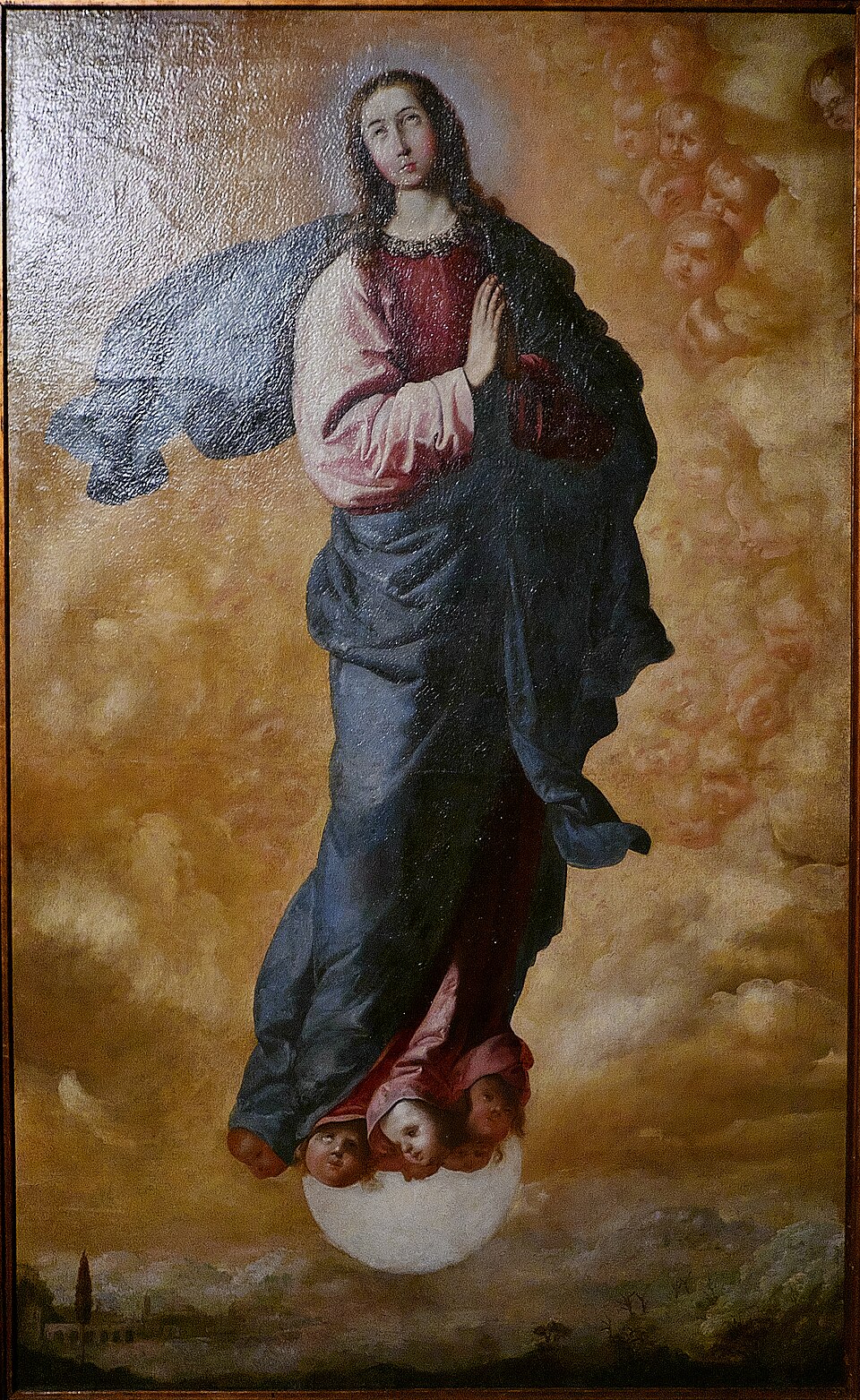
Mary lifts her eyes to heaven while golden clouds full of angel heads curl along her blue-grey mantle. Painted around 1645 for Seville, this Immaculate Conception has divided experts: a sketch, a workshop piece, or a refined work full of movement?
The story behind the painting
The image of the Immaculate Conception took shape during the sixteenth century from a verse in the Book of Revelation and symbols from the Litany of Loreto, and in Seville Luis del Alcázar in 1618 and Francisco Pacheco in his Art of Painting set out how it should look. Pacheco's rules were never followed strictly, and Zurbarán departed from them in the 1640s. This canvas, 198 by 120 cm and dated about 1645, was painted shortly after his version now in the Cerralbo Museum in Madrid. It is number 195 in Odile Delenda's catalogue.
What to look for
The painting follows exactly the same model as the Cerralbo version in pose and clothing, but without its unusual details such as the serpent and the dove, and with a slightly more elongated figure. Mary's face is different: here she looks up to heaven, and her features recall some of the female saints painted by Zurbarán's assistants. On the right, golden clouds with angel heads move in an undulating rhythm that follows the curve of the blue-grey mantle. Typical of the 1640s is the misty landscape lightly painted at the bottom, with a few symbols of the litany dissolved in golden light.
Meaning and intent
In these works of the 1640s the litany symbols that used to surround Mary give way to angel heads, leaving her alone in light. Scholars disagree about this canvas, and the source sets out their views. Juan Miguel Serrera saw a larger share of workshop help here than in the Cerralbo version. Paul Guinard considered it a sketch and judged it earlier than that painting. Martín S. Soria, on the other hand, praised its harmony of contrasts, the quality of its light and shade, its refined execution and its greater movement. The question of how much is Zurbarán's own hand remains open.
Legacy
The painting comes from the Convento del Pópulo in Seville. By 1868 it belonged to the Seville City Council, which still owns it. Since October 2008 it has been on deposit at the Centro Velázquez of the Fundación Focus in Seville, where visitors can see it in the city where Zurbarán worked and where the rules for painting this subject were first written down. It is also catalogued by Tiziana Frati as number 314, alongside the Cerralbo canvas, whose number in her list is 313.
¿Sabías que…?
- Dated about 1645, 198 by 120 cm.
- Number 195 in Delenda's catalogue, 314 in Frati's.
- Owned by Seville City Council since 1868, from the Convento del Pópulo.
- On deposit at the Fundación Focus, Seville, since 2008.
Sobre el artista
Francisco de Zurbarán (1598-1664)
arte religioso · Virgen María · barroco · Inmaculada Concepción
Más obras de Francisco de Zurbarán
 Saint Francis in Meditation - Francisco de Zurbarán (1639)
 Inmaculada Concepción - Francisco de Zurbarán (1661)
 San Francisco - Francisco de Zurbarán (1635)
 Inmaculada Concepción - Francisco de Zurbarán (1635)
 Inmaculada Concepción - Francisco de Zurbarán (1661)
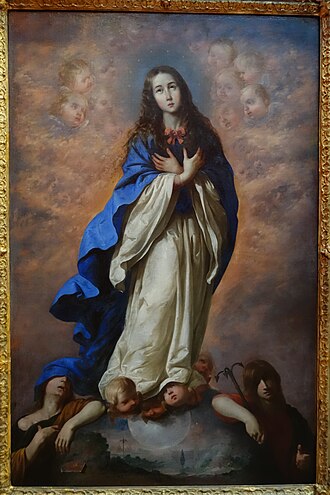 Inmaculada con dos figuras alegóricas - Francisco de Zurbarán (1658)
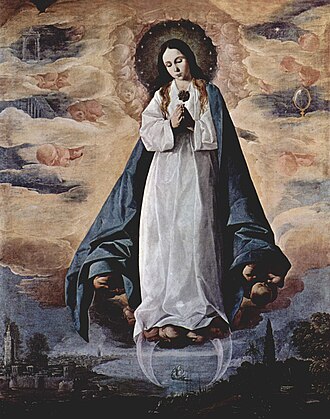 Inmaculada Concepcion - Francisco de Zurbarán (1630)
 San Lorenzo - Francisco de Zurbarán (1630s)
Obras de artistas relacionados
 La cena de Emaús - Caravaggio (1601)
 La vocación de San Mateo - Caravaggio (1609)
 Las meninas - Diego Velázquez (1656)
 La rendición de Breda - Diego Velázquez (1635)
 Triple retrato de Carlos I - Anthony van Dyck (1635)
 Charles I (1600-1649) with M. de St Antoine - Anthony van Dyck (1636)
 La elevación de la cruz - Peter Paul Rubens (1609)
 Rapto de las hijas de Leucipo - Peter Paul Rubens (1618)
 La ronda de noche - Rembrandt van Rijn (1642)
 Autorretrato - Rembrandt van Rijn (1659)
 El alegre bebedor - Frans Hals (1620s)
 Caballero sonriente - Frans Hals (1624)