Tommaso di Folco Portinari (1428–1501); Maria Portinari
Hans Memling · 1470
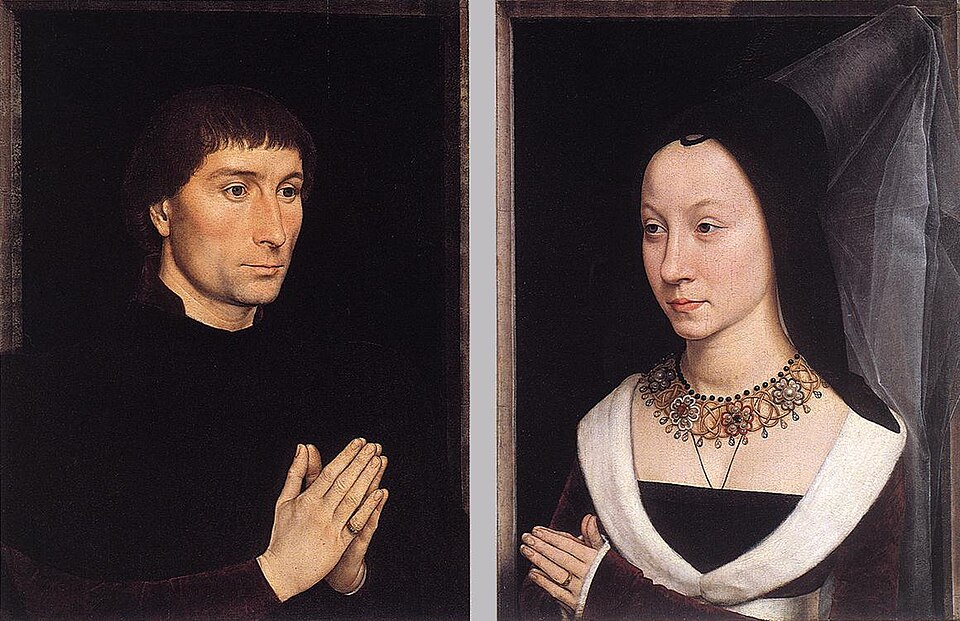
A Florentine banker and his young wife pray side by side, turned towards a Virgin who is no longer there. Memling painted the Portinari couple with porcelain-smooth skin and tiny truthful details, down to a small scar on Tommaso's jaw.
The story behind the painting
Tommaso Portinari was a banker who in 1465 became head of the Medici bank's branch in Bruges, one of the most prominent Florentines there and close to Charles the Bold. His wife, Maria Maddalena Baroncelli, was born in 1456. The French Wikipedia dates the portraits to about 1472, while Wikidata gives 1470. They were the wings of a small folding triptych whose centre, a Virgin and Child, is now lost.
What to look for
Each wing measures about 44 by 34 cm according to Wikipedia. Both figures pray, elbows on an implied ledge, against dark backgrounds. Tommaso wears a black cloak and a ring on his little finger. Maria is dressed in Flemish fashion with a tall hennin and a transparent veil that falls in front of the frame, bringing her closer to us. X-rays revealed the letters T and M, their initials, on her headdress. Her necklace of pearls, rubies and sapphires resembles the one worn by Margaret of York at her 1468 wedding to Charles the Bold, which the couple attended.
Meaning and intent
Memling built Tommaso's head from many fine layers of lead white, pinks and greys, so the brushwork shows only in the nose and the right ear, giving a finish that recalls porcelain. He recorded the shine of the skin, the fine lines around the eyes and the eyebrows almost hair by hair. Yet he also flattered, as a comparison with Hugo van der Goes's less forgiving portrayal of the same couple in the Portinari Triptych shows. The refinement suggests the work was meant to be seen by a small public, probably at the Portinari home.
Legacy
An inventory at Tommaso's death in 1501 describes a small painting with Our Lady in the middle and Tommaso and Maria on the sides. His son Francesco gave it in 1544 to the hospital of Santa Maria Nuova in Florence, where it stayed until the Napoleonic occupation. It later passed to Anatole Demidoff, was once attributed to Dirk Bouts, and moved through dealers in Rome, London, Paris and New York before Benjamin Altman gave it to the Metropolitan Museum in 1913.
Did you know?
- Portraits of the banker Tommaso Portinari and his wife Maria Baroncelli.
- Dated about 1472 by Wikipedia, 1470 by Wikidata.
- The lost centre panel showed the Virgin and Child.
- Given to the Metropolitan Museum by Benjamin Altman in 1913.
About the artist
Hans Memling (1435-1494)
woman · portrait · man · Metropolitan Museum of Art · Early Netherlandish painting
More by Hans Memling
 Annunciation - Hans Memling (1480s)
 Scenes from the Passion of Christ - Hans Memling (1470)
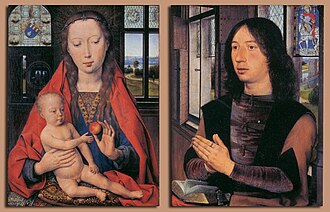 Diptych of Maarten van Nieuwenhove - Hans Memling (1487)
 St John Altarpiece - Hans Memling (1479)
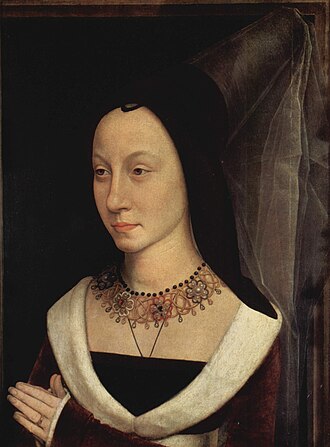 Portrait of Maria Portinari - Hans Memling (1470)
 Christ with singing and music-making Angels - Hans Memling (1480s)
 Moreel Triptych - Hans Memling (1484)
 Madonna of Jacob Floreins - Hans Memling (1485)
Paintings by related artists
 The Descent from the Cross - Rogier van der Weyden (1440s)
 Portrait of a Lady - Rogier van der Weyden (1460)
 Arnolfini Portrait - Jan van Eyck (1434)
 Ghent Altarpiece - Jan van Eyck (1432)
 The Garden of Earthly Delights - Hieronymus Bosch
 Ship of Fools - Hieronymus Bosch (1500s)
 The Hunters in the Snow - Pieter Bruegel the Elder (1565)
 Netherlandish Proverbs - Pieter Bruegel the Elder (1551)