Moreel Triptych
Hans Memling · 1484
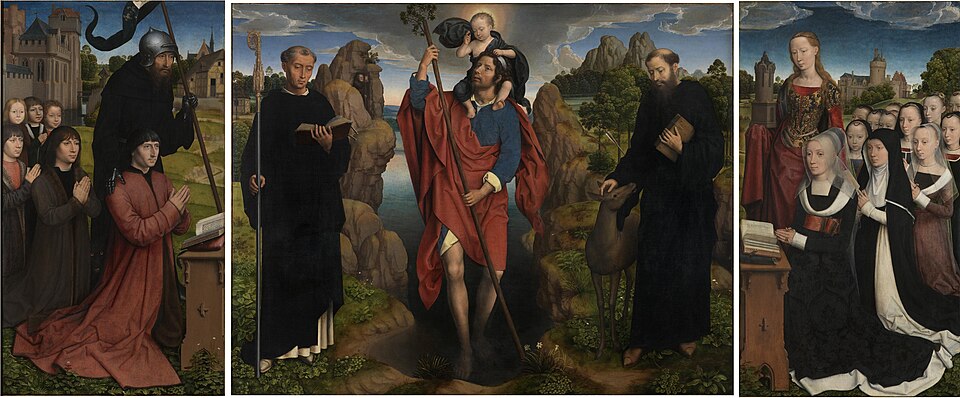
A giant saint wades through water with the Christ Child on his shoulders, while a Bruges family kneels in prayer on either side, sons on the left, daughters on the right. Some of those children were painted in years after Memling finished.
The story behind the painting
The Moreel Triptych, or Saint Christopher Altarpiece, was painted by Hans Memling in 1484 for Willem Moreel, a Bruges politician, merchant and banker, and his wife Barbara van Vlaenderberch. It was meant as their epitaph in a chapel of Saint James's Church, Bruges, which they had paid for and dedicated to Saints Giles and Maurus. Willem was twice alderman and burgomaster, an opponent of Maximilian of Austria, and was imprisoned for six months in 1481. Barbara died in 1499 and Willem in 1501; they were buried outside, and moved before the altar only in 1504.
What to look for
In the centre, Saint Christopher, patron of travellers, stands in water carrying the Christ Child, in a blue coat and long red cape, with a large staff. Saint Maurus holds a crosier and reads; Saint Giles holds an arrow and a doe. On the left, Willem kneels before an open prayer book in a fashionable fur-lined dress, with five sons, presented by Saint William of Maleval. On the right, Barbara kneels in a truncated hennin and red belt with eleven daughters, presented by Saint Barbara, who seems to hold her tower in her hand. One continuous landscape with flowers and cities runs behind all three panels.
Meaning and intent
The family is recorded with care. Of the couple's eighteen children, sixteen appear, identified in the mid 19th century by James Weale from faces, names, records and headstones. One girl is named Maria by the word on her headband; the eldest became a Dominican nun; a daughter, Catherine, may have posed for Memling's Sibylla Sambetha. The art historian Dirk De Vos found that at least six daughters are later additions painted over the landscape, likely by Memling's workshop for children born after 1484. The sons' panel was updated in the same way.
Legacy
The exterior wings show John the Baptist and Saint George slaying the dragon in grisaille. Many historians date them to about 1504, after the deaths of donor and painter, probably commissioned by the sons John and George in the final, successful effort to have their parents buried in the chapel. The panels keep their original frames, each inscribed with the year 1484. Despite damage and poor restorations, they remain in relatively good condition and are today in the Groeningemuseum in Bruges.
Did you know?
- Painted by Hans Memling in 1484 as the Moreels' epitaph.
- Sixteen of the couple's eighteen children appear on the wings.
- At least six daughters were added after the painting was finished.
- Now in the Groeningemuseum, Bruges.
About the artist
Hans Memling (1435-1494)
religious art · Early Netherlandish painting · book · Vlaamse Kunstcollectie · Saint Barbara · Groeningemuseum
More by Hans Memling
 Annunciation - Hans Memling (1480s)
 Scenes from the Passion of Christ - Hans Memling (1470)
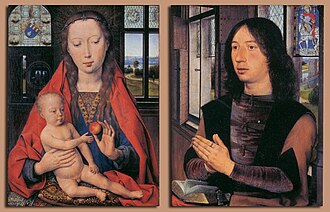 Diptych of Maarten van Nieuwenhove - Hans Memling (1487)
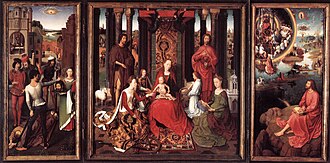 St John Altarpiece - Hans Memling (1479)
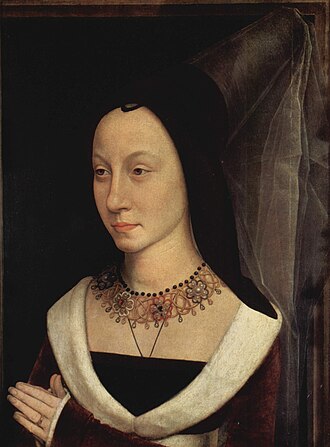 Portrait of Maria Portinari - Hans Memling (1470)
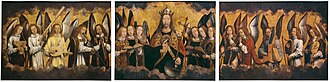 Christ with singing and music-making Angels - Hans Memling (1480s)
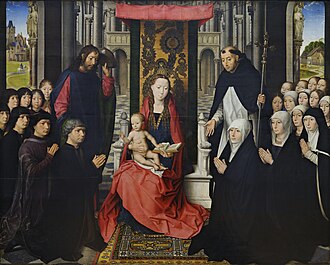 Madonna of Jacob Floreins - Hans Memling (1485)
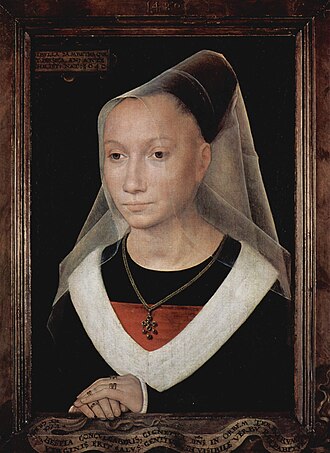 Sibylla Sambetha - Hans Memling (1480)
Paintings by related artists
 The Descent from the Cross - Rogier van der Weyden (1440s)
 Portrait of a Lady - Rogier van der Weyden (1460)
 Arnolfini Portrait - Jan van Eyck (1434)
 Ghent Altarpiece - Jan van Eyck (1432)
 The Garden of Earthly Delights - Hieronymus Bosch
 Ship of Fools - Hieronymus Bosch (1500s)
 The Hunters in the Snow - Pieter Bruegel the Elder (1565)
 Netherlandish Proverbs - Pieter Bruegel the Elder (1551)