Portrait of Maria Portinari
Hans Memling · 1470
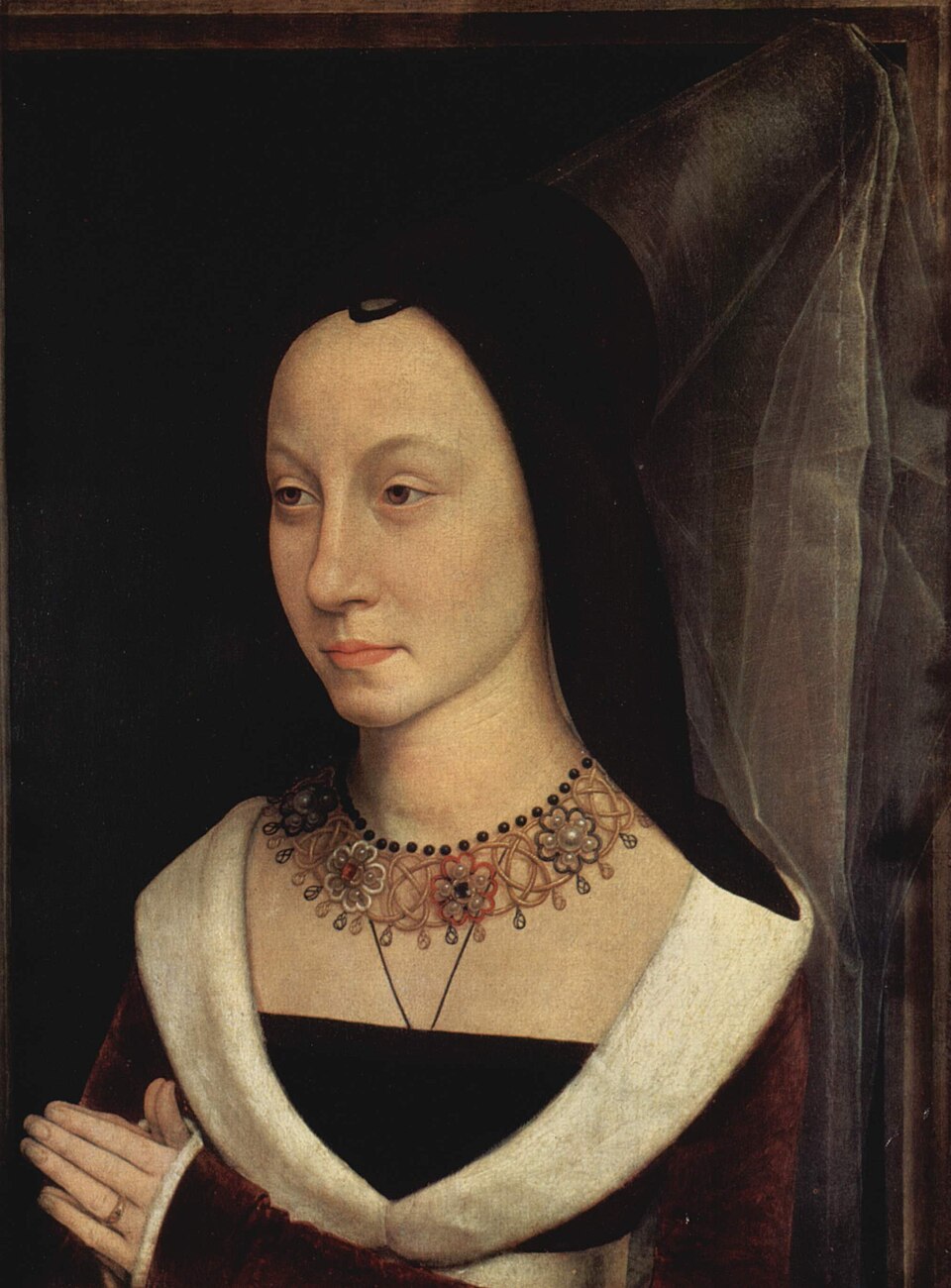
A girl of about fourteen, hands joined in prayer, under a tall black hennin and a necklace of rubies, sapphires and pearls. Hans Memling painted Maria Portinari around 1470, shortly before or after her wedding to a Medici banker in Bruges.
The story behind the painting
Maria Maddalena Baroncelli, born in 1456, was about fourteen when she married the Italian banker Tommaso Portinari, who ran the Bruges branch of the Medici bank and was a keen patron of Flemish art. Around 1470 he commissioned Hans Memling to paint a small hinged triptych: his own portrait on the left, Maria on the right, and a Virgin and Child in the centre. Their small size suggests private prayer. Tommaso later lost his position after risky loans to Charles the Bold. Very little is known about Maria herself.
What to look for
Maria turns three-quarters to the left against a flat dark background, her hands joined in prayer, though unrealistically off centre. Her elbows seem to rest on the painted stone frame, a trick that brings her closer to us. The tall black hennin carries a transparent veil falling to her shoulder. Her necklace of gold, pearls, rubies and sapphires holds three open flowers and hangs with small teardrops. X-rays show pearls on the hennin once spelled T and M, for Tommaso and Maria, and were painted out.
Meaning and intent
This is a devotional picture: Maria prays towards the lost Virgin and Child at the centre. Her face is idealised, with raised eyebrows and a long nose, and her body is slightly small for her head, as in other northern portraits of the time. Maryan Ainsworth suggests the pearl monogram was removed as too open a display of wealth before the Virgin. The necklace closely resembles one worn by Margaret of York at her 1468 wedding to Charles the Bold, which the Portinaris attended.
Legacy
The triptych passed to Tommaso's son Francesco, who left it to the hospital of Santa Maria Nuova in Florence, where it was probably broken up around the Napoleonic period. The panel was once attributed to Hugo van der Goes and to van Eyck, and sold in 1870 as a Dieric Bouts, but was recognised as Memling's by the 1902 Bruges exhibition. Hugo van der Goes painted Maria again in the Portinari Altarpiece with a very similar necklace. Since 1910, with Benjamin Altman, the couple hang side by side at the Metropolitan Museum.
Did you know?
- Painted by Hans Memling around 1470, when Maria was about 14.
- Right wing of a triptych whose central Virgin and Child is lost.
- X-rays show the hennin once carried pearl initials T and M.
- Hangs beside her husband's portrait in the Metropolitan Museum of Art.
About the artist
Hans Memling (1435-1494)
woman · portrait · Metropolitan Museum of Art · Early Netherlandish painting · hat · necklace
More by Hans Memling
 Annunciation - Hans Memling (1480s)
 Scenes from the Passion of Christ - Hans Memling (1470)
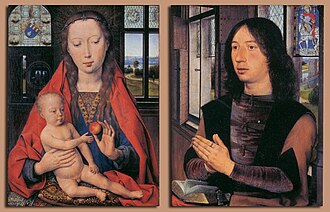 Diptych of Maarten van Nieuwenhove - Hans Memling (1487)
 St John Altarpiece - Hans Memling (1479)
 Christ with singing and music-making Angels - Hans Memling (1480s)
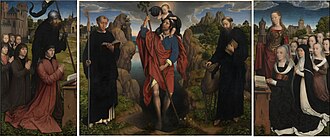 Moreel Triptych - Hans Memling (1484)
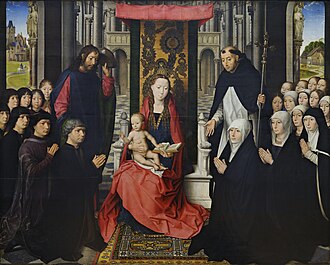 Madonna of Jacob Floreins - Hans Memling (1485)
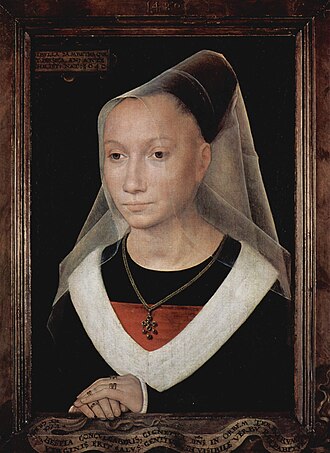 Sibylla Sambetha - Hans Memling (1480)
Paintings by related artists
 The Descent from the Cross - Rogier van der Weyden (1440s)
 Portrait of a Lady - Rogier van der Weyden (1460)
 Arnolfini Portrait - Jan van Eyck (1434)
 Ghent Altarpiece - Jan van Eyck (1432)
 The Garden of Earthly Delights - Hieronymus Bosch
 Ship of Fools - Hieronymus Bosch (1500s)
 The Hunters in the Snow - Pieter Bruegel the Elder (1565)
 Netherlandish Proverbs - Pieter Bruegel the Elder (1551)