The Martyrdom of St Sebastian
Hans Memling · 1475
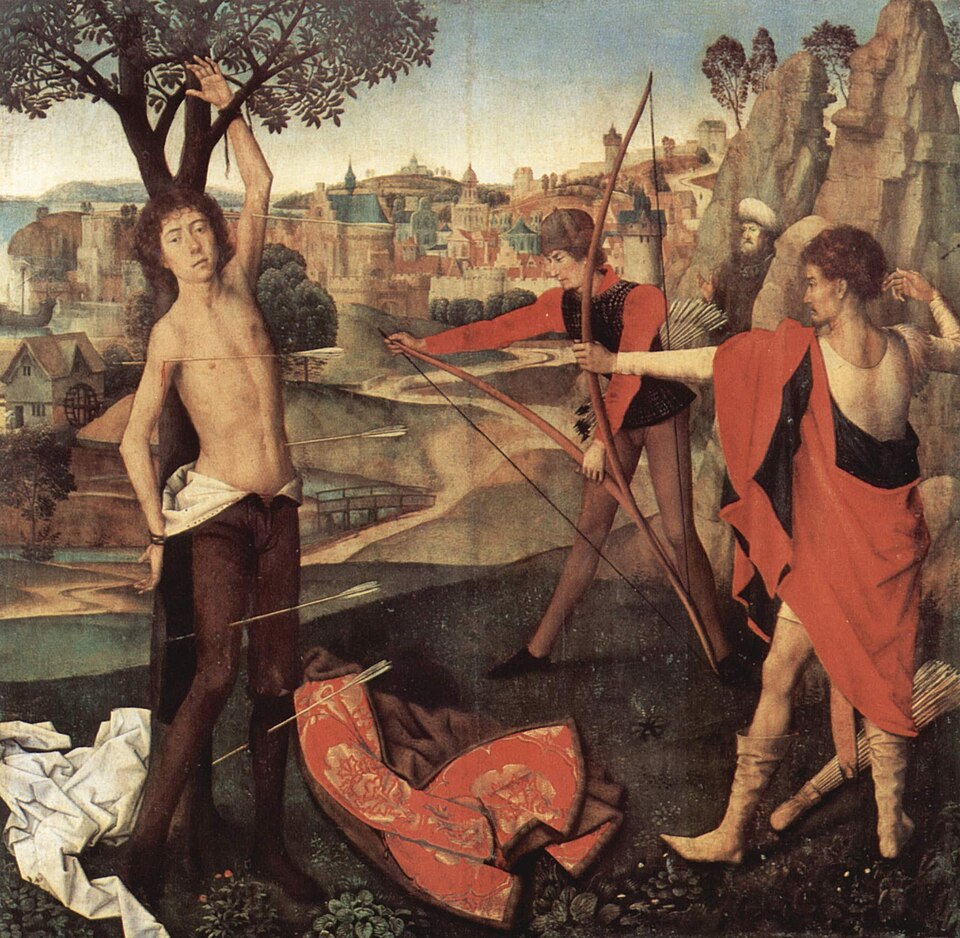
Five arrows pierce a young man tied to a tree, yet his face shows no pain at all. Behind him a whole walled harbour town glitters in the distance. This is Memling's gentle, unforgettable vision of martyrdom.
The story behind the painting
Hans Memling was born in the Electorate of Mainz and settled in the southern Netherlands around 1455 to 1460, probably training in the workshop of Rogier van der Weyden. He painted this oil on oak panel around 1475. Its subject is Sebastian, a young captain of the Praetorian Guard who helped Christians during Diocletian's persecutions. Discovered, he refused to give up his faith and was handed to archers. Left for dead, he survived thanks to a widow named Irene, but was later arrested again and put to death.
What to look for
The panel is almost square, about 67 cm each way. The scene is set on high ground above a wide landscape: a port town inside medieval walls. On the right one archer has just let fly while a second draws his bow. Behind them, half hidden between two rocks, the Emperor Diocletian gives the order. On the left Sebastian, bare chested, is bound to a tree, his shirt and rich brocade cloak thrown at his feet. Five arrows pierce him, yet no sign of suffering marks his face. Flowers and the city panorama are rendered with great care.
Meaning and intent
Memling chose the first confrontation with the archers and, as was customary, showed it gently, without brutality or drama. The calm face is a sign of faith triumphant, typical of his search for softness of form. Because the arrow was a symbol of plague, Sebastian, who survived it, became the great protector against that disease, and his pose, one arm down and one tied above his head, recalls German prints that accompanied prayers against plague. The arrows in his four limbs and side also point to the five wounds of Christ.
Legacy
Memling was among the first painters to create real depth with a distant landscape behind his figures, placing legendary scenes in realistic settings, and this panel is one example. His fine detail and rendering of materials, above all the brocade cloak in the foreground, place him among the great Flemish painters of the fifteenth century. This was his first treatment of the subject; he returned to it on a wing of the Resurrection triptych in the Louvre. The Royal Museums of Fine Arts of Belgium acquired the panel from the Paris dealer Léon Gauchez in 1884.
Did you know?
- Oil on oak panel, around 1475.
- Shows Sebastian struck by five arrows on Diocletian's order.
- Sebastian was invoked against the plague.
- In the Royal Museums of Fine Arts of Belgium since 1884.
About the artist
Hans Memling (1435-1494)
religious art · Early Netherlandish painting · Royal Museums of Fine Arts of Belgium · Saint Sebastian
More by Hans Memling
 Annunciation - Hans Memling (1480s)
 Scenes from the Passion of Christ - Hans Memling (1470)
 Diptych of Maarten van Nieuwenhove - Hans Memling (1487)
 St John Altarpiece - Hans Memling (1479)
 Portrait of Maria Portinari - Hans Memling (1470)
 Christ with singing and music-making Angels - Hans Memling (1480s)
 Moreel Triptych - Hans Memling (1484)
 Madonna of Jacob Floreins - Hans Memling (1485)
Paintings by related artists
 The Descent from the Cross - Rogier van der Weyden (1440s)
 Portrait of a Lady - Rogier van der Weyden (1460)
 Arnolfini Portrait - Jan van Eyck (1434)
 Ghent Altarpiece - Jan van Eyck (1432)
 The Garden of Earthly Delights - Hieronymus Bosch
 Ship of Fools - Hieronymus Bosch (1500s)
 The Hunters in the Snow - Pieter Bruegel the Elder (1565)
 Netherlandish Proverbs - Pieter Bruegel the Elder (1551)