The Disrobing of Christ. Lyon half painting version
El Greco · 1580s
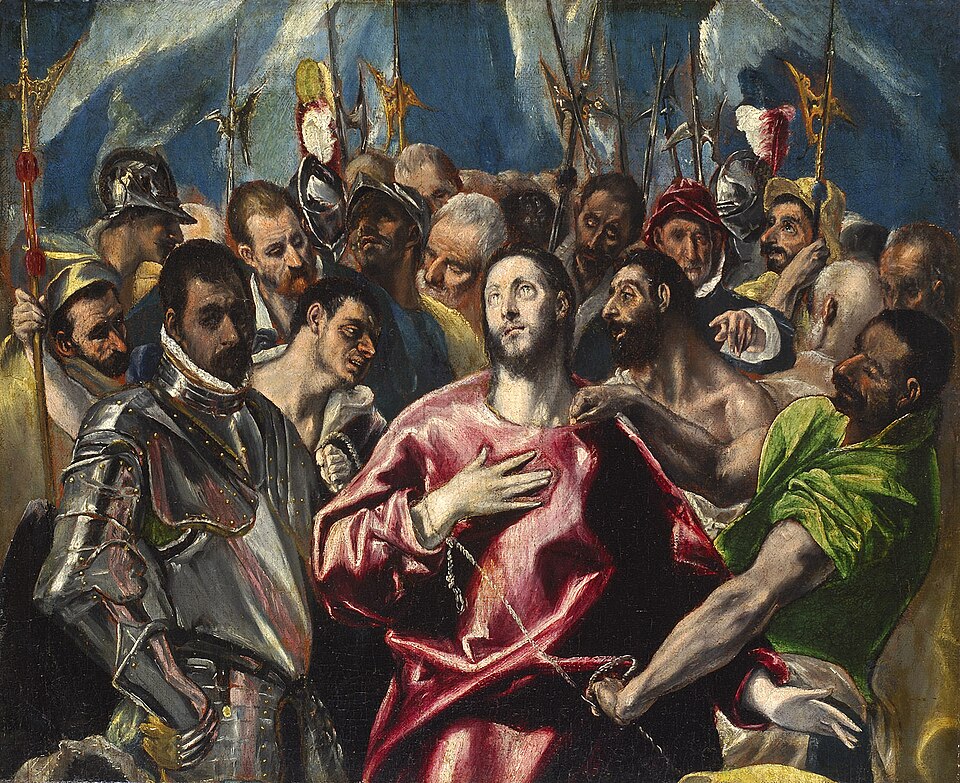
Only the upper half of El Greco's famous Toledo altarpiece survives in this small Lyon canvas: Christ's lit face, the glint of armour, the crowd sinking into shadow. In a few years, the painter had moved from pure colour to light.
The story behind the painting
El Greco painted the original El Expolio for Toledo Cathedral between 1577 and 1579, barely two years after arriving in Spain, and it established him as a painter valued by the elite. He and his workshop then made many replicas. This one, painted between 1581 and 1586, is in the Musée des Beaux-Arts de Lyon, bequeathed in 1886 by Alfred Bellet du Poisat. Specialists such as Cossío, Camón Aznar and Söhner consider it autograph, while Mayer is cited both among them and as seeing it as a workshop piece, as he does most versions, a contradiction in the source. Wikipedia gives its size as 47 by 58 cm and Wikidata as 46 by 58 cm.
What to look for
Where the Toledo canvas is vertical and monumental, five of the replicas, including Lyon's, keep only the upper part in a small horizontal format, and this is the smallest of them. Christ arrives at the top of Golgotha escorted by soldiers in helmets and armour like those of Philip II's armies. A man to the right binds Christ's hand with a rope, his green coat now broken by shadow and touches of yellow, and a man in yellow bores into a beam to make the place for a nail. Christ's robe is no longer a flat field of colour but modelled in deep folds, and reflections shine on weapons and armour.
Meaning and intent
The cathedral clergy had objected that the three Marys at the bottom of the Toledo picture were not in the Gospel account, and the source suggests this is why several replicas, Lyon's among them, leave out the lower part and the Marys. With half the height gone, the composition changes completely. Colour, the pure colour that recalls the Byzantine tradition El Greco learned in Crete, gives way to light and strong chiaroscuro. The sky no longer stands out from the crowd but swallows it, and everything leads to Christ's face, whose light seems to illuminate the scene.
Legacy
The Lyon canvas is part of a long family of copies, autograph or from the workshop, that grew from the success of the Toledo original, one of El Greco's most celebrated works. The largest horizontal replica, in Bilbao, measures 136 by 162 cm; the Lyon one is the smallest. Comparing it with Toledo, the source sees proof of how fast El Greco's style evolved in the three or four years between them, from bright contrasts of vermilion, green, yellow and deep blue toward a darker, more unified world where light, not colour, holds the picture together.
Did you know?
- A partial replica of El Greco's Toledo El Expolio, painted 1581-1586.
- The smallest of five horizontal versions showing only the upper half.
- Bequeathed to the Musée des Beaux-Arts de Lyon in 1886.
- Light and chiaroscuro replace the pure colour of the original.
About the artist
El Greco (1541-1614)
religious art · crowd · soldier · Museum of Fine Arts of Lyon
More by El Greco
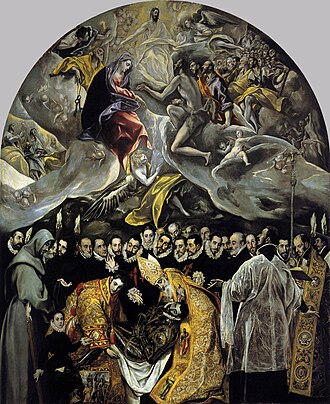 The Burial of the Count of Orgaz - El Greco (1586)
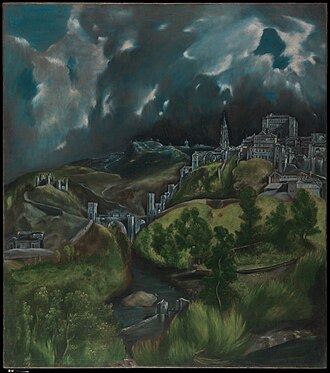 View of Toledo - El Greco (1596)
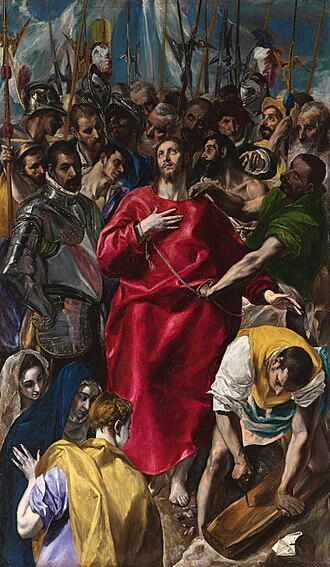 The Disrobing of Christ - El Greco (1570s)
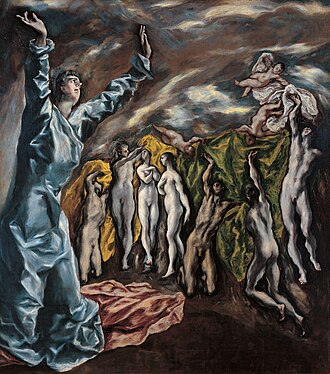 Opening of the Fifth Seal - El Greco (1610)
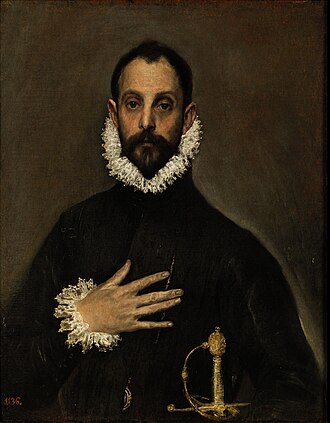 The Nobleman with his Hand on his Chest - El Greco (1580)
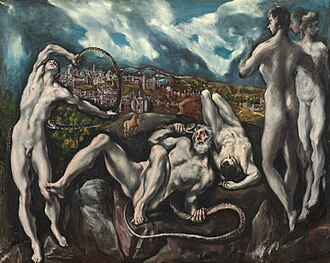 Laocoön - El Greco (1610s)
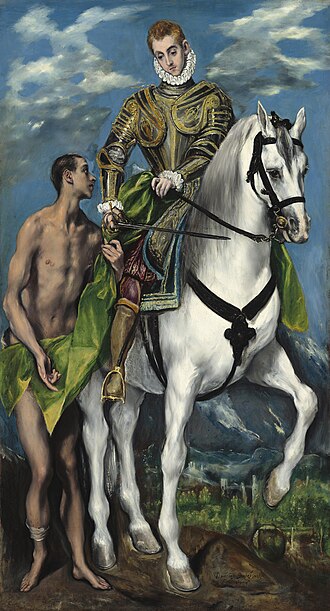 Saint Martin and the Beggar - El Greco (1597)
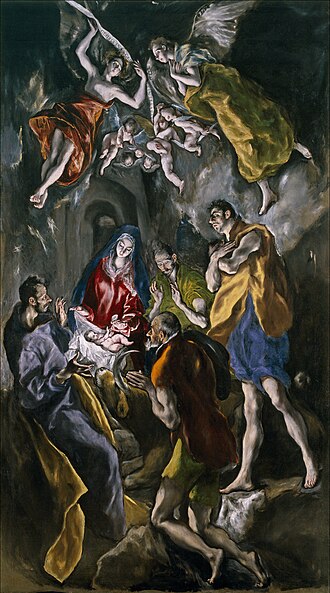 Adoration of the Shepherds - El Greco (1612)
Paintings by related artists
 The Wedding at Cana - Paolo Veronese (1560s)
 The Feast in the House of Levi - Paolo Veronese (1573)
 Last Supper - Jacopo Tintoretto (1563)
 Miracle of the Slave - Jacopo Tintoretto (1540s)
 Venus of Urbino - Titian (1538)
 Assumption of the Virgin - Titian (1510s)
 Supper at Emmaus - Caravaggio (1601)
 The Calling of Saint Matthew - Caravaggio (1609)
 The Ambassadors - Hans Holbein the Younger (1533)
 The Body of the Dead Christ in the Tomb - Hans Holbein the Younger (1520s)