The Black Brunswicker
John Everett Millais · 1860
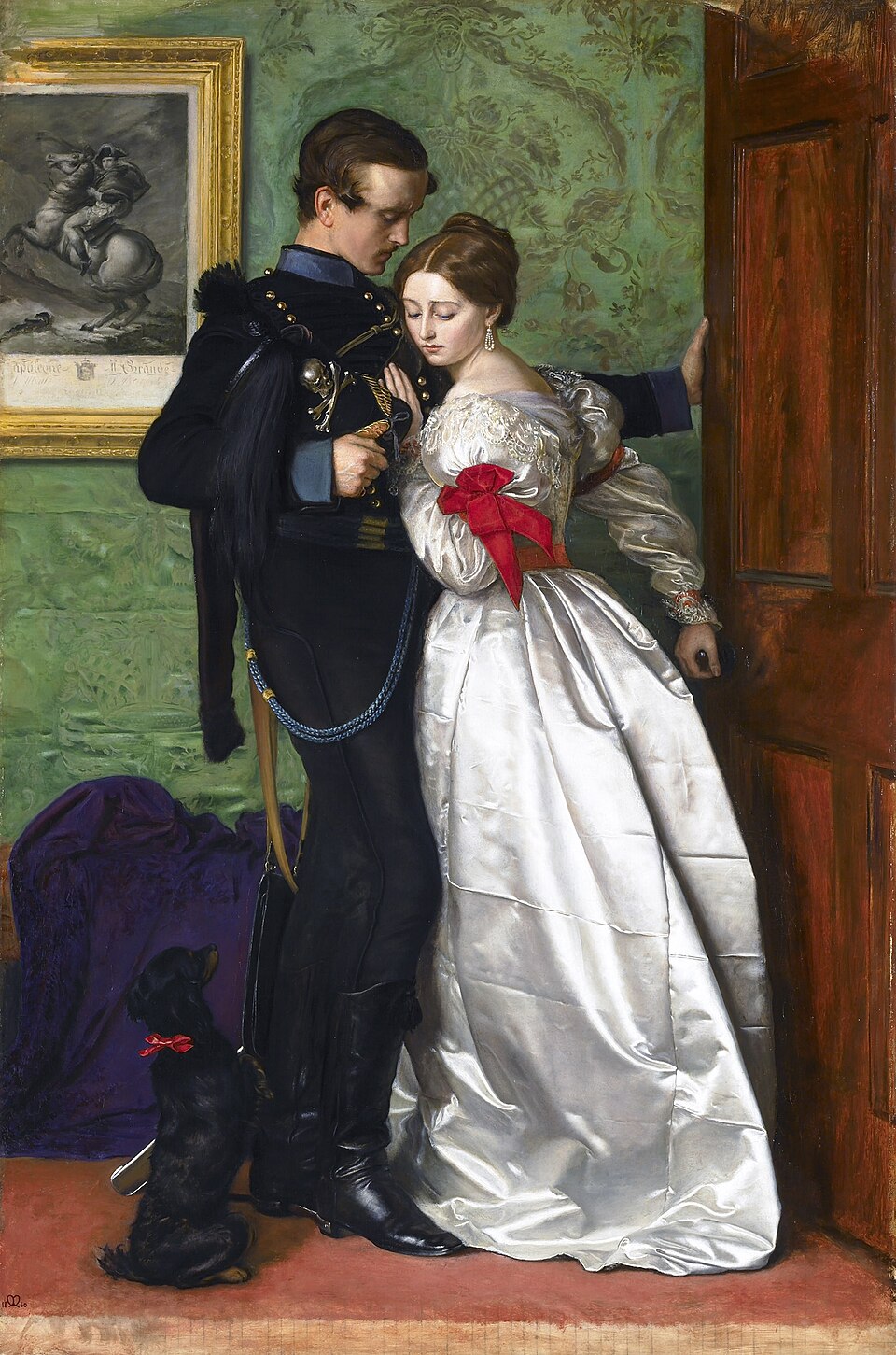
A soldier in black pulls a door open; a woman in a white satin ballgown pushes it shut. Millais painted the moment before he leaves for battle, yet the two models never met.
The story behind the painting
The Black Brunswickers were a German volunteer corps of the Napoleonic Wars. Millais took his subject from their part in the Waterloo campaign, and from the contrast of black broadcloth and pearl-white satin. The scene seems inspired by the Duchess of Richmond's ball on 15 June 1815, from which officers left to join the troops at Quatre Bras. Millais wrote to his wife, Effie Gray, that the war correspondent William Howard Russell thought the idea first-rate and would gather the information he needed. He meant it as a perfect pendant to The Huguenot, his first great success, and it came after a lean period for him.
What to look for
The soldier pulls the door open, his sweetheart in her ballgown tries to push it closed. Her dog, wearing a red ribbon like its mistress, watches closely. Millais took particular care with the correctness of the uniform. On the damask-hung wall hangs an engraving after Jacques-Louis David's Napoleon Crossing the Alps, the only trace of Napoleon in the picture. Millais once planned a black mourning armband sewn by the woman, echoing The Huguenot, but the idea was dropped and appears in no surviving drawing.
Meaning and intent
The print on the wall puzzled critics. Blackwood's Edinburgh Magazine wrote of possible cross purposes and rival jealousies, and The Times suggested her reluctance came partly from a romantic admiration for the great conqueror. Other critics think the print points both to Waterloo and to recent events, Napoleon III's attack on Austrian Lombardy in 1859, which repeated his predecessor's crossing of the Alps. The tenderness is real but staged: Kate Perugini, Charles Dickens' auburn-haired daughter, posed for the woman, and an anonymous soldier, who died of consumption soon after, posed for the man. Each embraced a wooden figure.
Legacy
The work took about three months to paint. It brought Millais the highest sum he had yet received, from the dealer Ernest Gambart, and later passed to the collector Thomas Plint and, after Plint's sale, in 1898 to William Hesketh Lever. Its likeness to The Huguenot is widely read as an attempt to repeat that earlier triumph. Millais liked it so much that he kept a copy in the family, and painted two watercolour versions. T. L. Atkinson engraved it in mezzotint in 1864. The canvas is now in the Lady Lever Art Gallery.
Did you know?
- Painted in 1860, inspired by the Waterloo campaign.
- Meant as a pendant to Millais' The Huguenot.
- Kate Perugini, Dickens' daughter, posed for the woman.
- Lady Lever Art Gallery.
About the artist
John Everett Millais (1829-1896)
woman · man · genre art · Pre-Raphaelite Brotherhood · brown hair · couple · moustache · military uniform
More by John Everett Millais
 Ophelia - John Everett Millais (1851)
%20-%20Google%20Art%20Project.jpg) Christ in the House of His Parents - John Everett Millais (1849)
Christ in the House of His Parents - John Everett Millais (1849) Isabella - John Everett Millais (1849)
 Autumn Leaves - John Everett Millais (1856)
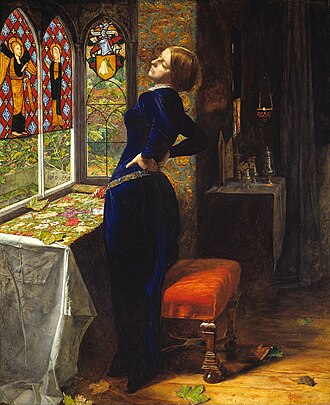 Mariana - John Everett Millais (1851)
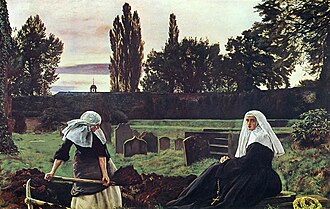 The Vale of Rest - John Everett Millais (1850s)
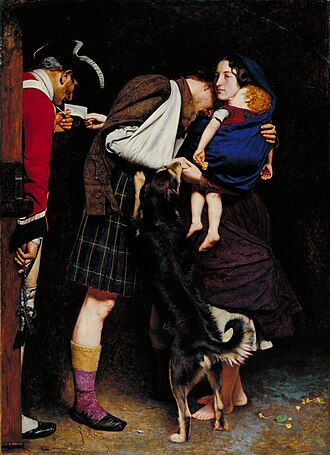 The Order of Release - John Everett Millais (1850s)
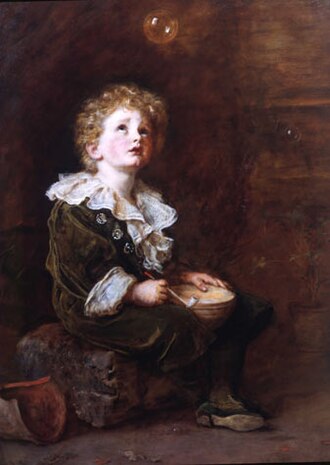 Bubbles - John Everett Millais (1886)
Paintings by related artists
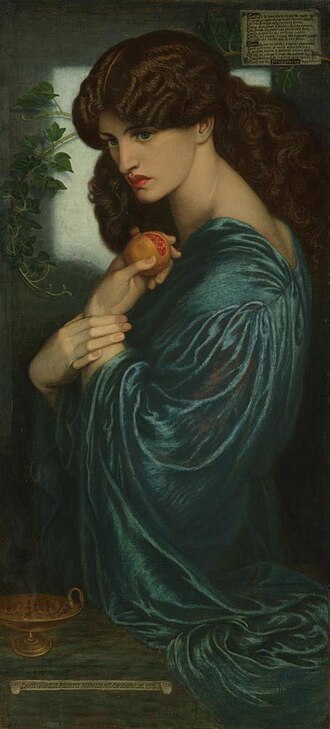 Proserpine - Dante Gabriel Rossetti (1874)
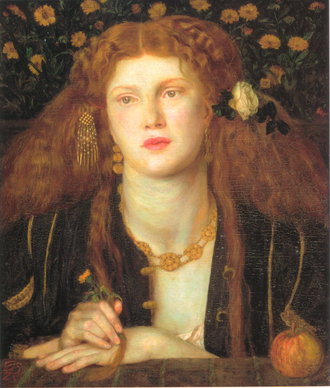 Bocca Baciata - Dante Gabriel Rossetti (1859)
 Hylas and the Nymphs - John William Waterhouse (1896)
.jpg) The Lady of Shalott - John William Waterhouse (1888)
The Lady of Shalott - John William Waterhouse (1888)