St. Matthew
Frans Hals · 1625
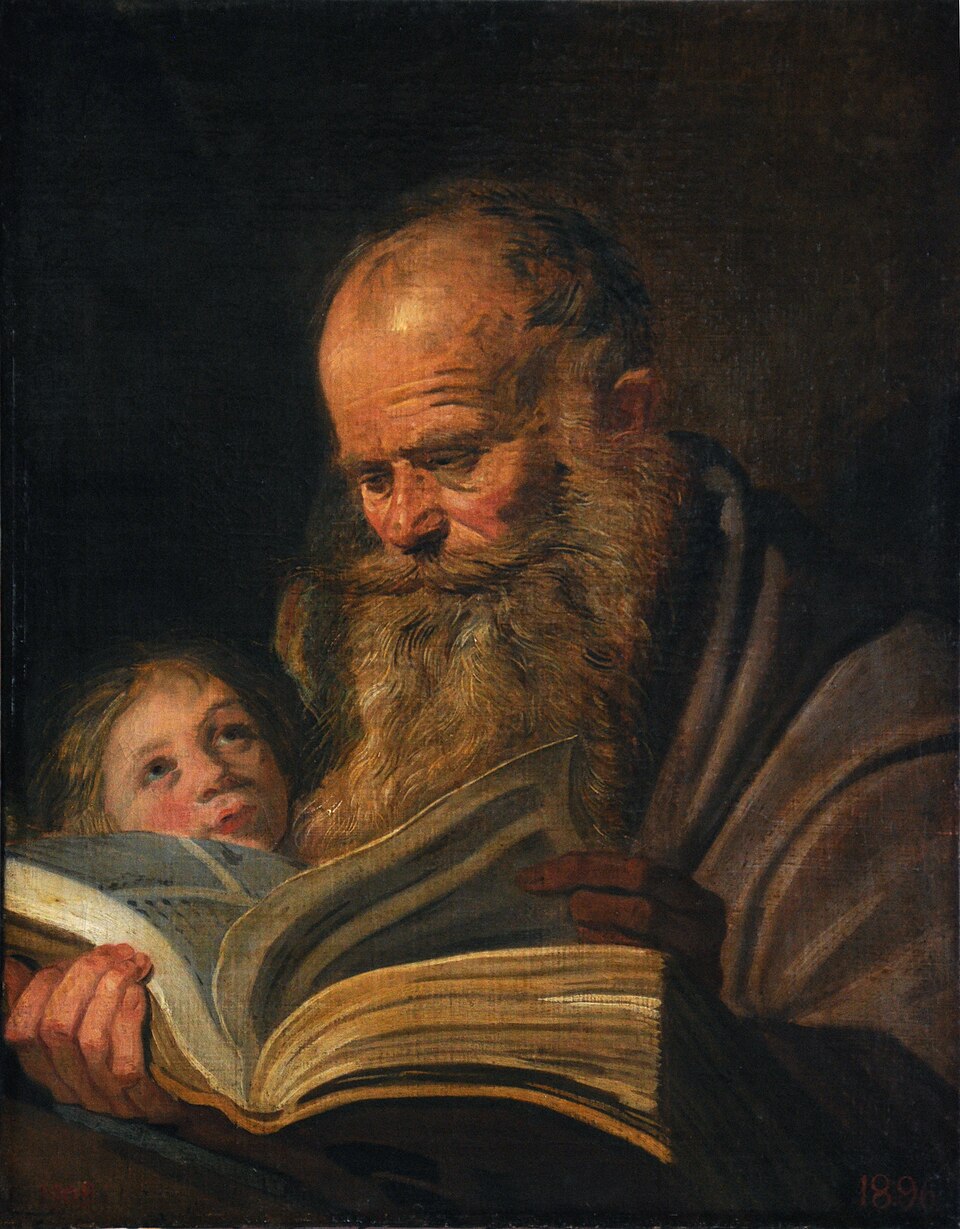
An old evangelist reads at his desk while a wide-eyed child looks up at him. For more than a century this canvas sat unrecognised in Ukraine, until a scholar saw the hand of Frans Hals in it.
The story behind the painting
Frans Hals painted St. Matthew in 1625 as part of a set of four evangelists, sharing one theme, one palette and his own way of handling paint. The earliest records of the picture are Dutch inventories of the 18th century. In 1771 Catherine II acquired the evangelists for her collection and brought them to St Petersburg, where they stayed in storage, and in 1774 they were numbered in the Hermitage catalogue. In 1812 Tsar Alexander I sent Matthew and Luke, with other paintings, to Catholic churches in the colonies of New Russia.
What to look for
Matthew sits at a desk, reading, with an angel at his elbow. On his left a young child gazes up at him with widened eyes. The saint is wrapped in heavy, voluminous fabric whose folds and creases are built from shadows, giving his body real weight. In his hands is a book with yellowed, slightly worn pages, its back leaning against the table. The figures are pressed close together and fill the centre of the canvas, about 70 by 50 cm, so the moment feels intimate rather than grand.
Meaning and intent
The painting pairs a main figure with a secondary witness, the child who watches the saint. Seymour Slive, in his 1989 catalogue of the international Hals exhibition, set this picture beside Hals' Two Singing Boys with a Lute and a Music Book to show that this pairing was common in Hals' work of the 1620s. He noted that the models used as witnesses in the two paintings were clearly cousins. The effect is human and warm: holy reading seen through the eyes of a curious child.
Legacy
Where the painting was between 1812 and 1948, when it was registered in Odesa's Museum of Western and Eastern Art, is unclear, and wartime losses destroyed much of its paper trail. At the time it was thought to be by an unknown 19th century painter, until Linnik recognised a 17th century master and identified Matthew and Luke as two of Hals' four lost evangelists. They were shown at the Haarlem Hals retrospective in 1962 and in Moscow in 1965, and the attention led to the rediscovery of John and Mark. In 2025 the work was on display in Berlin's Gemäldegalerie.
Did you know?
- Painted by Frans Hals in 1625, one of four evangelists.
- Acquired by Catherine II in 1771.
- Rediscovered in Odesa and recognised as a Hals by Linnik.
- Owned by the Odesa Museum of Western and Eastern Art; shown in Berlin in 2025.
About the artist
Frans Hals (1591-1666)
religious art · man · Matthew the Apostle
More by Frans Hals
 A Militiaman Holding a Berkemeyer, Known as the ‘Merry Drinker’ - Frans Hals (1620s)
 Laughing Cavalier - Frans Hals (1624)
 Gipsy Girl - Frans Hals (1628)
 Malle Babbe - Frans Hals (1640s)
 Willem van Heythuysen posing with a sword - Frans Hals (1625)
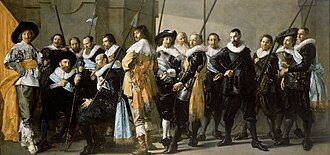 Militia Company of District XI under the Command of Captain Reynier Reael - Frans Hals (1630s)
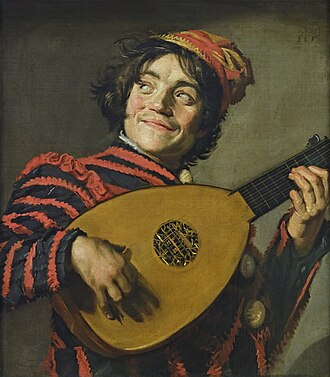 Jester with lute - Frans Hals (1623)
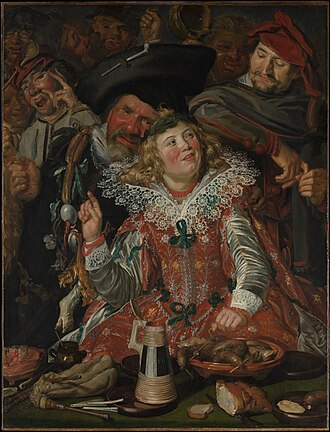 Merrymakers at Shrovetide - Frans Hals (1610s)
Paintings by related artists
 The Night Watch - Rembrandt van Rijn (1642)
 Self-Portrait - Rembrandt van Rijn (1659)
 Girl with a Pearl Earring - Johannes Vermeer (1665)
 The Milkmaid - Johannes Vermeer (c. 1658)
 The Feast of Saint Nicholas - Jan Steen (1660s)
 Girl eating oysters - Jan Steen (1658)
 The Windmill at Wijk bij Duurstede - Jacob van Ruisdael (1670)
 The Jewish Cemetery - Jacob van Ruisdael (1650s)
 The Courtyard of a House in Delft - Pieter de Hooch (1658)
 A Woman Peeling Apples - Pieter de Hooch (1663)