Mount Sinai
El Greco · 1570s
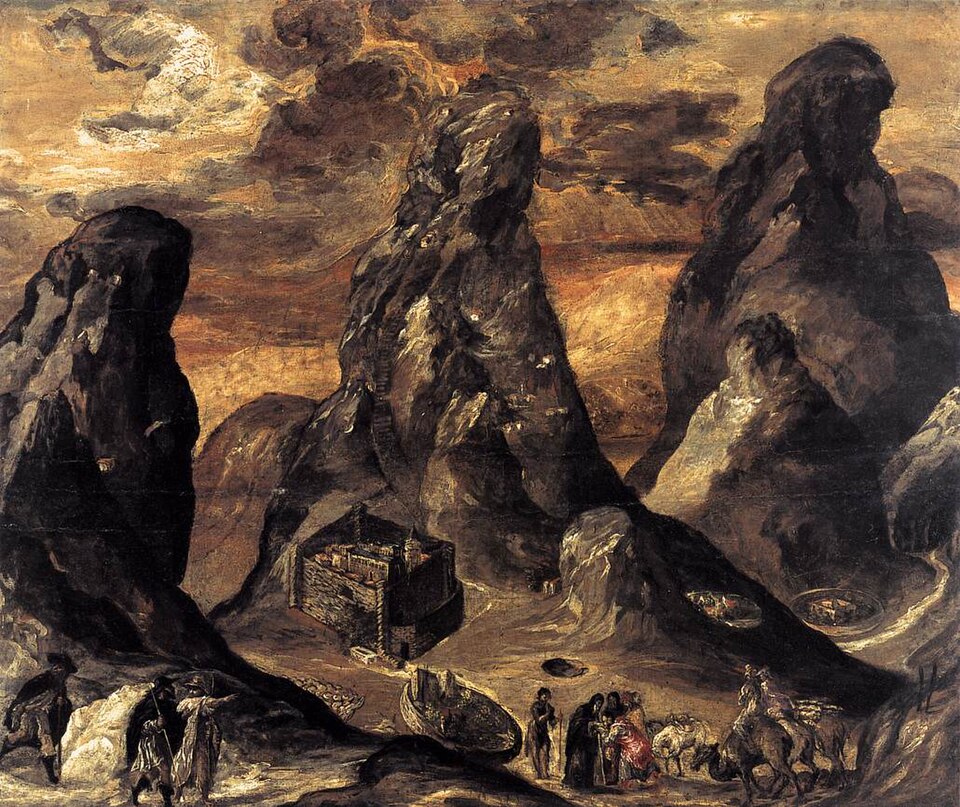
A small panel shows a holy mountain rising over a fortified monastery, with pilgrims winding toward it. El Greco left out the most famous moment of the story, Moses receiving the Law, and painted the strange landscape instead.
The story behind the painting
The panel is attributed to El Greco's years in Venice or Rome. In the early 1570s he lived in the Farnese Palace in Rome, where Fulvio Orsini was librarian, and Orsini's inventory of 1600 lists seven works by El Greco, among them a view of Mount Sinai that is probably this picture. It may have been painted in Rome, or brought there from Venice. The date is uncertain: Wikidata gives the 1570s, while the scholar Harold Wethey dated it to around 1550 and also doubted the link to the Orsini inventory.
What to look for
Look at the monastery set diagonally at the foot of the mountain, with its tall defensive walls and a low outer wall on the right guarding the main entrance. In the lower right corner a caravan of pilgrims approaches, and on the left another group of travellers appears. The panel is small, about 41 by 47.8 cm, and very close in composition to the same subject on the back of El Greco's Modena Triptych. There is no sign of God handing the tablets of the Law to Moses anywhere in the scene.
Meaning and intent
According to the Book of Exodus, Moses received the tablets with the Ten Commandments on a mountain usually identified as Sinai, or Horeb, and at its foot stands the Monastery of Saint Catherine, an important place of pilgrimage for Eastern Christianity. El Greco may have based his view on an engraving from the travel books printed in Western Europe in the sixteenth century. The source suggests he left out the biblical episode because he was more interested in showing an unusual landscape than in the story itself.
Legacy
The picture shares many details with an engraving by Giovanni Battista Fontana: the pilgrim caravan, the diagonal fortified monastery and the shape of its walls. Yet El Greco changed things, adding the travellers on the left and leaving out a figure who, in the engraving, raises or lowers a basket on a rope through an arched opening. The panel passed through the hands of Alfonso Levi in Venice, the Contini-Bonacossi collection in Rome and Baron F. Hatvany in Budapest, and it is now in the Historical Museum of Crete in Heraklion.
Did you know?
- Probably the view of Mount Sinai listed in Fulvio Orsini's inventory of 1600.
- Dated to the 1570s by Wikidata, around 1550 by Harold Wethey.
- Close to the same subject on the back of the Modena Triptych.
- Now in the Historical Museum of Crete, Heraklion.
About the artist
El Greco (1541-1614)
More by El Greco
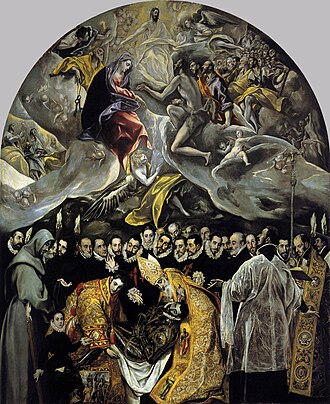 The Burial of the Count of Orgaz - El Greco (1586)
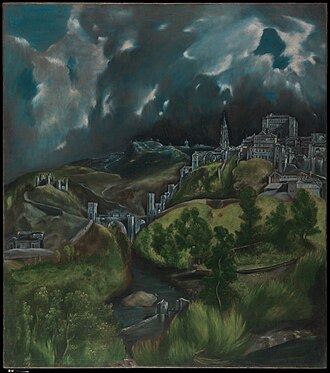 View of Toledo - El Greco (1596)
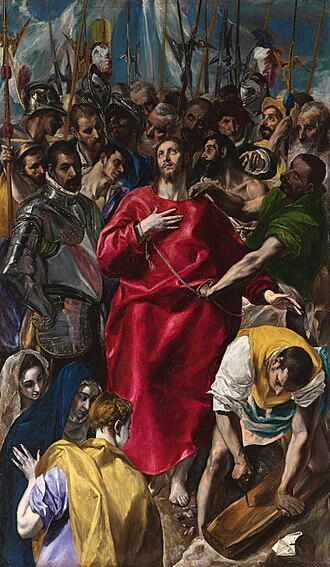 The Disrobing of Christ - El Greco (1570s)
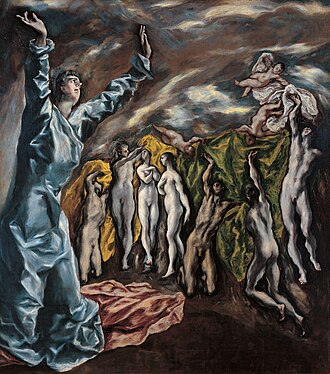 Opening of the Fifth Seal - El Greco (1610)
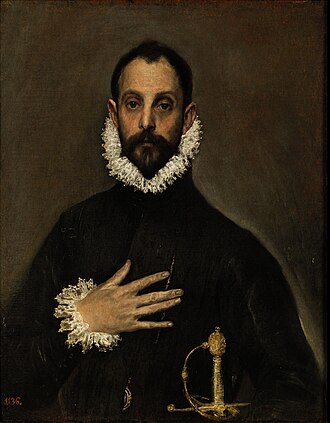 The Nobleman with his Hand on his Chest - El Greco (1580)
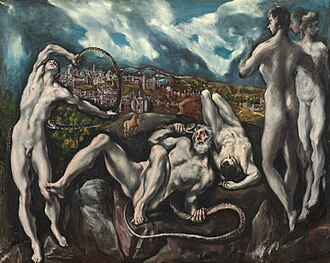 Laocoön - El Greco (1610s)
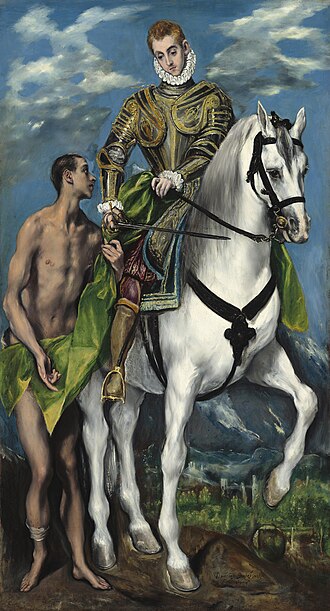 Saint Martin and the Beggar - El Greco (1597)
 Adoration of the Shepherds - El Greco (1612)
Paintings by related artists
 The Wedding at Cana - Paolo Veronese (1560s)
 The Feast in the House of Levi - Paolo Veronese (1573)
 Last Supper - Jacopo Tintoretto (1563)
 Miracle of the Slave - Jacopo Tintoretto (1540s)
 Venus of Urbino - Titian (1538)
 Assumption of the Virgin - Titian (1510s)
 Supper at Emmaus - Caravaggio (1601)
 The Calling of Saint Matthew - Caravaggio (1609)
 The Ambassadors - Hans Holbein the Younger (1533)
 The Body of the Dead Christ in the Tomb - Hans Holbein the Younger (1520s)