Venus und Amor mit einer Wabe
Lucas Cranach der Ältere · 1531
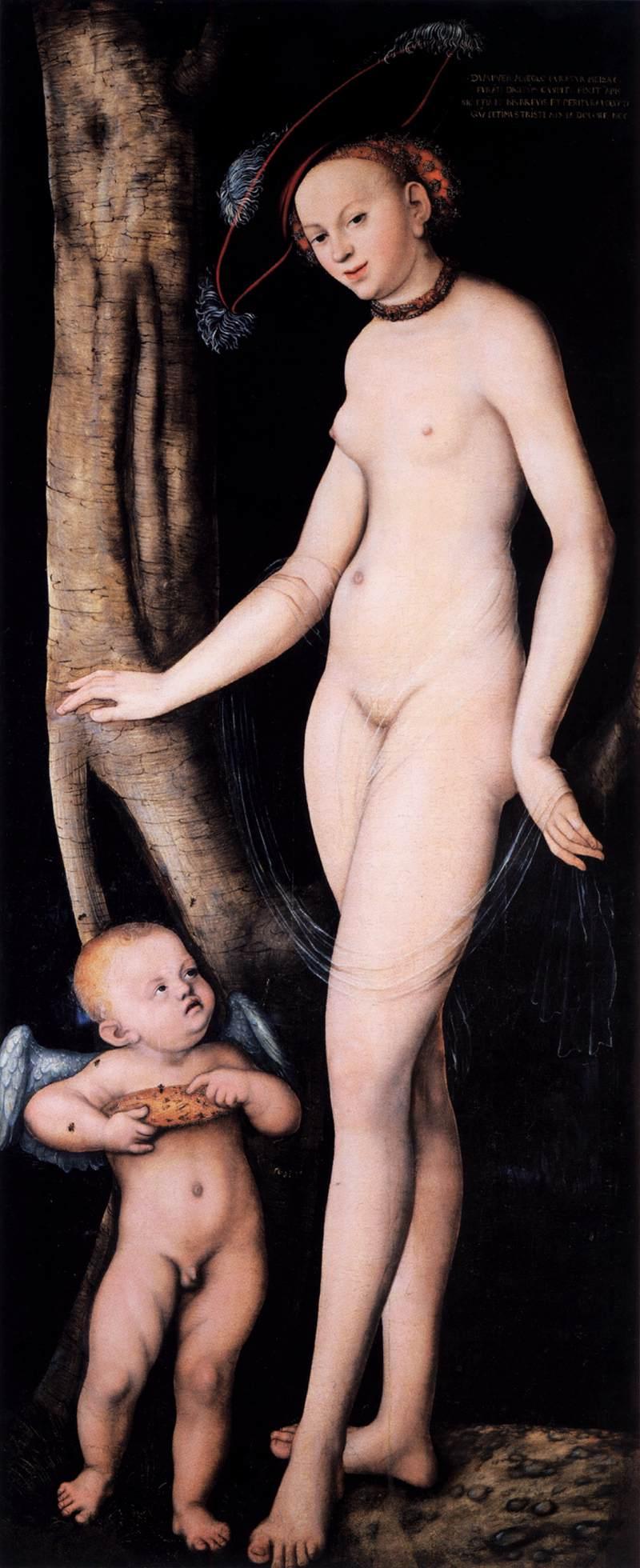
Little Cupid has stolen a honeycomb and the bees are stinging him, but his mother, naked except for a grand red hat, shows no pity. Cranach turned a playful myth into a warning about love.
The story behind the painting
The subject comes from an Idyll attributed to Theocritus, in which Cupid is stung by a bee while stealing a honeycomb, cries out, and flies to his mother to complain. Venus answers that he is like the bee: small, but able to inflict painful wounds. Cranach returned to Venus and Cupid many times, in a series that began in 1509, and this version was probably painted in 1531, after he met Georg Sabinus, a poet and scholar at the University of Wittenberg. An inscription once visible on the tree trunk gave his initials and the date.
What to look for
Against a brown background stands a bare tree, its wrinkled bark set against Venus's ivory skin. She is entirely naked, holding a thread-thin veil that hides nothing, and wears an elegant red hat with crane feathers, in fashion at the court of Saxony, plus a pearl cap, a jewelled necklace and a ribbon embroidered W.A.F.I., whose meaning is still unclear. At her feet Cupid, darker and rounded by light and shadow, with pale blue wings, holds the honeycomb while bees cover his arms. He does not scream. He looks up sullenly; she offers no comfort.
Meaning and intent
Cupid suffers the same kind of pain that he causes people with his arrows: bee stings stand for the wounds of desire. A Latin couplet in the upper right corner, attributed variously to Ercole Strozzi, Philip Melanchthon or Georg Sabinus, says that the sweetness of pleasure brings inevitable pain. The painting is read as an allegory of the pleasures and pains of love, and possibly as a warning about venereal disease such as syphilis, widespread among soldiers. The Y-shaped tree, borrowed from Durer's Adam and Eve, recalls the crossroads between the path of virtue and the path of pleasure.
Legacy
Cranach drew on Durer's engravings and on Jacopo de' Barbari, whom he replaced at the Saxon court in 1505. His delicate, graceful line reflects the Danube school, of which he was a founder, and the dark forest anticipates the Romantic idea of transcendence. The face of Venus is a portrait of a Saxon duchess, close to his official court portraits. The painting now hangs in the Galleria Borghese in Rome. According to the source, his Venus paintings have inspired many later artists, including Picasso, Otto Dix and John Currin.
Schon gewusst?
- Probably painted in 1531.
- Based on an Idyll of Theocritus about Cupid stung by bees.
- A Latin couplet warns that pleasure brings pain.
- In the Galleria Borghese, Rome.
Über den Künstler
Lucas Cranach der Ältere (1472-1553)
mythologische Malerei · Venus · Amor · Galleria Borghese
Mehr von Lucas Cranach der Ältere
.jpg) Der Jungbrunnen - Lucas Cranach the Elder (1546)
Der Jungbrunnen - Lucas Cranach the Elder (1546)%20-%20Venus%20and%20Cupid%20(National%20Gallery%2C%20London).jpg) Venus mit Amor als Honigdieb - Lucas Cranach the Elder (1520s)
Venus mit Amor als Honigdieb - Lucas Cranach the Elder (1520s).jpg) Caritas - Lucas Cranach the Elder (1540)
Caritas - Lucas Cranach the Elder (1540)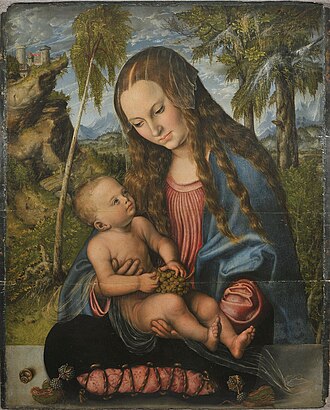 Madonna unter den Tannen - Lucas Cranach the Elder
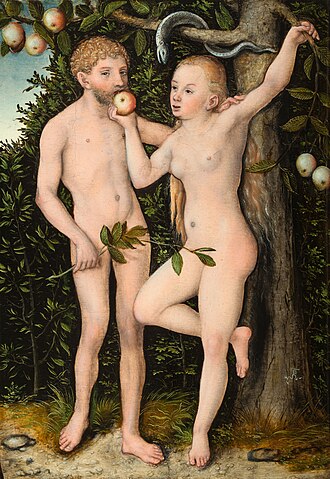 Adam und Eva - Lucas Cranach the Elder (1538)
.jpg) Gesetz und Gnade - Lucas Cranach the Elder (1529)
Gesetz und Gnade - Lucas Cranach the Elder (1529).jpg) Fürst Johann von Anhalt - Lucas Cranach the Elder (1520)
Fürst Johann von Anhalt - Lucas Cranach the Elder (1520).jpg) Ein ungleiches Paar - Lucas Cranach the Elder (1548)
Ein ungleiches Paar - Lucas Cranach the Elder (1548)
Werke verwandter Künstler
 Selbstbildnis im Pelzrock - Albrecht Dürer (1500)
 Anbetung der Könige - Albrecht Dürer (1504)