Venus mit Amor als Honigdieb
Lucas Cranach der Ältere · 1520s
%20-%20Venus%20and%20Cupid%20(National%20Gallery%2C%20London).jpg)
Little Cupid has stolen a honeycomb and the bees are stinging him. Venus, wearing nothing but a vast feathered hat, seems unmoved: love, too, stings.
The story behind the painting
Cranach and his workshop made nearly 20 versions of this subject, from 1527 to 1545, which suggests it was one of his most successful compositions. The National Gallery's version is undated but has been placed around 1526 to 1527, and may be the earliest. The story comes from an idyll attributed to Theocritus, The Honeycomb Stealer, in which Cupid complains of the bee stings and Venus laughs that his own darts hurt far more. The text was first translated into German in the 1520s, and a German patron may have suggested the subject.
What to look for
On the left of an apple tree, winged Cupid holds a honeycomb, perhaps taken from a hole in the trunk, while bees attack him. On the right Venus stands naked but for a red and gold hat with a wide circle of ostrich plumes, a gold chain and a jewelled choker, holding a branch and resting a foot on another. Below her foot, a stone bears Cranach's winged serpent with a ring, granted to him in 1508. A stag and hind hide in the trees, and a fortified rock is reflected in water. The Latin verse at top right is painted straight on the sky, which suggests this is the first version; later ones put it on a white panel.
Meaning and intent
The picture is read as an allegory of the pleasures and pains of love, and perhaps a warning about venereal disease. Venus's pose and the red apples recall Cranach's paintings of Eve, linking desire, temptation and the price that follows. In the poem Venus laughs at her son: the tiny bees hurt him, yet the darts he shoots at others wound far more. The picture holds both sides of that joke, the sweetness of the stolen honey and the sting that follows. A Latin inscription on the sky spells out the moral for the viewer.
Legacy
Its history is troubling. Nothing is known of it until the 1909 sale of the Frankfurt collector Emil Goldschmidt. It may then have belonged to Hans Hermann Vogel and in 1935 to Robert Allmers, and it appears to be the Cranach photographed in Hitler's collection at Berchtesgaden. In 1945 the American war correspondent Patricia Lochridge Hartwell took it from a warehouse in southern Germany. The National Gallery bought it in 1963, and in 2006 it was identified as possibly Nazi plunder, with no known heirs.
Schon gewusst?
- Cranach and his workshop made nearly 20 versions.
- The London version is dated around 1526 to 1527.
- Based on a poem attributed to Theocritus.
- Identified in 2006 as possible Nazi plunder.
Über den Künstler
Lucas Cranach der Ältere (1472-1553)
Frau · mythologische Malerei · National Gallery · Deutsche Renaissance · Venus · weibliche Brust · Amor · Bauchnabel · Aphrodite
Mehr von Lucas Cranach der Ältere
.jpg) Der Jungbrunnen - Lucas Cranach the Elder (1546)
Der Jungbrunnen - Lucas Cranach the Elder (1546).jpg) Caritas - Lucas Cranach the Elder (1540)
Caritas - Lucas Cranach the Elder (1540)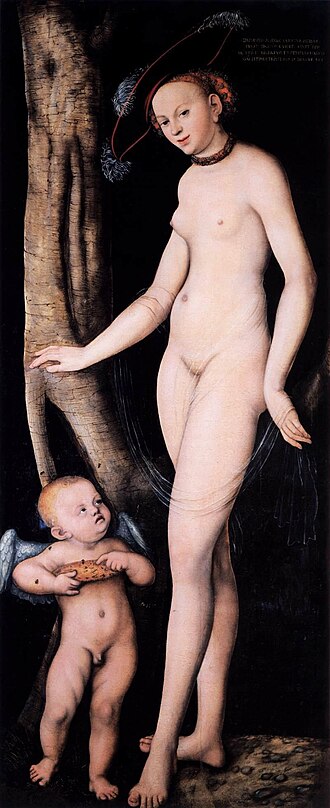 Venus und Amor mit einer Wabe - Lucas Cranach the Elder (1531)
 Madonna unter den Tannen - Lucas Cranach the Elder
 Adam und Eva - Lucas Cranach the Elder (1538)
.jpg) Gesetz und Gnade - Lucas Cranach the Elder (1529)
Gesetz und Gnade - Lucas Cranach the Elder (1529).jpg) Fürst Johann von Anhalt - Lucas Cranach the Elder (1520)
Fürst Johann von Anhalt - Lucas Cranach the Elder (1520).jpg) Ein ungleiches Paar - Lucas Cranach the Elder (1548)
Ein ungleiches Paar - Lucas Cranach the Elder (1548)
Werke verwandter Künstler
 Selbstbildnis im Pelzrock - Albrecht Dürer (1500)
 Anbetung der Könige - Albrecht Dürer (1504)