Madonna unter den Tannen
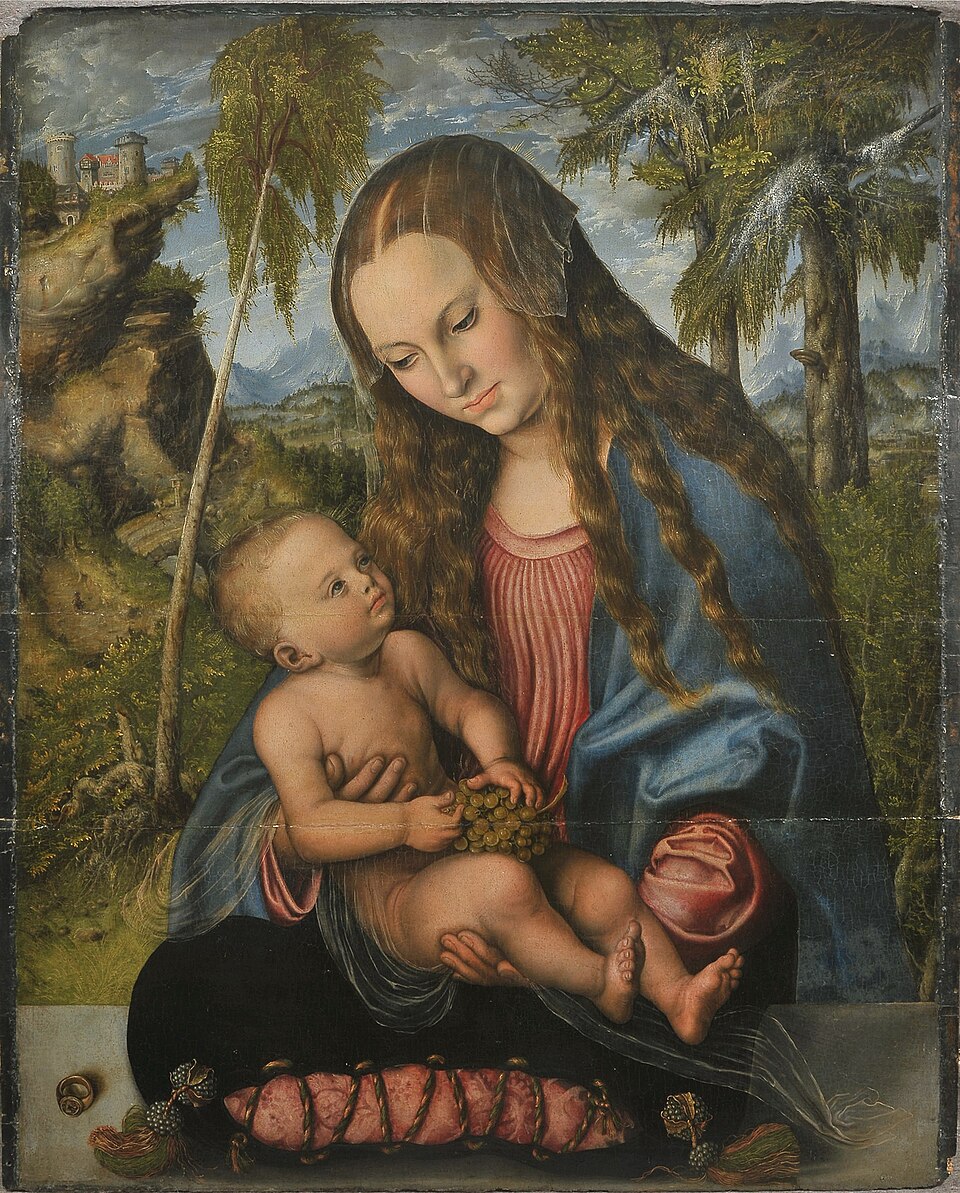
A mother in red holds a child clutching grapes, a fir and a birch rising behind them. Then the war ended, a priest made a copy, and the real Cranach vanished for more than sixty years.
The story behind the painting
Lucas Cranach the Elder painted this Madonna around 1510; Wikidata gives no date, and Friedlander, Rosenberg and Koepplin date it on grounds of style to about 1509 or 1510. Cranach is said to have made it on commission for Wroclaw Cathedral, then the German city of Breslau, and the notary Johann Hesse may have brought it from Wittenberg to Bishop Johann Thurzo, who placed it beside an image of John the Baptist. It hung in the cathedral's chapel of Saint John until the nineteenth century and before 1939 belonged to the cathedral treasury. In 1943 it was moved for safety and survived the war.
What to look for
The upright panel, about 71 by 57 cm, shows Mary in a carmine red dress and blue cloak behind a stone parapet. The Child sits on a cushion on the parapet, held in his mother's arms, with a bunch of grapes between his hands. Behind is a mountainous spring landscape with a castle, a birch on the left, and a fir and a leafy tree on the right. Look at the left edge of the parapet: Cranach signed by painting his own signet ring, cut with the coat of arms granted to him in 1508, a winged serpent, and his reversed initials. Already in 1900 Eduard Flechsig complained that the title is wrong, since there is only one large fir, and Mary is not under it.
Meaning and intent
In pose and type the panel is close to Albrecht Durer's Dresden Madonna, which was then in the castle chapel at Wittenberg. Dieter Koepplin counts it among the finest and most original of the roughly 150 known Cranach Madonnas. One writer saw it as a northern counterpart to the Madonnas of Raphael and Titian, of a different but not lesser beauty, closely bound to the landscape, with birch and fir flanking her like saints. Jan Wittmann notes that in such pictures the Child, usually not looking at the viewer, is more the desirable object for which Mary is envied than an active subject.
Legacy
After the war the priest Siegfried Zimmer repaired the cracked board and, with Georg Kupke, made a copy, to save it from the communists. Their copy differed: a fussy castle, a ring with the letters T. C., poor eyes and a badly foreshortened foot. Zimmer, expelled in 1947, may have taken the original disguised as a tray. From 1948 the copy passed as Cranach's, until in 1961 the restorer Daniela Stankiewicz saw it was a copy. Zimmer reached Munich in 1954 and in the 1960s sold the painting to a dealer. Shown to Koepplin in 1971, handed to a Swiss priest in 2011, it returned to Wroclaw in 2012 and went on view on 24 December 2012.
Schon gewusst?
- Painted around 1510 for Wroclaw (Breslau) Cathedral.
- Cranach signed it with an image of his signet ring.
- A post-war copy passed as the original until 1961.
- Returned to Wroclaw in 2012; shown from 24 December 2012.
Über den Künstler
Lucas Cranach der Ältere (1472-1553)
religiöse Kunst · Maria · Jesuskind
Mehr von Lucas Cranach der Ältere
.jpg) Der Jungbrunnen - Lucas Cranach the Elder (1546)
Der Jungbrunnen - Lucas Cranach the Elder (1546)%20-%20Venus%20and%20Cupid%20(National%20Gallery%2C%20London).jpg) Venus mit Amor als Honigdieb - Lucas Cranach the Elder (1520s)
Venus mit Amor als Honigdieb - Lucas Cranach the Elder (1520s).jpg) Caritas - Lucas Cranach the Elder (1540)
Caritas - Lucas Cranach the Elder (1540)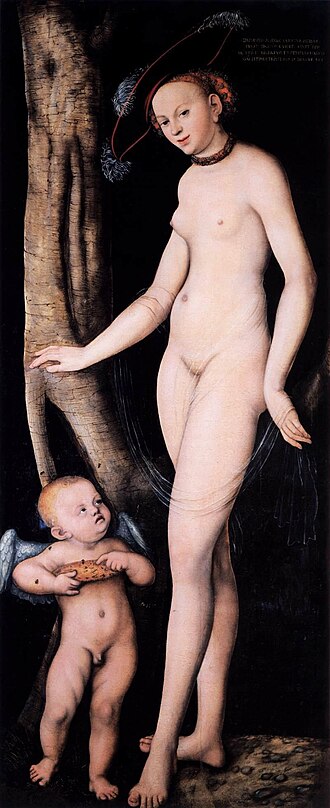 Venus und Amor mit einer Wabe - Lucas Cranach the Elder (1531)
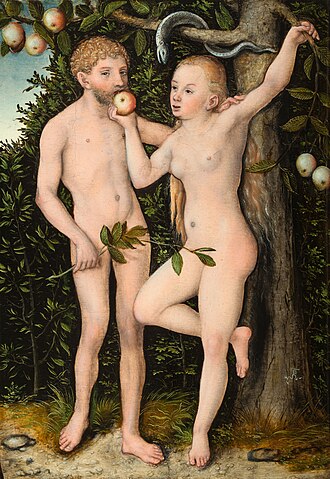 Adam und Eva - Lucas Cranach the Elder (1538)
.jpg) Gesetz und Gnade - Lucas Cranach the Elder (1529)
Gesetz und Gnade - Lucas Cranach the Elder (1529).jpg) Fürst Johann von Anhalt - Lucas Cranach the Elder (1520)
Fürst Johann von Anhalt - Lucas Cranach the Elder (1520).jpg) Ein ungleiches Paar - Lucas Cranach the Elder (1548)
Ein ungleiches Paar - Lucas Cranach the Elder (1548)
Werke verwandter Künstler
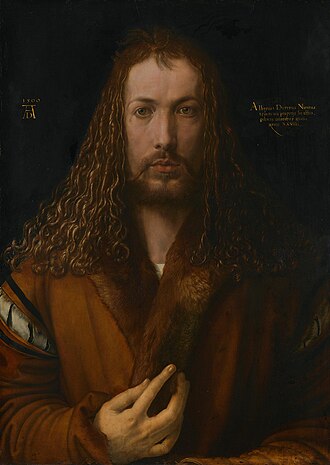 Selbstbildnis im Pelzrock - Albrecht Dürer (1500)
 Anbetung der Könige - Albrecht Dürer (1504)