Vénus Anadyomène
Jean-Auguste-Dominique Ingres · 1808
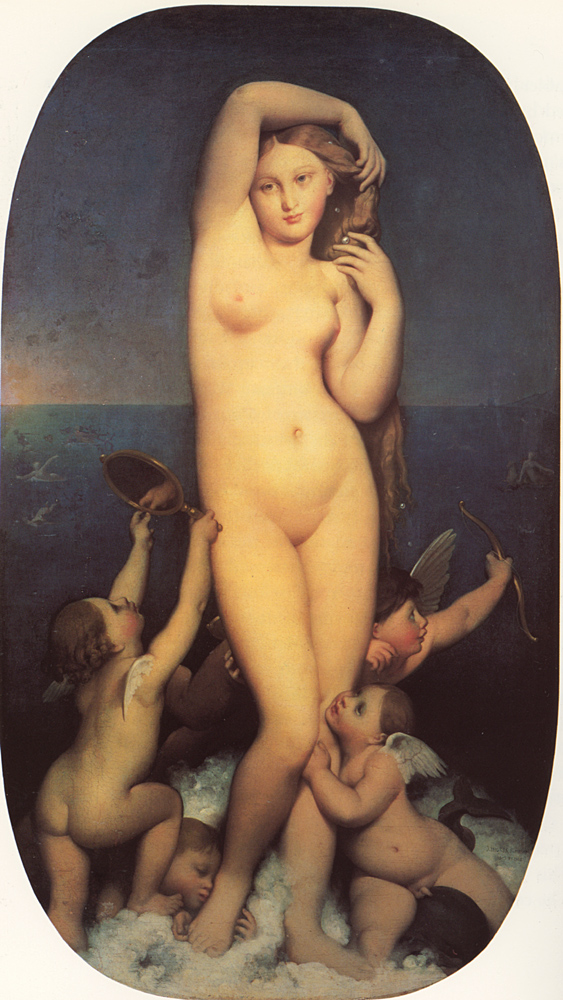
Ingres began this Venus rising from the sea as a young man in Rome in 1808, and finished it forty years later. One painting carries almost a whole working life, from the first drawings to the final brushstroke.
The story behind the painting
Ingres started the painting in 1808, while he was staying at the French Academy in Rome. Then it waited. The picture stayed in the planning stage until 1848, when he finally completed it as a commission from Benjamin Delessert, a banker and botanist. Finishing it meant major changes to the colours Ingres had first intended. Yet Delessert turned the painting down, because he felt the knee was drawn awkwardly. Later in 1848 it was sold to Frederic Reiset, curator of drawings at the Louvre.
What to look for
The goddess stands as Venus Anadyomene, Venus rising from the sea. In the first preparatory drawings Ingres placed her in the Venus Pudica pose, covering her breasts with her hands, a pose inspired by Botticelli's The Birth of Venus, which he could have seen at the Uffizi when he visited Florence in 1805. A drawing of 1806 then shows her with arms raised and her hair held in her hands, and that is the gesture to follow. Ingres used the same pose again in his 1856 painting The Source.
Meaning and intent
The painting is a meeting of many pasts. When it was shown at the Exposition Universelle in Paris in 1855, the poet Charles Baudelaire saw it and pulled it apart into its sources: the head, he argued, came from classical sculpture, the hands from Raphael, and the narrow torso from medieval sculpture. Ingres did not simply copy one model of beauty. He gathered antiquity, the Renaissance and the Middle Ages into one slender standing figure, and spent four decades deciding how she should finally look.
Legacy
In 1879 the painting, together with the rest of Reiset's collection, was bought by Henri d'Orleans, Duke of Aumale, and it is now held at the Musee Conde in Chantilly. Later painters soon took up the same subject, among them Theodore Chasseriau with his Venus marine and William Bouguereau with The Birth of Venus of 1879. A smaller copy made around 1825 to 1850 is in the Louvre, and the preparatory drawings are kept at the Ingres Museum in Montauban.
Schon gewusst?
- Begun in Rome in 1808, completed in 1848.
- Rejected by its patron, Benjamin Delessert, over the drawing of the knee.
- Shown at the 1855 Exposition Universelle, where Baudelaire saw it.
- Now at the Musee Conde, Chantilly.
Über den Künstler
Jean-Auguste-Dominique Ingres (1780-1867)
Frau · mythologische Malerei · Akt · langes Haar · Nacktheit · Klassizismus · Venus · Musée Condé · Putto · Kontrapost · tizianrot
Mehr von Jean-Auguste-Dominique Ingres
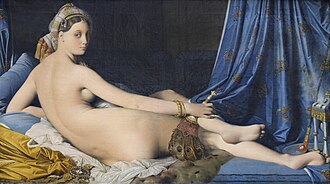 Die große Odaliske - Jean-Auguste-Dominique Ingres (1814)
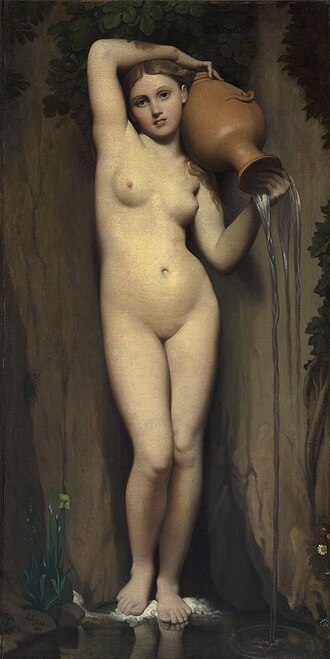 Die Quelle - Jean-Auguste-Dominique Ingres (1856)
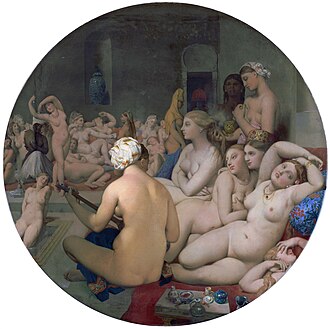 Das türkische Bad - Jean-Auguste-Dominique Ingres (1862)
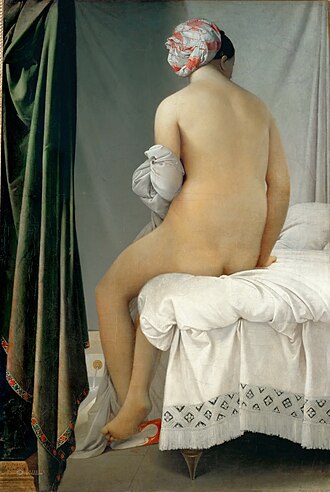 Die Badende von Valpençon - Jean-Auguste-Dominique Ingres (1808)
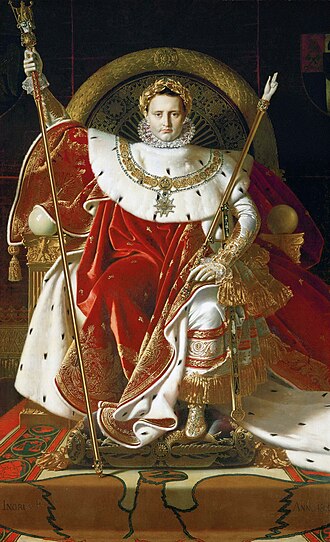 Napoleon I auf seinem kaiserlichen Thron - Jean-Auguste-Dominique Ingres (1806)
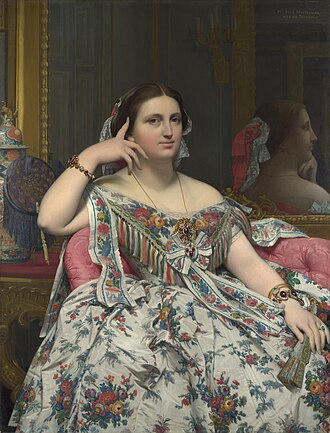 Madame Moitessier - Jean-Auguste-Dominique Ingres (1856)
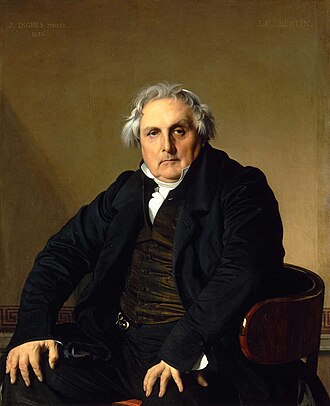 Porträt Monsieur Bertin - Jean-Auguste-Dominique Ingres (1832)
 Ödipus und die Sphinx - Jean-Auguste-Dominique Ingres (1808)
Werke verwandter Künstler
 Der Tod des Sokrates - Jacques-Louis David (1787)
 Der Schwur der Horatier - Jacques-Louis David (1784)
 Die Erschießung der Aufständischen - Francisco Goya (1814)
.jpg) Die nackte Maja - Francisco Goya (1800)
Die nackte Maja - Francisco Goya (1800)