Die Quelle
Jean-Auguste-Dominique Ingres · 1856
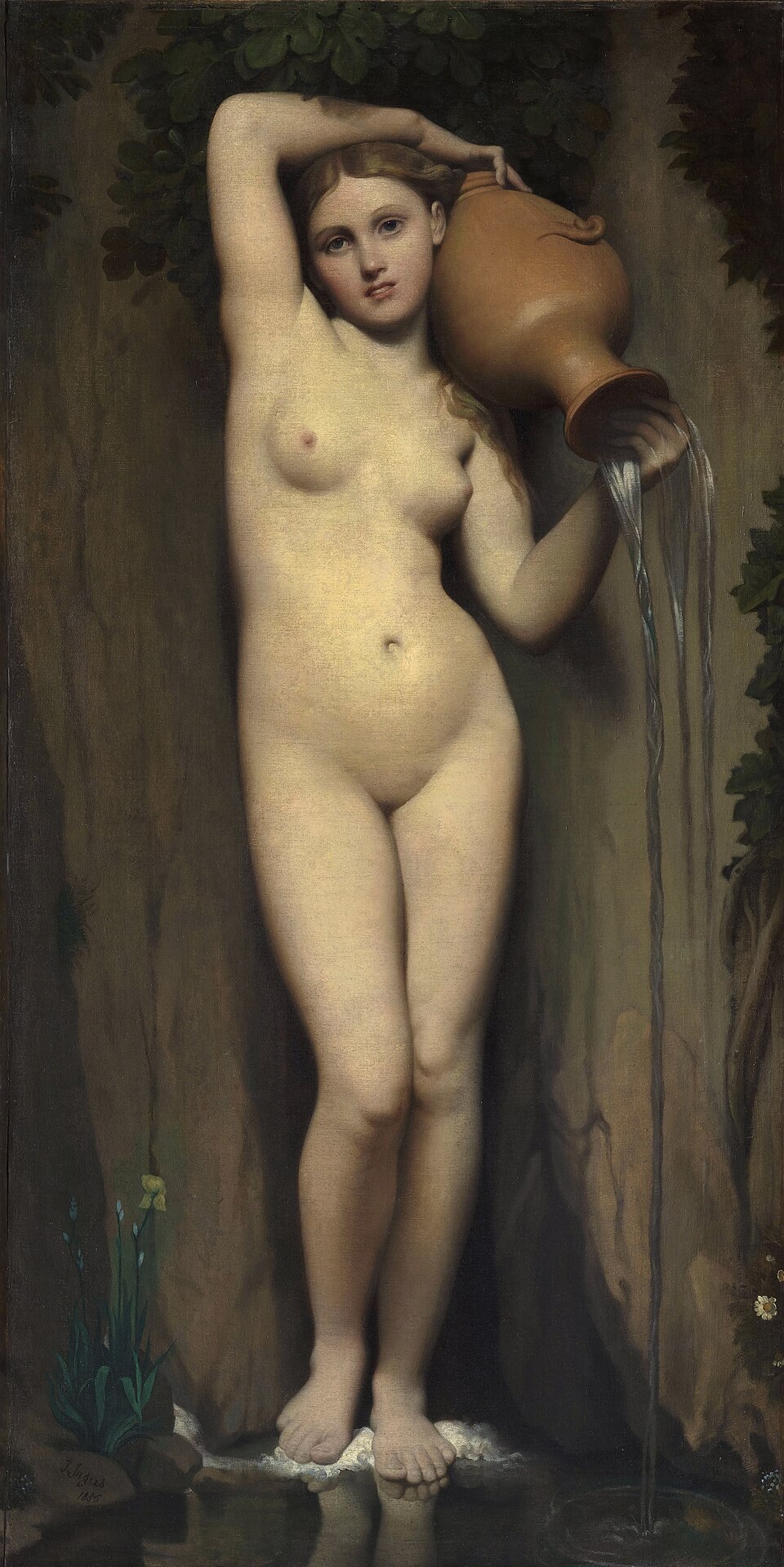
A young woman stands between the rocks, pouring water from a jar she holds. Ingres began The Source in Florence around 1820 and finished it in Paris in 1856, at seventy-six.
The story behind the painting
The painting took more than thirty years. Ingres began it in Florence around 1820 and completed it only in 1856 in Paris, when he was seventy-six, already famous and president of the École des Beaux-Arts. Two of his students, the painters Paul Balze and Alexandre Desgoffe, helped create the background and the water jar. The model was the young daughter of Ingres's concierge. The pose can be compared with his Venus Anadyomene of 1848, and it reimagines the classical Aphrodite of Cnidus, or Venus Pudica. The tall, narrow canvas measures about 163 by 80 cm.
What to look for
A nude woman stands upright in an opening in the rocks, holding a pitcher from which water flows. She stands between two flowers and is framed by ivy. The water she pours runs down between her and us, like a river marking a boundary. Notice how quiet and balanced the figure is, and how the plants and water form a setting around her. The title in French, La Source, is the ordinary word for a spring of water, and that is what she embodies: not a goddess from a story but the spring itself, given a human form.
Meaning and intent
In classical literature a spring is sacred to the Muses and a source of poetic inspiration. The flowers beside her have been read as a sign of vulnerability, and ivy is the plant of Dionysus, god of disorder, regeneration and ecstasy. The art historians Frances Fowle and Richard Thomson see a symbolic unity of woman and nature here. Kenneth Clark noted that the figure had been called the most beautiful in French painting. But the picture also raises questions: the novelist George Moore wrote bluntly about the young model and the price of art, a reminder that this dream of innocence was painted from a real girl.
Legacy
The Source was first exhibited in 1856, the year it was finished, and was received enthusiastically. The collector Duchâtel acquired it in 1857. The state took title to it in 1878 and it passed to the Louvre, and in 1986 it was transferred to the Musée d'Orsay. Haldane Macfall called it the superb nude by which Ingres is chiefly known, and Walter Friedländer called it simply the most famous of Ingres's paintings. It has been exhibited and reproduced again and again.
Schon gewusst?
- Begun in Florence around 1820, finished in Paris in 1856.
- Ingres's students Paul Balze and Alexandre Desgoffe helped with the background.
- Acquired by Duchâtel in 1857, state-owned from 1878.
- In the Musée d'Orsay since 1986.
Über den Künstler
Jean-Auguste-Dominique Ingres (1780-1867)
Frau · Gemäldeabteilung des Louvre · Akt · Musée d’Orsay · Klassizismus · Nacktheit · Allegorie · Krug
Mehr von Jean-Auguste-Dominique Ingres
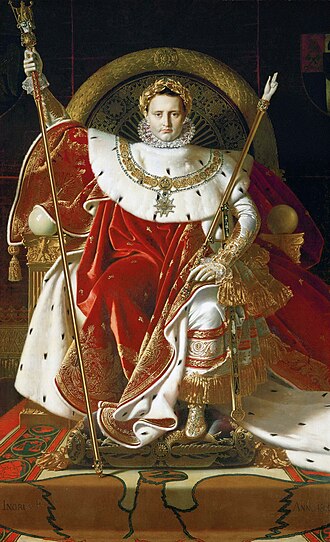 Napoleon I auf seinem kaiserlichen Thron - Jean-Auguste-Dominique Ingres (1806)
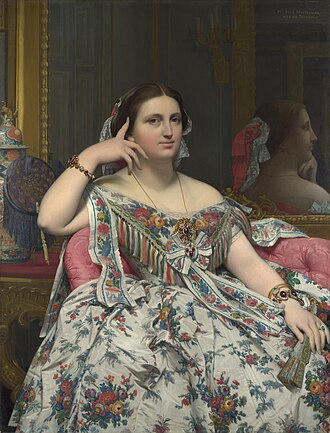 Madame Moitessier - Jean-Auguste-Dominique Ingres (1856)
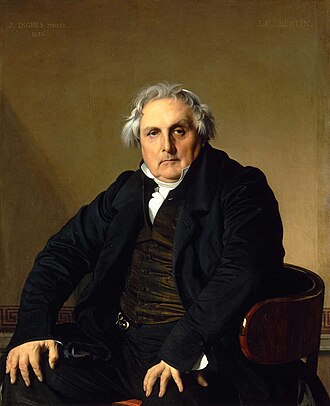 Porträt Monsieur Bertin - Jean-Auguste-Dominique Ingres (1832)
 Apotheose Homers - Jean-Auguste-Dominique Ingres (1827)
 Mademoiselle Caroline Rivière - Jean-Auguste-Dominique Ingres (1806)
 Jupiter und Thetis - Jean-Auguste-Dominique Ingres (1811)
 Der Tod des Leonardo da Vinci - Jean-Auguste-Dominique Ingres (1818)
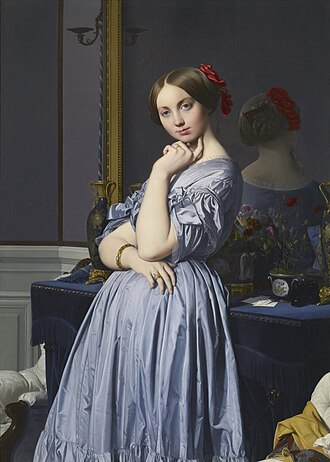 Comtesse d'Haussonville - Jean-Auguste-Dominique Ingres (1845)
Werke verwandter Künstler
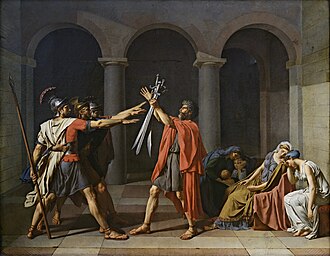 Der Schwur der Horatier - Jacques-Louis David (1784)
.jpg) The Intervention of the Sabine Women - Jacques-Louis David (1799)
The Intervention of the Sabine Women - Jacques-Louis David (1799)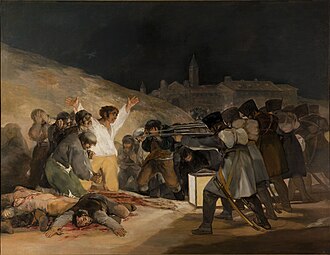 Die Erschießung der Aufständischen - Francisco Goya (1814)
.jpg) Die nackte Maja - Francisco Goya (1800)
Die nackte Maja - Francisco Goya (1800)