Die Kornsieberinnen
Gustave Courbet · 1850s
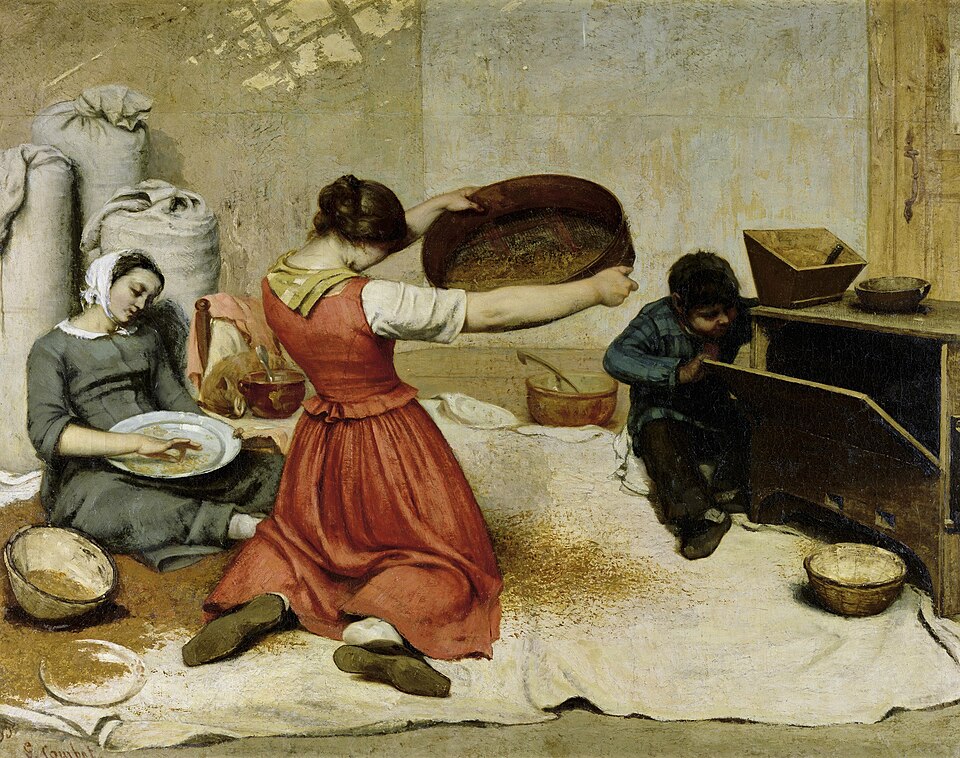
A young woman kneels with her back to us, arms thrust out, shaking a great round sieve. She is probably Courbet's sister. Critics called the picture indecent; Courbet himself called it strange.
The story behind the painting
Courbet painted The Wheat Sifters in his hometown of Ornans during the winter of 1853 to 1854, while working on four other pieces. The young women are believed to be his sisters: Zoë is the central figure and Juliette sits on the left. The boy is most likely Désiré Binet, the painter's illegitimate son, who would have been six when Courbet began. In an 1854 letter to the critic Champfleury, Courbet said he had finished a painting of country life and called it a strange painting. Wikipedia dates it 1854, while Wikidata gives only the 1850s.
What to look for
Three ways of cleaning grain appear side by side. On the left, Juliette sits cross-legged, reclining, sorting grain by hand from a round dish in her lap. In the centre, Zoë, seen from behind, works a large circular sieve, her legs open, her body shifting. On the right, the boy peers into a tarare, an early machine for cleaning grain. Faces are mostly hidden; instead Courbet draws attention to tools, clothing, bowls, sacks and scattered grain. The motion of the sieve and the round utensils create a circular rhythm, and thick impasto makes the labour feel physical. The canvas is about 131 by 167 cm.
Meaning and intent
Courbet saw the work as part of a series on the young ladies of the village, recording customs of his native Franche-Comté; it was later shown as a scene of agricultural life there. Petra ten-Doesschate Chu calls it a modern allegory of labour and his most significant new work at the 1855 Exposition Universelle, related to The Stone Breakers. Michael Fried reads the figures as stand-ins for the painter: the kneeling sifter his hand and brush, the seated one his palette, the grain paint. Linda Nochlin challenges overly sexual readings, places the strong central woman in 19th-century debates about working women, and notes that the tarare stands for mechanisation pushing women out of winnowing.
Legacy
The muscular central figure and her thrust-out arms led critics to call the work indecent. The caricaturist Cham exaggerated the hard labour in a print, joking that the sifter could find neither time nor space to wash herself. The painting was exhibited at the Salon of 1855 in Paris, shown in Brussels in 1857 and in Besançon in 1860 under different titles, then in 1861 at the ninth exhibition of the Society of Friends of the Arts of Nantes, which bought it for the Musée des Beaux-Arts de Nantes, where it remains today.
Schon gewusst?
- Painted in Ornans in the winter of 1853-1854.
- The sifters are believed to be Courbet's sisters Zoë and Juliette.
- Shown at the 1855 Exposition Universelle in Paris.
- In the Musée d'arts de Nantes since 1861.
Über den Künstler
Gustave Courbet (1819-1877)
Mehr von Gustave Courbet
 Der Ursprung der Welt - Gustave Courbet (1866)
 Ein Begräbnis in Ornans - Gustave Courbet (2020)
%2C%20Paris%2C%20Petit%20Palais.jpg) Le Sommeil - Gustave Courbet (1866)
Le Sommeil - Gustave Courbet (1866) Das Atelier des Künstlers - Gustave Courbet (1855)
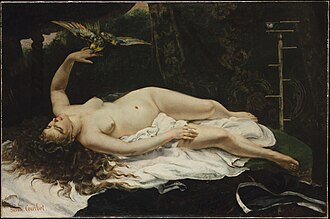 Frau mit Papagei - Gustave Courbet (1866)
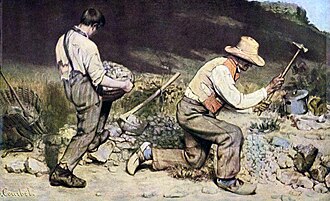 Die Steinklopfer - Gustave Courbet (1850)
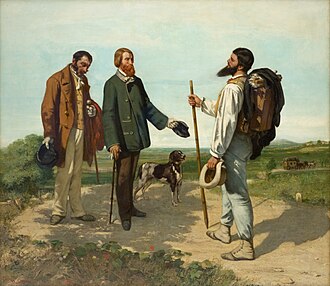 Die Begegnung, oder Bonjour, Monsieur Courbet! - Gustave Courbet (1854)
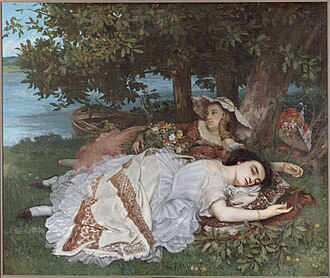 Mädchen an der Seine - Gustave Courbet (1857)
Werke verwandter Künstler
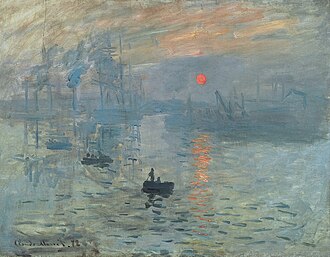 Impression, Sonnenaufgang - Claude Monet (1872)
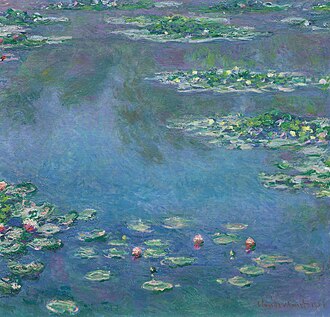 Seerosen - Claude Monet (1906)
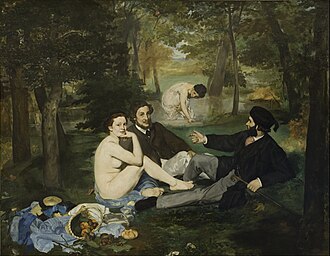 Das Frühstück im Grünen - Édouard Manet (1863)
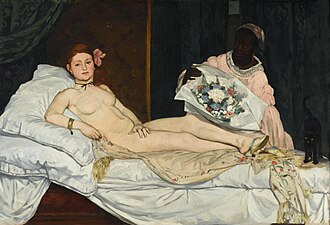 Olympia - Édouard Manet (1863)
 Die Sternennacht - Vincent van Gogh (1889)
.jpg) Caféterrasse am Abend - Vincent van Gogh (1888)
Caféterrasse am Abend - Vincent van Gogh (1888)