Es frischt auf
Winslow Homer · 1873
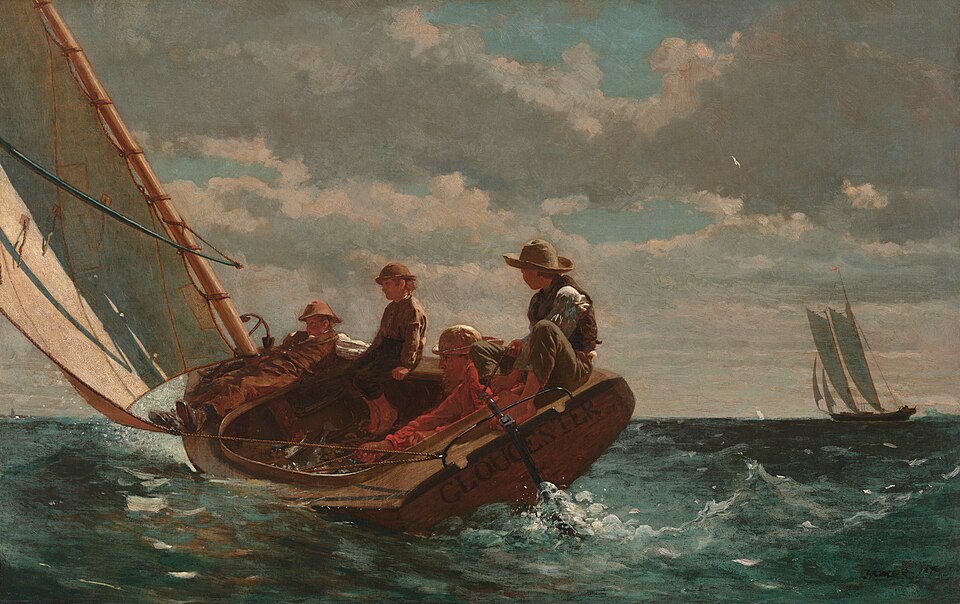
A small catboat heels in the wind, a man and three boys leaning with it, their catch in the bottom of the boat. Homer called it A Fair Wind, and it became one of the most loved images of 19th-century America.
The story behind the painting
Homer began the canvas in New York in 1873, after a stay in Gloucester, Massachusetts, where he first worked in watercolour. He used sketches made there, most closely Sailing the Catboat of 1873, and worked on the oil for three years. Infrared reflectography shows how much he changed: he removed a fourth boy near the mast and a second schooner in the distance, and at one point the man held both the sheet and the tiller, a pose taken from an 1874 oil study called The Flirt. He finished it in the centennial year, 1876.
What to look for
The catboat, named Gloucester, chops through the harbour of that city under a fair wind, Homer's original title. Inside are a man, three boys and their catch. Despite the choppy waves, the boaters look relaxed. An anchor sits where a boy once was in the bow, and the boy at the tiller looks ahead to the horizon. Notice the balance between the busy left half and the sparse right half, which shows the influence of Japanese art on Western painters. Wikidata gives the canvas as 61.5 by 97 cm.
Meaning and intent
The painting's message is positive. The anchor was understood as a symbol of hope, and the boy at the tiller gazing at the horizon as a statement of optimism about his future and that of the young United States. Homer had visited France in 1866 and 1867, and marine paintings by Courbet and Monet left their mark, though not all of Homer's seas are so kind. A critic of the time wrote that the boat, bending to the wind, seemed actually to cleave the waves, and that there was no truer or heartier work in the exhibition.
Legacy
Breezing Up was first shown at the National Academy of Design in 1876, then at the Centennial Exposition in Philadelphia. By 1879 it had become known as Breezing Up, a title that was not Homer's but one he did not seem to mind. Another critic praised how the figures sway with the rolling boat, stiffening or relaxing as the keel rises and sinks. Today it is considered an iconic American painting and among Homer's finest. The National Gallery of Art in Washington bought it in 1943 and calls it one of the best-known and most beloved images of 19th-century American life.
Schon gewusst?
- Begun in 1873, finished in 1876.
- Homer's own title was A Fair Wind.
- Infrared shows a fourth boy was painted out.
- In the National Gallery of Art since 1943.
Über den Künstler
Winslow Homer (1836-1910)
Genreszene · National Gallery of Art · Marinekunst · Boot · Wind
Mehr von Winslow Homer
 Nebelwarnung - Winslow Homer (1885)
 The Gulf Stream - Winslow Homer (1899)
 Fox Hunt - Winslow Homer (1893)
 The Cotton Pickers - Winslow Homer (1876)
 A Visit from the Old Mistress - Winslow Homer (1876)
 Eight Bells - Winslow Homer (1886)
 In Front of Yorktown - Winslow Homer (1860s)
 Rechts und Links - Winslow Homer (1909)
Werke verwandter Künstler
 Der Ursprung der Welt - Gustave Courbet (1866)
 Ein Begräbnis in Ornans - Gustave Courbet (2020)
 Das Frühstück im Grünen - Édouard Manet (1863)
 Olympia - Édouard Manet (1863)
 Die Sternennacht - Vincent van Gogh (1889)
 Caféterrasse am Abend - Vincent van Gogh (1888)